

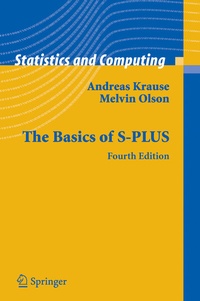
The Basics of S-PLUS
Description

Reviews / Votes
From the reviews of the third edition:
"Written to coincide with Version 7.0 of S-PLUS, the fourth edition of The Basics of S-PLUS furnishes a gently paced, but detailed, introduction to the S-PLUS statistical computing environment." Journal of Statistical Software, Vol. 14, December 2005
"Now in its fourth edition, this paperback continues to evolve smoothly, keeping up with changes in S-PLUS and its underlying language, S...If you own a first or second edition of this book, I recommend updating to the fourth edition." Journal of the American Statistical Association, September 2006
"This is the third edition of the book within five years of publication. This gives an idea of the popularity of the book. The basic structure of the book remains the same. But the new edition covers the S-Plus version 6 for Unix and Windows. In particular the contents now reflect introduction of a graphical user interface (GUI), new formats of graphics and for export and import of data. The comparable public domain software R receives a separate coverage as an introduction to R." (Arup Bose, Sankhya, Vol 64 (3), 2002)
"This is an introductory book on S-PLUS that even first-time users will find accessible, informative, and easy to follow. . One strength of the book is its coverage of several implementations of S-PLUS, in particular of its graphical user interfaces (GUIs) under both Windows and UNIX. . All the while, the book avoids the overwhelming complexities typical of a software manual, and the few, well-thought-out exercises (with careful solutions) at the end of each chapter supply the motivation to explore more advanced topics." (Mario Peruggia, Journal of the American Statistical Association, December, 2002)
"The second edition (2E) was 50% larger than the first edition. This update has considerably fewer changes. . Its inclusion of GUI coverage makes it a good choice for any statistician who wants toget started with S-PLUS." (Technometrics, Vol. 45 (2), May, 2003)
From the reviews of the fourth edition:
"A basic introduction to S-Plus statistical computing based on version 7.0 of S-Plus. It is suitable for people with little computing knowledge and basic understanding of statistical data analysis. . Overall presentation in this book is good and this book is ideal for a quick basic introduction to S-Plus. It is well suited for self-study and may be considered as a text book for S-Plus statistical computing. If the reader carefully goes through this book, he will acquire substantial knowledge in S-Plus data analysis." (Anil K. Ghosh, Sankhya: The Indian Journal of Statistics, Vol. 68 (1), 2006)
More details
Other editions
Additional editions
Content
7 Exploring Data (p. 193)
In the preceding chapters, we have laid the foundation for understanding the concepts and ideas of the S-Plus system. We explored basic ideas and how to use S-Plus for performing calculations, and we have seen how data can be generated, stored, and accessed. Furthermore, we also looked at how data can be displayed graphically. All this will be useful as we explore real data sets in this chapter. We will explore data sets that come with S-Plus, speci.cally the Barley and Geyser data sets.
Rather than presenting a list of available statistical functions, we will go through a typical data analysis as a way of introducing the more useful and common commands and the kind of output we'll encounter. We chose to use S-Plus data sets so you can follow along with the analysis we present and complete the exercises at the end of this chapter. We divide the data analysis into two categories: "descriptive" and "graphical" exploration. Further sections cover distributions and related functions, con.rmatory statistics and hypothesis testing, and missing and in.nite values.
7.1 Descriptive Data Exploration
We will now explore the di.erent variables contained in the Barley data set. We will first analyze the variables in one dimension, or, in other words, we will take a univariate approach. The analysis of the dependence between the variables and the exploration of higher-dimensional structure follows later.
The Barley Data Set
The Barley data are measurements of yield in bushels per acre at di.erent sites. The analysis comprises 6 sites planting 10 di.erent varieties of barley in 2 successive years, 1931 and 1932. The data set therefore contains 120 measurements of barley yield. Our main goal will be to investigate di.erences in barley yields given by the di.erent variable constellations, such as the 1931 harvest of the .fth variety on site 4 and the 1932 harvest of the seventh variety at the same site.
Just enter
> barley
to see the data.
Given the basic information about the Barley data, the following analysis is intended to gain more information and structural knowledge about the numbers we have.
A typical place to begin is, of course, looking at the data. If the data set is small, we can easily look at it simply by printing it out. We check the data size by entering
> dim(barley)
120 4
