

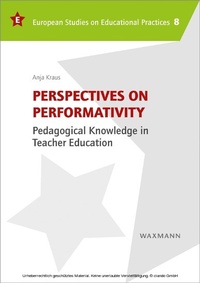
Perspectives on Performativity
Pedagogical Knowledge in Teacher Education
1st Edition
Published on 1. April 2016
164 pages
978-3-8309-8422-1 (ISBN)
Description

Re-thinking the idea of scholarly life regarding teacher education means to critically examine the specifics of classroom teaching, respectively pedagogical challenges. School does not exist simply to convey information or expertise. It is a society in which everyone is responsible for in a reflected way participating in diverse relationships to him-/herself, to others and to the world, and, based on diverse forms of knowledge and representation, actively forming them. Education in the classroom consists also of giving the students an idea of that. Hereby, tacit forms of knowledge and educational practices play an important role.
In the concept of 'performative play' teacher education is seen as a linking up of theories in Educational and other Human Sciences with the everyday practice of teachers. It will be shown that the performative paradigm opens up the possibility to overcome the concentration of a science-oriented education in school on rational, linguistically symbolized knowledge and metrical explanatory models. By this, a model of a science- as well as practice-oriented teacher education will be unfolded that is supposed to be open to diverse cultural modes of learning.
Anja Kraus, PhD, studied Educational Sciences, Philosophy and Arts Education in Berlin. From 2004 to 2013 she was Junior Professor for Educational Sciences at the Ludwigsburg University/Germany. Now, she is Associate Professor for Educational Sciences at the Linné-University Växjö/Sweden. Main research: pedagogical learning theories, physicalness in schools, integration of artistic positions into didactical concepts and into empirical teaching research, heterogeneity in schools and anthropological issues. Dr. phil. Anja Kraus, phil. mag., Studium Erziehungswissenschaft, Philosophie und Lehramt Kunst in Berlin. 2004-2013 Juniorprofessorin für Erziehungswissenschaft an der Pädagogischen Hochschule Ludwigsburg, seit 2013 Ass. Prof. für Bildungswissenschaft an der Linnéuniversität Växjö/Sweden. Forschungsschwerpunkte: Pädagogische Lerntheorien, Körperlichkeit in der Schule, Integration von künstlerischen Positionen in didaktische Konzepte und in die empirische Unterrichtsforschung, Heterogenität in der Schule, anthropologische Fragen
In the concept of 'performative play' teacher education is seen as a linking up of theories in Educational and other Human Sciences with the everyday practice of teachers. It will be shown that the performative paradigm opens up the possibility to overcome the concentration of a science-oriented education in school on rational, linguistically symbolized knowledge and metrical explanatory models. By this, a model of a science- as well as practice-oriented teacher education will be unfolded that is supposed to be open to diverse cultural modes of learning.
Anja Kraus, PhD, studied Educational Sciences, Philosophy and Arts Education in Berlin. From 2004 to 2013 she was Junior Professor for Educational Sciences at the Ludwigsburg University/Germany. Now, she is Associate Professor for Educational Sciences at the Linné-University Växjö/Sweden. Main research: pedagogical learning theories, physicalness in schools, integration of artistic positions into didactical concepts and into empirical teaching research, heterogeneity in schools and anthropological issues. Dr. phil. Anja Kraus, phil. mag., Studium Erziehungswissenschaft, Philosophie und Lehramt Kunst in Berlin. 2004-2013 Juniorprofessorin für Erziehungswissenschaft an der Pädagogischen Hochschule Ludwigsburg, seit 2013 Ass. Prof. für Bildungswissenschaft an der Linnéuniversität Växjö/Sweden. Forschungsschwerpunkte: Pädagogische Lerntheorien, Körperlichkeit in der Schule, Integration von künstlerischen Positionen in didaktische Konzepte und in die empirische Unterrichtsforschung, Heterogenität in der Schule, anthropologische Fragen
More details
Other editions
Additional editions
Book
04/2016
1st Edition
Waxmann
€24.90
Article exhausted; check different version
Content
1 - Book Cover [Seite 1]
2 - Contents [Seite 5]
3 - 1. Introduction and Outline [Seite 7]
4 - 2. Pedagogical Knowledge [Seite 22]
4.1 - 2.1 Pedagogical Tact as a Link between Pedagogical Theory and Practice [Seite 22]
4.2 - 2.2 Pedagogical Coordination and Convincing [Seite 30]
4.3 - 2.3 Equating Pedagogy with its Objectives, Educational Practices, and the Pedagogical Concept of Learning [Seite 35]
4.4 - 2.4 Fields of Tension within Pedagogy [Seite 38]
4.5 - 2.5 The Plurivalent Normativity of Pedagogy [Seite 41]
4.6 - 2.6 Tacit Dimensions of Pedagogy [Seite 43]
4.7 - 2.7 Pedagogical Context Sensitivity and Acting under Time Pressure [Seite 46]
4.8 - 2.8 The Obstinancy of Habitus and Traps of Familiarity [Seite 50]
4.9 - 2.9 Practical Knowledge for the Teaching Profession [Seite 57]
5 - 3. Pedagogy in the Classroom [Seite 61]
5.1 - 3.1 Teaching as Orchestration and Choreography [Seite 61]
5.2 - 3.2 Notations of Teaching [Seite 62]
6 - 4. University Teacher Education [Seite 68]
6.1 - 4.1 Competences and Competence Development for Teachers [Seite 68]
6.2 - 4.2 "Reflective Practitioner" [Seite 74]
6.3 - 4.3 Approaches of Action Research [Seite 78]
6.4 - 4.4 Working with Cases at the University [Seite 80]
6.5 - 4.5 Research-based Learning at the University [Seite 82]
6.5.1 - 4.5.1 Example of Research-based Learning at the University: Design-based Research (DBR) [Seite 86]
6.5.2 - 4.5.2 Example of an Approach to Research-based Learning at Schools and Universities: Research-based School - Quality in Development [Seite 89]
7 - 5. Performative Pedagogy [Seite 97]
7.1 - 5.1 Performativity and Rationality [Seite 97]
7.2 - 5.2 Performativity and Competence [Seite 110]
7.3 - 5.3 Learning and Performativity [Seite 113]
7.4 - 5.4 Educational Processes58 and Performativity [Seite 115]
7.5 - 5.5 Performativity, Staging, and Choreography [Seite 121]
7.6 - 5.6 The Mediality and Performativity of Professional Teacher Action [Seite 122]
7.7 - 5.7 Performativity and Personality Development [Seite 128]
7.8 - 5.8 The Performative Play as a Didactic Principle [Seite 132]
8 - 6. Processing of Pedagogical Challenges within University Teacher Education Based on Theoretical Performativity [Seite 138]
8.1 - 6.1 Performative Play as a Didactic Principle in University [Seite 138]
8.2 - 6.2 Example: The "Pupil Job" as an Incentive for Reflection [Seite 142]
8.3 - 6.3 Example: Voice in the Classroom [Seite 143]
8.4 - 6.4 Example: The First Lesson [Seite 143]
8.5 - 6.5 Example: Practice Research by Videotaping from a Performativity-Theoretical Perspective [Seite 144]
9 - 7. Outlook: Avenues of Research [Seite 146]
10 - References [Seite 147]
2 - Contents [Seite 5]
3 - 1. Introduction and Outline [Seite 7]
4 - 2. Pedagogical Knowledge [Seite 22]
4.1 - 2.1 Pedagogical Tact as a Link between Pedagogical Theory and Practice [Seite 22]
4.2 - 2.2 Pedagogical Coordination and Convincing [Seite 30]
4.3 - 2.3 Equating Pedagogy with its Objectives, Educational Practices, and the Pedagogical Concept of Learning [Seite 35]
4.4 - 2.4 Fields of Tension within Pedagogy [Seite 38]
4.5 - 2.5 The Plurivalent Normativity of Pedagogy [Seite 41]
4.6 - 2.6 Tacit Dimensions of Pedagogy [Seite 43]
4.7 - 2.7 Pedagogical Context Sensitivity and Acting under Time Pressure [Seite 46]
4.8 - 2.8 The Obstinancy of Habitus and Traps of Familiarity [Seite 50]
4.9 - 2.9 Practical Knowledge for the Teaching Profession [Seite 57]
5 - 3. Pedagogy in the Classroom [Seite 61]
5.1 - 3.1 Teaching as Orchestration and Choreography [Seite 61]
5.2 - 3.2 Notations of Teaching [Seite 62]
6 - 4. University Teacher Education [Seite 68]
6.1 - 4.1 Competences and Competence Development for Teachers [Seite 68]
6.2 - 4.2 "Reflective Practitioner" [Seite 74]
6.3 - 4.3 Approaches of Action Research [Seite 78]
6.4 - 4.4 Working with Cases at the University [Seite 80]
6.5 - 4.5 Research-based Learning at the University [Seite 82]
6.5.1 - 4.5.1 Example of Research-based Learning at the University: Design-based Research (DBR) [Seite 86]
6.5.2 - 4.5.2 Example of an Approach to Research-based Learning at Schools and Universities: Research-based School - Quality in Development [Seite 89]
7 - 5. Performative Pedagogy [Seite 97]
7.1 - 5.1 Performativity and Rationality [Seite 97]
7.2 - 5.2 Performativity and Competence [Seite 110]
7.3 - 5.3 Learning and Performativity [Seite 113]
7.4 - 5.4 Educational Processes58 and Performativity [Seite 115]
7.5 - 5.5 Performativity, Staging, and Choreography [Seite 121]
7.6 - 5.6 The Mediality and Performativity of Professional Teacher Action [Seite 122]
7.7 - 5.7 Performativity and Personality Development [Seite 128]
7.8 - 5.8 The Performative Play as a Didactic Principle [Seite 132]
8 - 6. Processing of Pedagogical Challenges within University Teacher Education Based on Theoretical Performativity [Seite 138]
8.1 - 6.1 Performative Play as a Didactic Principle in University [Seite 138]
8.2 - 6.2 Example: The "Pupil Job" as an Incentive for Reflection [Seite 142]
8.3 - 6.3 Example: Voice in the Classroom [Seite 143]
8.4 - 6.4 Example: The First Lesson [Seite 143]
8.5 - 6.5 Example: Practice Research by Videotaping from a Performativity-Theoretical Perspective [Seite 144]
9 - 7. Outlook: Avenues of Research [Seite 146]
10 - References [Seite 147]
