
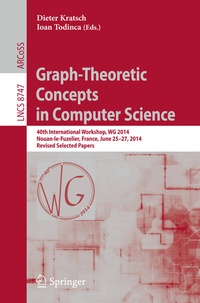
Graph-Theoretic Concepts in Computer Science
Description
Alles über E-Books | Antworten auf Fragen rund um E-Books, Kopierschutz und Dateiformate finden Sie in unserem Info- & Hilfebereich.
This book constitutes the thoroughly refereed post-conference proceedings of the 40th International Workshop on Graph-Theoretic Concepts in Computer Science, WG 2014, held in Nouan-le-Fuzelier, France, in June 2014.
The 32 revised full papers presented were carefully reviewed and selected from 80 submissions. The book also includes two invited papers. The papers cover a wide range of topics in graph theory related to computer science, such as design and analysis of sequential, parallel, randomized, parameterized and distributed graph and network algorithms; structural graph theory with algorithmic or complexity applications; computational complexity of graph and network problems; graph grammars, graph rewriting systems and graph modeling; graph drawing and layouts; computational geometry; random graphs and models of the web and scale-free networks; and support of these concepts by suitable implementations and applications.
More details
Other editions
Additional editions

Persons
Content
System requirements
File format: PDF
Copy protection: Watermark-DRM (Digital Rights Management)
System requirements:
- Computer (Windows; MacOS X; Linux): Use the free software Adobe Reader, Adobe Digital Editions, or any other PDF viewer of your choice (see eBook Help).
- Tablet/Smartphone (Android; iOS): Install the free app Adobe Digital Editions or another reading app for eBooks, e.g., PocketBook (see eBook Help).
- E-reader: Bookeen, Kobo, Pocketbook, Sony, Tolino and many more (only limited: Kindle).
The file format PDF always displays a book page identically on any hardware. This makes PDF suitable for complex layouts such as those used in textbooks and reference books (images, tables, columns, footnotes). Unfortunately, on the small screens of e-readers or smartphones, PDFs are rather annoying, requiring too much scrolling.
This eBook uses Watermark-DRM, a „soft” copy protection. This means that there are no technical restrictions to prevent illegal distribution. However, there is a personalised watermark embedded in the eBook that can be used to identify the purchaser of the eBook in the event of misuse and to provide evidence for legal purposes.
For more information, see our eBook Help page.