

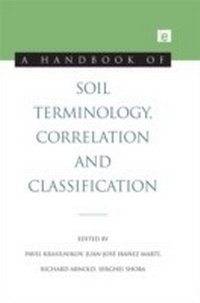
A Handbook of Soil Terminology, Correlation and Classification
1st Edition
Published on 1. December 2009
448 pages
978-1-136-54663-1 (ISBN)
Description

Soil classification and terminology are fundamental issues for the clear understanding and communication of the subject. However, while there are many national soil classification systems, these do not directly correlate with each other. This leads to confusion and great difficulty in undertaking comparative scientific research that draws on more than one system and in making sense of international scientific papers using a system that is unfamiliar to the reader. This book aims to clarify this position by describing and comparing different systems and evaluating them in the context of the World Reference Base (WRB) for Soil Resources. The latter was set up to resolve these problems by creating an international 'umbrella' system for soil correlation. All soil scientists should then classify soils using the WRB as well as their national systems. The book is a definitive and essential reference work for all students studying soils as part of life, earth or environmental sciences, as well as professional soil scientists.
Published with International Union of Soil Sciences
Published with International Union of Soil Sciences
Reviews / Votes
'Anyone who has to deal with soils and their classification, especially if they are involved in trans-national work, should have access to this book. Its primary function will be as a look-up table. However, users are urged strongly to read the extra chapters that explain how classification works.' - P. Loveland, European Journal of Soil Science'This is the most comprehensive and complete review of the state of the art of world-wide soil classification systems...A real desk reference book for soil scientists, especially pedologists.' - Prof. Winfried E.H. Blum, University of Natural Resources and Applied Life Sciences (BOKU), Vienna, Austria
'Do you know what Spodosol or Rendzina are? This is an invaluable review of soil classification systems and terminology as used in a number of countries. It also reviews efforts for a correlative World Reference Base of Soil Resources (WRB) in addition to the more detailed USDA-sponsored Soil Taxonomy (ST).' - Prof. (emer.) Dan H. Yaalon, Hebrew University, Israel
'Soil classification systems are more varied than those of other natural objects such as rocks and plants. This book unravels the diversity and idiosyncracies of the world's multitudinous soil classifications, both scientific and cultural. It reveals overt and cryptic commonalities and structures within them, and points the way towards a more united future.' - Prof. Alex. McBratney, The University of Sydney, Australia
'The most comprehensive inventory of soil classification and correlation systems in the world, this book provides a full overview of the rich diversity of global soil resources and their naming and classification conventions; proving once again, that soil types are a strictly local reality deeply rooted in the cultural and historical context of their locations.' - Luca Montanarella, Land Management/ SOIL Action Unit, European Commission
`The classification of soils . . . is nightmare stuff . . . so much jargon . . . and such complexity'; so wrote an eminent environmental scientist recently. The editors of this book dispel the mystery with charm and understanding while retaining the technical detail. They provide the keys to our Tower of Babel by matching the soil names in local schemes of classification to the World Reference Base for Soil Resources. The book will prove valuable to all pedologists and especially to those who have to communicate across national borders.' - R. Webster, Rothamsted Research, UK
'...provided an excellent insight to our current understanding of soil classification problems and diverse theoretical and practical solutions for designing soil taxonomies' - Arid Land Research and Management, 2010.
More details
Language
English
Place of publication
London
United Kingdom
Publishing group
Taylor & Francis Ltd
Target group
College/higher education
Product notice
Reflowable
File size
1,80 MB
ISBN-13
978-1-136-54663-1 (9781136546631)
Copyright in bibliographic data and cover images is held by Nielsen Book Services Limited or by the publishers or by their respective licensors: all rights reserved.
Schweitzer Classification
Other editions
Additional editions
Pavel Krasilnikov | Juan-Jose Ibanez Marti | Richard Arnold
A Handbook of Soil Terminology, Correlation and Classification
Book
02/2016
1st Edition
Routledge
€95.10
Shipment within 10-20 days
Pavel Krasilnikov | Juan-Jose Ibanez Marti | Richard Arnold
A Handbook of Soil Terminology, Correlation and Classification
Book
10/2009
1st Edition
Earthscan Ltd
€233.20
Shipment within 3-4 weeks
Persons
Pavel Krasilnikov is a Professor at the Faculty of Sciences of National Autonomous University of Mexico (UNAM), and is the Head of the Laboratory of Soil Geography and Ecology, Institute of Biology KarRC RAS, Petrozavodsk, Russia. Juan-Jos Ibanez Marti is a Senior Researcher at Centro de Investigaciones sobre Desertificaci n, CIDE (CSIC-UV, Valencia, Spain) and also works at E.P.S. Area de Ciencias del Suelo y Qu mica Agr cola, University of Burgos, Spain. Richard W. Arnold has taught at University Guelph, Ontario (1963-1966), and Cornell University (1966-1980), and worked at USDA -NRCS (Washington DC) from 1980-2000 as Director of Soil Survey. He is now retired. Serghei Shoba is the Dean of the Faculty of Soil Sciences of Lomonosov University, the President of Dokuchaev's (Russian) Soil Science Society, and Editor-in-Chief of the journal 'Eurasian Soil Science'.
Additional Contributors:
Chapter 9 written together with Dr. P. Schad
Chapter 16 with Professor E. Micheli
Chapter 26 with Dr. A. Hernandez Jimenez
Part III co-written by J. Tabor
Additional Contributors:
Chapter 9 written together with Dr. P. Schad
Chapter 16 with Professor E. Micheli
Chapter 26 with Dr. A. Hernandez Jimenez
Part III co-written by J. Tabor
Content
Introduction
Part I: The Theoretical Bases of Soil Classifications
1. Introduction to Classifications with an Emphasis on Soil Taxonomies
2. Soil Classifications: Their Peculiarity, Diversity and Correlation
3. The Structures of Soil Classifications
Part II: Soil Classifications and their Correlations
4. World Reference Base for Soil Resources - A Tool for International Soil Correlation
5. The United States Soil Taxonomy
6. Soil Classification of Canada
7. French Soil Classification System
8. Soil Classification of the United Kingdom
9. German Soil Classification
10. Soil Classification of Austria
11. Soil Classification of Switzerland
12. Soil Classification of the Netherlands
13. Soil Classification of Poland
14. Soil Classification of Czech Republic
15. Soil Classification of Slovakia
16. Soil Classification of Hungary
17. Soil Classification of Romania
18. Soil Classification of Bulgaria
19. Soil Classification and Diagnostics of the Former Soviet Union, 1977
20. Russian Soil Classification, 2006
21. Soil Classifications of the New Independent States
22. Soil Classification of Israel
23. Soil Classification of People's Republic of China
24. Soil Classification of Japan
25. Soil Classification of Brazil
26. Soil Classification of Cuba
27. Australian Soil Classification
28. Soil Classification of New Zealand
29. Soil Classification of Ghana
30. Soil Classification of South African Republic
31. Outdated, Extinct and Underdeveloped Classifications
32. Classifications of Paleosols
33. A Review of World Soil Classifications
Part III: Folk Soil Classifications
34. Ethnopedology and Folk Soil Classifications
35. Folk Soil Terminology, Listed by Regions
Index
Part I: The Theoretical Bases of Soil Classifications
1. Introduction to Classifications with an Emphasis on Soil Taxonomies
2. Soil Classifications: Their Peculiarity, Diversity and Correlation
3. The Structures of Soil Classifications
Part II: Soil Classifications and their Correlations
4. World Reference Base for Soil Resources - A Tool for International Soil Correlation
5. The United States Soil Taxonomy
6. Soil Classification of Canada
7. French Soil Classification System
8. Soil Classification of the United Kingdom
9. German Soil Classification
10. Soil Classification of Austria
11. Soil Classification of Switzerland
12. Soil Classification of the Netherlands
13. Soil Classification of Poland
14. Soil Classification of Czech Republic
15. Soil Classification of Slovakia
16. Soil Classification of Hungary
17. Soil Classification of Romania
18. Soil Classification of Bulgaria
19. Soil Classification and Diagnostics of the Former Soviet Union, 1977
20. Russian Soil Classification, 2006
21. Soil Classifications of the New Independent States
22. Soil Classification of Israel
23. Soil Classification of People's Republic of China
24. Soil Classification of Japan
25. Soil Classification of Brazil
26. Soil Classification of Cuba
27. Australian Soil Classification
28. Soil Classification of New Zealand
29. Soil Classification of Ghana
30. Soil Classification of South African Republic
31. Outdated, Extinct and Underdeveloped Classifications
32. Classifications of Paleosols
33. A Review of World Soil Classifications
Part III: Folk Soil Classifications
34. Ethnopedology and Folk Soil Classifications
35. Folk Soil Terminology, Listed by Regions
Index
