

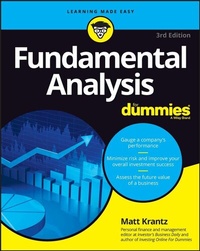
Fundamental Analysis For Dummies
Description

Become familiar with the key concepts of fundamental analysis and learn how to put them into action in the real world
Fundamental Analysis For Dummies is a valuable guide for investors who want to know the future. Okay, it's not a crystal ball, but fundamental analysis will help you gain insight into a company's staying power, as you evaluate revenue, expenses, assets, liabilities, competitors, management, interest rates, and other key business details. This Dummies resource makes it easy to get a handle on the underlying forces that affect the well-being of the economy, industry groups, and companies. You'll explore the tools and strategies of fundamental analysis, and you'll get easy-to-follow examples of how they're used in relation to stock and commodity investing. This latest edition is fully updated with coverage of today's investment landscape.
- Apply fundamental analysis techniques to your investments and increase your profits
- Learn strategies for making smart investments in stocks, currency, bonds, and commodities
- Harness the same tools used by Warren Buffett and other successful investors
- Protect your investments during an economic downturn
Investors looking to become proficient in using fundamental analysis will love this plain-English breakdown of all the must-know information.
More details
Other editions
Additional editions
Person
Matt Krantz is a nationally recognized financial journalist who specializes in investment topics and personal finance. He's the management editor for Investor's Business Daily, and his work has appeared in USA Today and Money magazine.
Content
Introduction 1
Part 1: Getting Started with Fundamental Analysis 5
Chapter 1: Understanding Fundamental Analysis 7
Chapter 2: Getting Up to Speed with Fundamental Analysis 19
Chapter 3: Gaining an Upper Hand on Wall Street: Why Fundamental Analysis Gives Investors an Edge 37
Chapter 4: Getting Your Hands on Fundamental Data 55
Part 2: Performing Fundamental Analysis Yourself 75
Chapter 5: Analyzing a Company's Profitability Using the Income Statement 77
Chapter 6: Measuring a Company's Staying Power with the Balance Sheet 97
Chapter 7: Tracking Cash with the Statement of Cash Flow 115
Chapter 8: Using Financial Ratios to Pinpoint Investments 133
Chapter 9: Mining the Proxy Statement for Investment Clues 155
Part 3: Making Money with Fundamental Analysis 173
Chapter 10: Looking for Fundamental Reasons to Buy or Sell 175
Chapter 11: Finding a Right Price for a Stock Using Discounted Cash Flow 197
Chapter 12: Using the Annual Report (10-K) to See What a Company Is Worth 215
Chapter 13: Analyzing a Company's Public Comments and Statements 237
Chapter 14: Gleaning from the Fundamental Analysis Done by Others 249
Chapter 15: Performing "Top-Down" Fundamental Analysis 267
Part 4: Getting Advanced with Fundamental Analysis 279
Chapter 16: Digging into an Industry's Fundamentals 281
Chapter 17: Pinpointing Trends Using Fundamental Analysis 297
Chapter 18: Avoiding Investment Blowups with Fundamental Analysis 313
Chapter 19: Marrying Fundamental Analysis with Technical Analysis 329
Part 5: The Part of Tens 349
Chapter 20: Ten Things to Look at When Analyzing a Company 351
Chapter 21: Ten Things Fundamental Analysis Cannot Do 359
Index 369
Chapter 1
Understanding Fundamental Analysis
IN THIS CHAPTER
Getting a solid overview of why fundamental analysis is worth your time
Stepping through some of the main concepts that are critical to fundamental analysis
Understanding the ways that fundamental analysis can fit into many investment strategies
Grasping how to use this book to further your understanding of fundamental analysis
Before you gulp down that neon-colored energy drink or pour yourself a bowl of super-sweetened cereal that looks like it was made by Willy Wonka himself, you probably do something first. It's usually not a bad idea to take a glance at the nutrition label that spells out what ingredients are in the box.
You might not know what guar gum, guarana, or other ingredients that often show up on the labels of such processed foods are, but you can get a pretty good idea of what's good for you and what's not. If a bottle of apple juice, for instance, has a list of ingredients longer than your arm and is filled with stuff you can't pronounce, you know you're not drinking squeezed apples. Being aware of what's in a food may or may not sway your decision to eat it, but at least you know what you're putting into your body.
Companies and stocks, too, come with similar labels. All companies that are publicly traded, or that allow investors to buy and sell their shares on public marketplaces, are required to disclose what they're all about. Just as food processors must list all the ingredients that go into their products, companies must tell investors what they're composed of.
Unfortunately, all the information investors need to know about a company doesn't fit inside a tiny rectangle - like it does on a food label. Instead, the key elements that make up a company are broken down at length in a series of financial statements and other sources of fundamental data.
Reading these critical financial statements and gleaning insights from them are the most basic goals of fundamental analysis. Fundamental analysis is the skill of reading through all the information companies provide about themselves to make intelligent decisions.
Why Bother with Fundamental Analysis?
You might wonder why you need to hassle with fundamental analysis. Why bother with technical things like net income or discounted cash flow analysis when you can just turn on the TV, write down a couple of stock symbols, buy the stocks and hope for the best?
You might also figure learning how companies operate is just needless information. After all, you don't need to know about fuel injection systems, suspensions, and car battery technology to drive a car. And you don't need to know what's going on behind the curtain to enjoy a play. Some investors figure they can just pick a couple of hot stocks, buy them, and drive off to riches.
If the bear market that began in 2022 taught investors anything, it's that blindly buying stocks just because you might "like" a company or its products was hardly a sound way to tune up a portfolio. Chasing hunches, online posts, personal opinion, stories, and "memes" about stocks is often not a great way to invest, as you'll find out in Chapter 20. Many of these "meme investors" who followed their guts lost half, or much more, of their money invested in these stocks. This isn't the first time hype punished investors for not paying attention. The financial crisis of 2008 and 2009 pounded many investors, who assumed financial stocks and real estate would never fall.
Some of the real values of fundamental analysis
Ever notice how there's always a new wonder diet promising to make you healthier? More times than not, though, it seems these things never work. Getting healthy comes back to the basics - a balanced diet and exercise.
The same goes with investing. Believe it or not, investing can be full of fads. There's always a new investment pundit or economist with a novel way to pick winning stocks. And just as an hour on the treadmill will do you more good than a miracle diet, successfully choosing stocks often comes back to fundamental analysis.
Fundamental analysis is the classic way to examine companies and investments for a variety of reasons, including the fact it is:
- Based on fact, not opinion: It's easy to get caught up in general enthusiasm about what a company is doing or the products it's selling. Fundamental analysis blinds you to this investment hype and gets you focused on cold-hard business realities. It doesn't matter if all the kids in your neighborhood are buying a company's products if the company isn't making any money at selling them.
- Good at pinpointing shifts in the business's health: If a company's success is starting to fade, you'll see it show up in the fundamentals. No, there won't be a giant sign saying "Sell this stock." But there are clues if you know how to look, as you'll discover in Chapter 18. Companies are required to disclose key aspects of their business, so if there's a problem, a fundamental analyst will often be early at spotting some trouble.
- All about execution: Companies' CEOs are usually good at getting investors focused on the future and how things are going to get better next quarter. But fundamentals are based in reality. Just think of children who say how hard they're working at school. The report card is still the tangible evidence of how things are actually going. The numbers don't lie - if you know where to look.
- A way to put price tags on companies: What's a painting worth? What's a used car worth? The price of an asset with a subjective value is generally what someone else is willing to pay for it. The stock market, an auction of buyers and sellers, does a good job putting price tags on companies. But fundamental analysis gives you another way to see just how much investors, by buying or selling stock, are paying for a stock.
Driving home an example
One of the best examples of how fundamental analysis can help you and your portfolio is General Motors. It's one for the history books of capitalism. For decades, GM represented the might of U.S. industriousness, know-how, and creativity. GM commanded a massive market value of $3.5 billion in 1928, says Standard & Poor's. I'll step you through what market value means in more detail in Chapter 3, but for now, just know that GM was the most valuable company by far in 1928.
For decades, investors figured a dollar invested in GM was money in the bank. The company slugged through upturns and downturns and was a lasting power that helped drive the U.S. economy. The company kept paying fat dividends and kept powering profits higher. There was even an expression: "As GM goes, so goes the nation."
But investors who blindly bet GM would remain a lasting force and ignored the fundamental signs of trouble suffered a brutal blow on June 1, 2009. On that day, which will forever remain one of the lowlights of capitalism, GM became the fourth-largest public company to seek bankruptcy protection, according to BankruptcyData.com. Shares of GM stock collapsed to just 75 cents a share, down 97 percent from their level just three years before.
Fundamental analysis may not have helped you predict just how shocking GM's fate would be. But concrete elements from the company's financial statements could have tipped you off to how challenged GM was well before it became a penny stock and was liquidated. GM was ultimately reborn when a new company was created and bought many of the old company's assets, including the GM name. You can be sure that investors in the new GM paid much closer attention to the fundamentals.
GM VERSUS FORD
Even months before GM filed for bankruptcy protection, fundamental analysis could have served you well.
Back in January 2009, seeing both GM and Ford facing intense financial strain, many investors wondered if either one was worth taking a bet on. Some helpful fundamental analysis tools, including an analysis of the statement of cash flows, could have determined whether you lost a fortune or enjoyed a big gain.
I'll show you how to read the statement of cash flow in detail in Chapter 7. But for now, I'm just giving you a real example of why fundamental analysis matters to whet your appetite. At the beginning of 2009, both Ford and GM were constantly in the news. Both faced a tough business climate and both had depressed stock prices: Ford began 2009 at $2.46 a share and GM $3.65. The market clearly saw big-time troubles at both firms.
But a quick fundamental analysis showed Ford was the much better bet. Ford ended the quarter with $27.5 billion in cash and burnt $600 million in cash. Don't let the numbers scare you at this point. I'm just exposing you to a basic free cash flow analysis, as you'll learn about later. Just for now, know that at the quarterly rate, Ford had enough cash to last nearly 46 quarters.
Over at GM, however, the company ended the quarter with just $15.9 billion in cash. Meanwhile, it burnt through $8.9 billion during the quarter. A fundamental analyst knew right away the company wasn't going to make it through the year at that rate. That's critical...
