

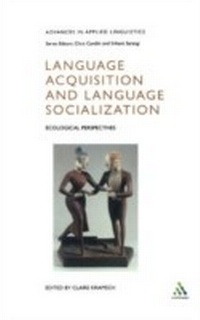
Language Acquisition and Language Socialization
Ecological Perspectives
1st Edition
Published on 1. February 2003
320 pages
978-0-8264-2599-7 (ISBN)
Description

'This is an outstanding collection of papers by top scholars in a range of disciplines who shed stimulating, complementary insights into the social, cognitive and semiotic frameworks that shape both the acquisition of language, and the constitution of social actors through that process. The intentionally loose ecological framing of the volume provides an arena within which a range of perspectives, all united by their opposition to a mechanistic view of language acquisition, can enter into dialogue with each other. This is a most stimulating collection, with a range of insightful investigations of settings as diverse as an autistic child learning to interact with others on the playing field, professional gate-keeping encounters, and foreign language classrooms.'
Professor Charles Goodwin, University of California at Los Angeles
The book brings together well-known scholars in two relatively distinct fields, language acquisition and language socialization, and from a variety of orientations within applied linguistics to describe language development from a relational perspective.
The papers in this volume are a response to three main questions: 1) What conceptual models best capture the ecological nature of language learning? 2) What research approaches are best likely to illuminate the relationship between language and social structure? 3) How is educational success defined for language acquisition and language socialization?
Professor Charles Goodwin, University of California at Los Angeles
The book brings together well-known scholars in two relatively distinct fields, language acquisition and language socialization, and from a variety of orientations within applied linguistics to describe language development from a relational perspective.
The papers in this volume are a response to three main questions: 1) What conceptual models best capture the ecological nature of language learning? 2) What research approaches are best likely to illuminate the relationship between language and social structure? 3) How is educational success defined for language acquisition and language socialization?
Reviews / Votes
"This volume heralds a significant leap in our understanding of issues in language development, and is crucial reading for all language teachers." -- Vai Ramanathan, Associate Professor in the Linguistics department at the University of California, Davis. 'For those of us working in the field of EAL, this book is highly relevant. Its ten chapters cover the breadth of the field and, as it suggested, represent what one might call interdisciplinary-in-interaction. In addition to an excellent introduction which sets out the theoretical framework for the chapters which follow, there are commentaries ending each of the four parts into which the book is divided. These commentaries offer fascinating insights into the writers' discussions during a colloquium which preceded the writing of the book...This is an excellent book. Readable, thought provoking and intellectually engaging.' Angela Creese, University of Birmingham, UK, National Association for Language Development in the CurriculumMore details
Series
Edition
1. Auflage
Language
English
Place of publication
New York
United States
ISBN-13
978-0-8264-2599-7 (9780826425997)
Copyright in bibliographic data and cover images is held by Nielsen Book Services Limited or by the publishers or by their respective licensors: all rights reserved.
Schweitzer Classification
Other editions
Additional editions
Book
02/2003
Continuum International Publishing Group Ltd.
€247.50
Shipment within 15-20 days
Book
02/2003
Continuum International Publishing Group Ltd.
€79.60
Shipment within 15-20 days
Person
Claire Kramsch is Professor of German and Foreign Language Acquisition at the University of California, Berkeley.
Content
Introduction: How Can We Tell the Dancer from the Dance? Claire Kramsch
Part I: Language Development as Spatial and Temporal Positioning
1. Language Acquisition and Language Use from a Chaos/Complexity Perspective, Diane Larsen-Freeman, University of Michigan
2. Modelling the Acquisition of Speech in a 'Multilingual' Society: An Ecological Approach, Jonathan Leather, University of Amsterdam
3. Language Development and Identity: Multiple Timescales in the Social Ecology of Learning, Jay L. Lemke, City University of New York
Commentaries to Part I
Part II: Language Development as Mediated, Social Semiotic Activity
4. Becoming a Speaker of Culture, Elinor Ochs, UCLA
5. Cross-cultural Learning and Other Catastrophes, Ron Scollon, Georgetown University
6. An Ecological-semiotic Perspective on Language and Linguistics, Leo van Lier, Monterey Institute of International Studies
Commentaries to Part II
Part III: Discourse Alignments and Trajectories in Institutional Settings
7. 'I'd Rather Switch than Fight': An Activity Theoretic Study of Power, Success and Failure in a Foreign Language Classroom, James P. Lantolf, The Pennsylvania State University and Patricia B. Genung, The United States Military Academy
8. Discoursal, Misalignments in Professional Gatekeeping Encounters, Srikant Sarangi, Cardiff University and Celia Roberts, Thames Valley University
Commentaries to Part III
Part IV: Interaction Rituals in Language Acquisition and Use
9. Ritual, Face and Play in a First English Lesson: Bootstrapping a Classroom Culture, Jet van Dam, University of Amsterdam
10. Negotiating the Paradoxes of Spontaneous Talk in Advanced L2 Classes, Anne Bannink, University of Amsterdam
Commentaries to Part IV
Part I: Language Development as Spatial and Temporal Positioning
1. Language Acquisition and Language Use from a Chaos/Complexity Perspective, Diane Larsen-Freeman, University of Michigan
2. Modelling the Acquisition of Speech in a 'Multilingual' Society: An Ecological Approach, Jonathan Leather, University of Amsterdam
3. Language Development and Identity: Multiple Timescales in the Social Ecology of Learning, Jay L. Lemke, City University of New York
Commentaries to Part I
Part II: Language Development as Mediated, Social Semiotic Activity
4. Becoming a Speaker of Culture, Elinor Ochs, UCLA
5. Cross-cultural Learning and Other Catastrophes, Ron Scollon, Georgetown University
6. An Ecological-semiotic Perspective on Language and Linguistics, Leo van Lier, Monterey Institute of International Studies
Commentaries to Part II
Part III: Discourse Alignments and Trajectories in Institutional Settings
7. 'I'd Rather Switch than Fight': An Activity Theoretic Study of Power, Success and Failure in a Foreign Language Classroom, James P. Lantolf, The Pennsylvania State University and Patricia B. Genung, The United States Military Academy
8. Discoursal, Misalignments in Professional Gatekeeping Encounters, Srikant Sarangi, Cardiff University and Celia Roberts, Thames Valley University
Commentaries to Part III
Part IV: Interaction Rituals in Language Acquisition and Use
9. Ritual, Face and Play in a First English Lesson: Bootstrapping a Classroom Culture, Jet van Dam, University of Amsterdam
10. Negotiating the Paradoxes of Spontaneous Talk in Advanced L2 Classes, Anne Bannink, University of Amsterdam
Commentaries to Part IV
