

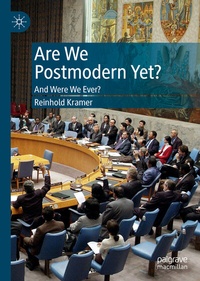
Are We Postmodern Yet?
Description

In this book, Reinhold Kramer explores a variety of important social changes, including the resistance to objective measures of truth, the rise of "How-I-Feel" ethics, the ascendancy of individualism, the immersion in cyber-simulations, the push toward globalization and multilateralism, and the decline of political and religious faiths. He argues that the displacement, since the 1990s, of grand narratives by ego-based narratives and small narratives has proven inadequate, and that selective adherence, pluralist adaptation, and humanism are more worthy replacements. Relying on evolutionary psychology as much as on Charles Taylor, Kramer argues that no single answer is possible to the book title's question, but that the term "postmodernity" - referring to the era, not to postmodernism - still usefully describes major currents within the contemporary world.
Reviews / Votes
"This impressively wide-ranging book suggests that there is an important distinction between postmodernism (the theories) and postmodernity (the practices) - between 'literary and philosophical skepticism about foundations and reality' and 'post-war social developments.' . the book has plenty of range, and this is one of the great pleasures of reading it." (Karl Manis, University of Toronto Quarterly, Vol. 91 (3), August, 2022)More details
Other editions
Additional editions
Person
Reinhold Kramer is a professor at Brandon University in Canada. He is the author of Scatology and Civility in the English-Canadian Novel and Mordecai Richler: Leaving St. Urbain (winner of a Jewish Book Award and the Gabrielle Roy Prize).
Content
Chapter 1: Introduction: The Contemporary Era.- Chapter 2: Truth or Truths?.- Chapter 3 Ethics: "How I feel at the time".- Chapter 4: Individualism: "I Believe in Me".- Chapter 5: Adventures in Cyber-culture.- Chapter 6 :The Nation.- Chapter 7 :Faith and Other Grand Narratives.- Chapter 8: Conclusion.
