

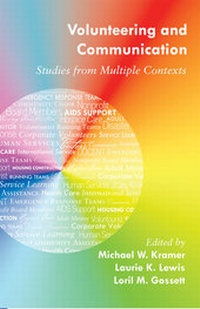
Volunteering and Communication
Studies from Multiple Contexts
1st Edition
Published on 1. August 2012
XII, 434 pages
978-1-4539-0959-1 (ISBN)
Description

This book won the 2014 Applied Communication Division Award for Outstanding Edited Book
There is a growing interest in studying nonprofit organizations and volunteers as an alternative to studying employees in for-profit businesses and government agencies. This is driven in part by the recognition that volunteers make important contributions to society and the economy. This book is the first edited volume written primarily by communication scholars to focus on volunteers. It explores the experience of being a volunteer and managing volunteers through a focus on empirical examination of communication in volunteering. The contributors explore volunteers broadly and are divided into five sections which cover becoming a volunteer; learning about self as a volunteer; dark sides of volunteering; organizationally supported volunteering; and voice and dissent. The final chapter suggests areas of future research and application of the book.
An important focus of the book is its data-based, empirical studies. Although each chapter includes applications, those recommendations are based on systematic studies of volunteers rather than primarily on anecdotal evidence or previous literature. Furthermore, each chapter includes a brief field experience narrative written by a volunteer, as well as addressing a broader conceptual or theoretical issue of organizational studies. In this way the book provides more than just case studies of volunteers, but also addresses general organizational issues.
There is a growing interest in studying nonprofit organizations and volunteers as an alternative to studying employees in for-profit businesses and government agencies. This is driven in part by the recognition that volunteers make important contributions to society and the economy. This book is the first edited volume written primarily by communication scholars to focus on volunteers. It explores the experience of being a volunteer and managing volunteers through a focus on empirical examination of communication in volunteering. The contributors explore volunteers broadly and are divided into five sections which cover becoming a volunteer; learning about self as a volunteer; dark sides of volunteering; organizationally supported volunteering; and voice and dissent. The final chapter suggests areas of future research and application of the book.
An important focus of the book is its data-based, empirical studies. Although each chapter includes applications, those recommendations are based on systematic studies of volunteers rather than primarily on anecdotal evidence or previous literature. Furthermore, each chapter includes a brief field experience narrative written by a volunteer, as well as addressing a broader conceptual or theoretical issue of organizational studies. In this way the book provides more than just case studies of volunteers, but also addresses general organizational issues.
More details
Other editions
Additional editions
Michael W. Kramer | Loril M. Gossett | Laurie K. Lewis
Volunteering and Communication
Studies from Multiple Contexts
Book
05/2013
Peter Lang Verlag
€155.70
Shipment within 7-9 days
Michael W. Kramer | Loril M. Gossett | Laurie K. Lewis
Volunteering and Communication
Studies from Multiple Contexts
Book
05/2013
Peter Lang Verlag
€41.85
Shipment within 7-9 days
Michael W. Kramer | Loril M. Gossett | Laurie K. Lewis
Volunteering and Communication
Studies from Multiple Contexts
E-Book
08/2012
1st Edition
Peter Lang Verlag
€45.49
Available for download
Persons
Michael W. Kramer (PhD, University of Texas) was Professor at the University of Missouri for nineteen years before coming to the University of Oklahoma in 2010 as Chair and Professor of the Department of Communication. His research focuses on the assimilation/socialization process of employees in transition but lately has focused on volunteers. He has published two other books: Managing Uncertainty in Organizational Contexts (2004) and Organizational Socialization: Joining and Leaving Organizations (2010).
Laurie K. Lewis (PhD, University of California at Santa Barbara) is Professor and Chair of the Department of Communication in the Rutgers University School of Communication and Information. Previously she held faculty positions at Pennsylvania State University and the University of Texas at Austin. A recognized expert in organizational communication including change processes, nonprofits, and collaboration, her work has appeared in Communication Monographs, Human Communication Research, Management Communication Quarterly, and her book, Organizational Change: Creating Change through Strategic Communication. She has consulted and done training for various nonprofit organizations including Habitat for Humanity, Austin Presbyterian Theological Seminary, the Sharing Network, and Austin's Community Action Network.
Loril M. Gossett (PhD, Colorado at Boulder) is Associate Professor of Communication Studies and Organizational Science at the University of North Carolina at Charlotte. Previously she was a faculty member at the University of Nevada at Las Vegas and the University of Texas at Austin. Her theoretical interests are focused on issues of identification, member voice, and managerial control strategies within organizational settings. Her research has been published in such forums as Communication Monographs, Management Communication Quarterly, Communication Yearbook, and Public Performance and Management Review.
Laurie K. Lewis (PhD, University of California at Santa Barbara) is Professor and Chair of the Department of Communication in the Rutgers University School of Communication and Information. Previously she held faculty positions at Pennsylvania State University and the University of Texas at Austin. A recognized expert in organizational communication including change processes, nonprofits, and collaboration, her work has appeared in Communication Monographs, Human Communication Research, Management Communication Quarterly, and her book, Organizational Change: Creating Change through Strategic Communication. She has consulted and done training for various nonprofit organizations including Habitat for Humanity, Austin Presbyterian Theological Seminary, the Sharing Network, and Austin's Community Action Network.
Loril M. Gossett (PhD, Colorado at Boulder) is Associate Professor of Communication Studies and Organizational Science at the University of North Carolina at Charlotte. Previously she was a faculty member at the University of Nevada at Las Vegas and the University of Texas at Austin. Her theoretical interests are focused on issues of identification, member voice, and managerial control strategies within organizational settings. Her research has been published in such forums as Communication Monographs, Management Communication Quarterly, Communication Yearbook, and Public Performance and Management Review.
Content
Contents: Casey Malone Maugh: Blogging for Peace: Realistic Job Preview Strategies from the 21st Century Peace Corps Volunteer - Joel O. Iverson: Communicating Belonging: Building Communities of Expert Volunteers - Michael W. Kramer: The Socialization of Community Choir Members: A Comparison of New and Continuing Volunteers - Theresa R. Castor/Mary Jo Jiter: Learning by the «Seat of Your Pants»: The Socialization of Nonprofit Board Members - April A. Kedrowicz: Supporting the Supporters: Implications for Organizational Commitment - Claudia L. Hale/Anita C. James: The Sisterhood of the Hammer: Women Organizing for Community and Self - Cristina M. Gilstrap/Zachary M. White: «Like Nothing Else I've Ever Experienced»: Examining the Metaphors of Residential Hospice Volunteers - Janette C. Douglas/Do Kyun Kim: What Does This Mean, «Just be a Friend»?: Analysis of Volunteer Uncertainty During the Assimilation and Socialization Process at a Youth Mentoring Organization - Jennifer Mize Smith: Volunteer Tourists: The Identity and Discourse of Travelers Combining Largesse and Leisure - Abbey E. Wojno: «You Just Gotta Be Careful About Those Boundaries»: Managing Risk in a Volunteer-based Organization - Jacquelyn N. Chinn/Joshua B. Barbour: Negotiating Aging and Agedness in Volunteer Disaster Response Teams - Disraelly Cruz: Managing Volunteer Tensions: Unpacking Experiences and Responses to Organizational Irrationalities - Donnalyn Pompper: Volunteerism and Corporate Social Responsibility: Definitions, Measurement, Roles, and Commitment - Isabel C. Botero/Tomasz A. Fediuk/Kate M. Sies: When Volunteering is No Longer Voluntary: Assessing the Impact of Student Forced Volunteerism on Future Intentions to Volunteer - Loril M. Gossett/Rachel A. Smith: Spontaneous Volunteers: Understanding Member Identification Among Unaffiliated Volunteers - Jenny Onyx: Breaking the Rules: The Secret of Successful Volunteering in a Caring Role - Johny T. Garner/Kristen Horton: Connecting, Voicing, Retaining: Linking Volunteers' Involvement, Willingness to Voice Ideas, and Intent to Remain with the Organization - Kirstie McAllum: Challenging Nonprofit Praxis: Organizational Volunteers and the Expression of Dissent - Laurie K. Lewis/Loril M. Gossett/Michael W. Kramer: New Directions for Volunteering.
