

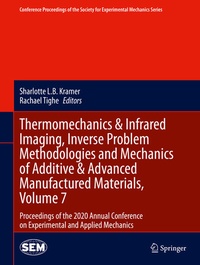
Thermomechanics & Infrared Imaging, Inverse Problem Methodologies and Mechanics of Additive & Advanced Manufactured Materials, Volume 7
Description

Test Design and Inverse Method Algorithms
Inverse Problems: Virtual Fields Method
Residual Stresses: Measurement, Uncertainty & Validation
Residual Stresses: Eigenvalues, Modeling, & Crack Growth
Material Characterizations Using Thermography
Fatigue, Damage & Fracture Evaluation Using Infrared ThermographyMore details
Other editions
Additional editions
Content
Visualization and Simulation of Particle Rearrangement and Deformation During Powder Compaction.- Full-Field Analysis of Strain-Induced Crystallization in Natural Rubber.- Grain Size and Mechanical Property of Magnesium Experienced Rolling and Post Heat Treatment.- Evaluation and Comparison of the Mechanical Performance of Adhesively Bonded and Self-Piercing Riveted Aluminum Joints under Tension Loading.- Dynamic Strain Aging in Additively Manufactured Steel at Elevated Temperatures.- Material Characterization of 3D Printed Components with Different Layup Orientation.- Strain Controlled Tensile Test Through High Rate Thermal Expansion.- High Temperature Welded Thermocouple Preparation and Calibration.- Analytical Methods to Understand Deformation Mechanics in Additively Manufactured Metals.- Infrared Thermography Applied to the Assessment of Fatigue Initiation.- DIC-IR Analysis of Transient Thermal Stresses.- The Role of Extraneous Oxygen in the Formation of Oxide Inclusions In 316LStainless Steel Manufactured by Laser Powder Bed Fusion.- Evolution and Impact of Oxygen Inclusions in 316L Stainless Steel Manufactured by Laser Powder bed Fusion.- Implementing a Commercially Available Self-Locking Screw System in Additively Manufactured Medical Implants.- Experimental Validation and Noise Assessment of the Thermal-VFM.- Role of Glass Transition Temperature on Energy Absorption Mechanisms in High Strain Rate Impact Performance of Fiber Reinforced Composites.
