

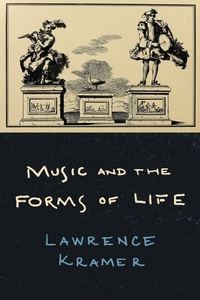
Music and the Forms of Life
1st Edition
Published on 4. October 2022
204 pages
978-0-520-38912-0 (ISBN)
Description

Inventors in the age of the Enlightenment created lifelike androids capable of playing music on real instruments. Music and the Forms of Life examines the link between such simulated life and music, which began in the era's scientific literature and extended into a series of famous musical works by Haydn, Mozart, and Beethoven. Music invented auditory metaphors for the scientific elements of life (drive, pulse, sensibility, irritability, even metabolism), investigated the affinities and antagonisms between life and mechanism, and explored questions of whether and how mechanisms can come to life. The resulting changes in the conceptions of both life and music had wide cultural resonance at the time, and those concepts continued to evolve long after. A critical part of that evolution was a nineteenth-century shift in focus from moving androids to the projection of life in motion, culminating in the invention of cinema. Weaving together cultural and musical practices, Lawrence Kramer traces these developments through a collection of case studies ranging from classical symphonies to modernist projections of waltzing specters by Mahler and Ravel to a novel linking Bach's Goldberg Variations to the genetic code. The publisher gratefully acknowledges the generous support of the AMS 75 PAYS Fund of the American Musicological Society, supported in part by the National Endowment for the Humanities and the Andrew W. Mellon Foundation.
More details
Other editions
Additional editions
Lawrence Kramer
Music and the Forms of Life
Book
10/2022
1st Edition
University of California Press
€37.50
Shipment within 10-20 days
Lawrence Kramer
Music and the Forms of Life
Book
10/2022
1st Edition
University of California Press
€99.20
Shipment within 10-20 days
Person
Lawrence Kramer, Distinguished Professor at Fordham University, is the author of The Hum of the World and The Thought of Music (winner of the ASCAP Foundation Virgil Thomson Award for Outstanding Music Criticism), among many other books. He is an award-winning composer whose works have been performed internationally.
Content
Contents
List of Musical Examples and Figures
Introduction: Music and the Life of Statues
1 • From Clockwork to Pulsation I: Intensity and Drive
2 • From Clockwork to Pulsation II: Action and Feeling
3 • From Clockwork to Pulsation III: Metabolism
4 • 1812 Overtures: Wellington's Victory and Live Action
5 • "Dear Listener" . . . : Music and the Invention of Subjectivity
6 • Waltzing Specters: Life, Perception, and Ravel's "La Valse"
7 • The Musical Biome
Epilogue: Sound and the Forms of Life
Notes
Index
List of Musical Examples and Figures
Introduction: Music and the Life of Statues
1 • From Clockwork to Pulsation I: Intensity and Drive
2 • From Clockwork to Pulsation II: Action and Feeling
3 • From Clockwork to Pulsation III: Metabolism
4 • 1812 Overtures: Wellington's Victory and Live Action
5 • "Dear Listener" . . . : Music and the Invention of Subjectivity
6 • Waltzing Specters: Life, Perception, and Ravel's "La Valse"
7 • The Musical Biome
Epilogue: Sound and the Forms of Life
Notes
Index
