

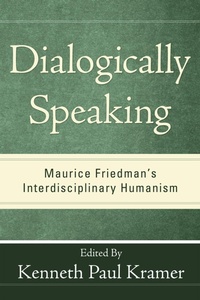
Dialogically Speaking
Maurice Friedman's Interdisciplinary Humanism
Published on 1. January 2011
330 pages
978-1-4982-7339-8 (ISBN)
Description

What makes us authentically human? According to Maurice Friedman, world-renowned Martin Buber scholar, translator, and biographer, it is genuine dialogue. "When there's a willingness for dialogue," Friedman says, "then one must 'navigate' moment-by-moment. It's a listening process." Friedman addresses our humanity in ever-unique ways through his dialogue with philosophy, literature, religion, and psychotherapy. At least two things make this book new. Friedman presents his wide-ranging thought directly in five original essays forming an "intertextual compass," which is then elaborated upon by colleagues familiar with his work. Second, a special feature of this book is found at the end of each part which invites readers to engage with questions drawn from and pointing toward Friedman's writing. The book's intended audience includes teachers, scholars, and students interested in dialogical approaches to any of the human sciences. In a time when we are in danger of losing our human birthright, Friedman's interdisciplinary insights point us again to "the touch of the other."
More details
Other editions
Additional editions
Book
01/2011
Wipf & Stock Publishers
€38.60
Shipment within 3-4 weeks
Book
01/2011
Wipf & Stock Publishers
€64.00
Shipment within 15-20 days
Person
Kenneth Paul Kramer is Professor Emeritus of Comparative Religious Studies at San Jose State University, where he taught from 1978 to 2001. He is the author of Redeeming Time: T. S. Eliot's Four Quartets (2007); Martin Buber's I and Thou: Practicing Living Dialogue (2003); Death Dreams: Unveiling Mysteries of the Unconscious Mind (1993); The Sacred Art of Dying (1988); and World Scriptures: An Introduction to Comparative Religions (1986).
Content
- Intro
- Title Page
- Contributors
- Preface
- Acknowledgment
- Introduction: My Dialogue with Dialogue
- Part One: Philosophy as Dialogue
- Chapter 1: Becoming Authentically Human: The Consciousness of Dialogue
- Chapter 2: Sharing the Narrow Ridge: Maurice Friedman and Martin Buber
- Chapter 3: Meaning and Non-Meaning: Maurice Friedman's Dialogue with Existentialism
- Part One-Afterword: Dialogical Knowing
- Part Two: Literature as Dialogue
- Chapter 4: The Poetics of Dialogue: The Human Image
- Chapter 5: Maurice Friedman's Dialogue with Religion and Literature
- Chapter 6: Interior Dialogue and the Human Image
- Part Two-Afterword: Dialogical Knowing
- Part Three: Religion as Dialogue
- Chapter 7: Religion and the Religions: Touchstones of Reality
- Chapter 8: Encountering the Ineffable: Maurice Friedman's Dialogue with God
- Chapter 9: Maurice Friedman's Dialogue with Asian Religions
- Chapter 10: You Are My Witnesses: Maurice Friedman and Abraham Joshua Heschel
- Chapter 11: Touchstones of Reality: Understanding Genocide and the Absence of Dialogue
- Chapter 12: Strelisk
- Strelisk-Introduced by a Dialogue on Hasidism between Elie Wiesel and Maurice Friedman
- Part Three-Afterword: Dialogical Knowing
- Part Four: Psychotherapy as Dialogue
- Chapter 13: Healing through Meeting: Dialogical Psychotherapy
- Chapter 14: Dialogical Psychotherapy: The Seminal Influence of Maury Friedman
- Chapter 15: Engagement: The Strict Sacrament of Dialogue
- Chapter 16: Studying Communication, Confirmation, and Dialogue: In Dialogue with Maurice Friedman
- Part Four-Afterword: Dialogical Knowing
- Conclusion: Confirmation through Conflict?
- Conflict in the Dialogue of Touchstones
- Annotated Bibliography
