

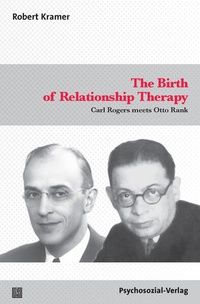
The Birth of Relationship Therapy
Carl Rogers meets Otto Rank
2nd Edition
Published on 1. June 2019
138 pages
978-3-8379-7469-0 (ISBN)
Description

Carl Rogers is one of the most influential figures in humanistic psychology. Surprisingly, however, almost no one knows the full story of how he came to develop »relationship therapy«, one of the most popular in the world today. Yet Rogers always acknowledged that a personal encounter with Otto Rank in 1936 revolutionized the way he thought about psychotherapy. »I became infected with Rankian ideas«, he told his biographer. Like Rank, whose last book was entitled Beyond Psychology, Rogers concluded by the end of his life that there is a realm »beyond« scientific psychology, a realm he came to prize as »the transcendent, the indescribable, the spiritual«. Ironically, the spiritual had always been there, hidden in what was closest and most familiar to Rogers: the empathic relationship between therapist and client. This book shows that the spirit of Otto Rank, from whom »relationship therapy« originated, lived on in the mind, heart, and soul of Carl Rogers.
Reviews / Votes
»Although Otto Rank had his own terminology, which was sometimes a bit obscure to American audiences, these are clearly ideas that he passed along to Carl Rogers, Rollo May and, through them (we might add) to current leading lights in this approach such as Kirk Schneider. Robert Kramer's book is not the first to point out these continuities between Rank and later, more popular theories, but Kramer certainly draws these lines of connection as tightly, succinctly and clearly as any other piece of writing I have seen. This is a worthy contribution to the field that deserves wide attention.«Daniel Liechty, ernestbecker.org, 21. Juli 2021
»Einen Hintergrund für die geschilderte Entwicklung von Freud über Rank zu Rogers und den heutigen relationalen Psychotherapien kann man in der gestiegenen Ichstärke und der damit verbundenen gestiegenen Fähigkeit zur emotionalen Reflexivität sehen, wie sie mit der Festigung der demokratischen und wirtschaftlichen Strukturen in der westlichen Welt verbunden ist. Das ermöglicht in meiner Sicht auch den weiteren Fortschritt, wie er von Marshall Rosenberg, einem der wichtigsten Schüler von Carl Rogers, mit der gewaltfreien Kommunikation erreicht wurde, die es erlaubt, auch komplexe aggressive Elemente in der Kommunikation zu klären und zu verarbeiten, die in den Anfängen der Psychoanalyse noch als Aggressionstrieb, Todestrieb und später als schizoide Position, Grundstörung, oder Gamma-Elemente mythologisiert wurden, weil die prä- und perinatale und die psychohistorische Dimension, wie sie von Rank erschlossen worden waren, ausgeblendet wurde. Darum wäre es auch für die etablierten Psychotherapien so bedeutsam, sich mit den von Robert Kramer in seinem Buch aufgedeckten Traditionslinien zu beschäftigen. Das gilt natürlich auch für die Gesprächspsychotherapie und die gewaltfreie Kommunikation.«
Ludwig Janus, Gesprächspsychotherapie und Personzentrierte Beratung 2/202
More details
Other editions
Additional editions
Book
06/2019
2nd Edition
Psychosozial-Verlag
€22.90
Shipment within 7-9 days
Person
Content
- Intro
- Content
- Preface
- The Trauma of Birth
- There's No Substitute for Reading Rank
- Otto Rank, Midwife of the Subject
- Mother Love
- I Sense an Intelligence Rendered Clairvoyant by Feeling
- What Does a WomanWant?
- He Was Always Wrapped Up in His Deep Feelings
- The Surgeon, Who Puts Aside All Feelings, Even His Human Sympathy
- Relationship Therapy
- The Real I, or Self with Its Own Power, the Will
- Learning to Will . Learning to Feel
- The Consciousness of Living
- Life Fear . Death Fear
- A Powerful Desire to Identify with the Cosmic Forces
- Creation of One's Own Individual Cosmos
- Volitional Affirmation of the Obligatory
- Maximum Individuality and Maximum Community
- This, Then, Is the New
- The Simultaneous Dissolution of Individuality in a Greater Whole
- I Became Infected with Rankian Ideas
- The "Birth"of Client-Centered Therapy
- Daimonic
- Is This the Only Reality?
- An Identity with the Cosmic Process
- Who Am I? How Did I Come into the World? Why Was I Not Consulted?
- I Was Born Beyond Psychology
- References
