

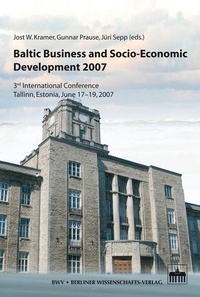
Baltic Business and Socio-Economic Development 2007
3rd International Conference Tallinn, Estonia, June 17-19, 2007
1st Edition
Published on 6. December 2010
1109 pages
978-3-8305-2592-9 (ISBN)
Description

The 3rd International Conference on "Baltic Business and Socio-Economic Development" took place between 17th and 19th of June 2007 in Tallinn. The conference provided an opportunity to discuss issues related particularly to assessment of socio-economic development and business environment in the Baltic Sea Region, the economic and financial situation of SMEs, and possibilities of international co-operation in the area of education activity. With more than 100 participants the conference represented a great platform to disseminate knowledge on socio-economic conditions for regional and business development as well as on solutions applied in that scope in different economies. The most relevant papers from this conference are presented in this volume, focussing on entrepreneurship, small and medium-sized enterprises (SMEs), regional development as well as on macroeconomic environment and finance. This broad range of topics and papers provides not only information and opinions, but offers incentives for further research and the gathering of new knowledge.
More details
Other editions
Additional editions

Jost W. Kramer | Gunnar Prause | Jüri Sepp
Baltic Business and Socio-Economic Development 2007
3rd International Conference Tallinn, Estonia, June 17-19, 2007
Book
03/2010
1st Edition
Berliner Wissenschafts-Verlag
€98.00
Article exhausted; check different version
Content
- Intro
- Baltic Business and Socio-Economic Development 2007
- Contents
- Preface
- Eight Years of EMU - What are the Benefits?
- 1. Welcome Address
- 2. What changes has the euro brought about?
- 3. Monetary policy
- 4. Looking ahead
- Monetary Policy, Currency and Finance
- On the road to EMU: Which Exchange Rate System Performs Best for Estonia? Karen Cabos, Jörn Eckhoff
- 1. Introduction
- 2. How do the exchange arrangements of CEECs look like?
- 3. The Estonian Currency Board
- 4. Problems of the existing currency board arrangement
- 5. What are the alternatives?
- 6. What should be done?
- References
- Technical Annex
- 1. Estimation output for Estonian exports
- 3. Estonian inflation dynamics
- 2. Estimation output for Estonian Imports
- Comparison of Price Stickiness in the Euro Area and Estonia Aurelijus Dabusinskas, Martti Randveer
- Abstract
- 1. Introduction
- 2. General information about the firm and its market
- 3. Price stickiness
- 4. Summary
- References
- Empirical Analysis of Capital Structure and Dividend Decisions Under the Distributed Profit Taxation Regime of Estonia1 Aaro Hazak
- Abstract
- 1. Introduction
- 2. Distributed Profit Taxation in Estonia
- 3. Key Related Literature
- 4. Data and Methodology
- 5. Results
- 6. Conclusions
- References
- Estimates of Money Demand Functions for Estonia Hans-Eggert Reimers, Kairi Roht
- Abstract
- 1. Introduction
- 2. Money demand framework
- 3. Econometric framework
- 4. Basic analysis of the data and graphs
- 5. Analysing the model
- 6. Conclusion
- References
- Monetary Aggregates, Portfolio Shifts, and Monetary Policy Armin Rohde, Agnes Oestreich
- Abstract
- 1. Functional Definition of Money
- 2. The relevant monetary aggregate
- 3. The relevance of the M-Aggregates
- 4. Relevant monetary components outside the monetary aggregate M3
- 5. The impact of portfolio decisions on the relevance of the monetary aggregates
- 6. Alternative definitions of monetary aggregates compared with the monetary aggregate M3
- 7. Conclusions
- References
- Discussion of Euro Adoption in the New EU Member Countries - Stylized Facts Stanislav Saroch
- Abstract
- 1. Introduction
- 2. Fact a) Real and nominal convergence of new Member States
- 3. Fact b) Maastricht convergence criteria were created for a different group of countries, in a period with diverse parameters of an economic development
- 4. Fact c) Maastricht exchange rate and inflation Maastricht criteria under the EU economic conditions accomplish the condition of so called "impossible trinity"
- 5. Fact d) A long-term effort to keep fixed nominal exchange rate and very low inflation rate at the same time is in contradiction to the process of real and nominal convergence
- 6. Fact e) The euro adoption in new Member States would not significantly threaten price stability (inflation target) specified by the ECB
- 7. Timing the euro area entry for new Member States - A problem of optimalization or a political choice?
- References
- The Exchange Rate Pass-Through and the CEE Countries Euro Admission within the Exchange Rate Political Economy Jaromír Sindel
- Abstract
- 1. Introduction
- 2. Exchange Rate Political Economy and the Exchange Rate Passthrough
- 3. Exchange rate and terms of trade in the CEE countries
- 4. Exchange Rate Pass-through into Terms of Trade
- 5. Exchange rate pass-through into Czech export prices
- 6. Exchange rate pass-through within the exchange rate political economy framework - discussion related to exchange rate appreciation within the pre-euro adoption period
- 7. Discussion over the PTM approach - a case of currency hedging
- 8. Conclusion
- References
- Phenomenon of Money Laundering as Threat to Development of Financial Systems of CEE Countries (Case Study of Poland) S awomir Smyczek
- Abstract
- Introduction
- 1. Money laundering - evolution and characteristics
- 2. The model of money laundering process
- 3. Factors stimulating the process of money laundering
- 4. The influence of money laundering upon modern economic and financial systems
- Conclusions
- References
- E-Banking in Estonia: Regional Development and Risk Management Practices Dmitri Sokolov
- Abstract
- 1. Introduction
- 2. Regional Development of E-Banking in Estonia
- 3. Risks of E-Banking
- 4. Studying E-Banking Risk Management Practices of the Estonian Banks
- 5. Board and Management Oversight of E-Banking Risks in Estonia
- 6. Security Control Processes for E-Banking in Estonia
- 7. Legal and Reputational Risk Management in Estonia
- 8. Conclusions
- References
- Commercial Banks in Estonia Support Socio-Economic Development Mart Sõrg
- Abstract
- Introduction
- 1. Development of the banking sector in Estonia has created objective preconditions for it to support social development
- 2. Estonian banks' practices of supporting socio-economic development
- Conclusions
- References
- Appendix 1. Sponsoring principles of Hansapank
- Appendix 2. Scholarships of Hansapank
- SME and Entrepreneurship
- The Importance of Developing Performance Appraisal Systems in Romanian Small Enterprises Maria-Madela Abrudan, Mirela Bucurean, Horia Demian
- Abstract
- 1. Introduction
- 2. The obstacles of change
- 3. Suggestion for implementing an efficiently performance appraisal system
- Bibliography
- Economic Internationalization Potential of SMEs in the BSR- Comparative Analysis Anatoli Beifert
- Abstract
- Introduction
- Research area and objectives
- Uppsala Perspective
- Network theory
- Previous regional studies on business internationalization
- BBDN-research project
- Research approach
- Research results
- Background information
- Evaluation of current state of transport and IT infrastructure
- Evaluation of previous international experience and motivation
- Problems and risks perceived by SMEs in regard to business internationalization
- Evaluation of language and intercultural issues
- Summary
- References
- Entrepreneurial Visions of International Competitiveness in Estonian SMEs Tiit Elenurm
- 1. Introduction
- 2. Internationalization strategies and SMEs
- 3. European integration and international competitiveness challenges for SMEs in a new EU member state
- 4. Combining quantitative and qualitative research
- 5. Questionnaire survey and interview results
- 6. Does the size of an enterprise make a difference?
- 7. Discussion and conclusions
- References
- Entrepreneurship's Development in Estonian Industrial Company-Towns During Post-Communist Transition Period: Impact of Local Factors Raigo Ernits
- Abstract
- Introduction
- 1. Possibilities for formation of sustainable entrepreneurship on regional level in contemporary era
- 2. Entrepreneurships' development factors in Estonian postsocialist company towns
- 2.1. General characterisation and development of observed settlements
- 2.2. Sustainability of entrepreneurship in observed settlements in the observation time
- 2.3. "Turning points" and their reasons in entrepreneurship's development
- Conclusions
- References
- Problems and Perspectives of Co-operative Development and Corporate Governance Structures in German Co-operatives Jost W. Kramer
- Abstract
- 1. Introduction
- 2. Co-operative Ideologies in Capitalism
- 2.1. Motives for the Development of the First Co-operatives
- 2.2. Social Aims of Early Co-operatives
- 2.2.1. Overcoming Capitalism
- 2.2.2. Reforming Capitalism
- 2.3. Current Social Ideology of Co-operatives
- 3. Co-operatives in a Market Economy
- 3.1. Definition of the Co-operative Concept
- 3.2. The European Co-operative Discussion
- 3.2.1. Distinction from Capitalist Enterprises
- 3.2.2. Co-operative Goals
- 4. Structural Economic Types of the Co-operative According to Dülfer
- 4.1. Executively Operating Co-operative (traditional co-operative)
- 4.2. Market-Linkage Co-operative (market co-operative)
- 4.3. Integrated Co-operative
- 5. Property Rights Theory and Co-operatives
- 6. Attenuation of Property Rights
- 7. Structural Influences of the Legal Form, the Registered Co-operative
- 7.1. General Structure
- 7.2. Structural Details
- 8. The Allocation of Property Rights within a Co-operative
- 9. Where are the Problems?
- 9.1. The Promotion Principle
- 9.2. The Identity Principle
- 9.3. The Democracy Principle
- 9.4. The Solidarity Principle
- 10. What could be done?
- References
- Administrative Costs of SMEs Kalle Määttä
- Abstract
- Introduction
- Some Results about the Administrative Costs of Enterprises
- Pitfalls in the Measurement of Administrative Costs
- Simplification of Legislation or Legal Reliefs for SMEs?
- Concluding Remarks
- References
- Choice of Performance Measurement Indicators in Estonian SMEs Ülle Pärl, Toomas Haldma
- Abstract
- 1. Introduction
- 2. Theoretical framework
- 3. Research method and design
- 4. Findings and discussion
- 5. Conclusion
- References
- Logistics-related Entrepreneurship and Regional Development - An Empiric Study Gunnar Prause
- Introduction
- I. LogOn Baltic & InterBaltic
- II. Expert Interviews
- III. Regional expectations: Mecklenburg-Vorpommern
- IV. Strategic location: Gateway MV
- V. Knowledge
- VI. Soft factors
- VII. Economic effects of logistics
- VIII. Logistics investments
- IX. The Seaport of Rostock: A closer look
- X. Conclusions
- Bibliography
- SME in Service Cluster - A Regional Study Gunnar Prause
- Introduction
- Logistics in Mecklenburg-Vorpommern
- Seaport Rostock
- Seaport Cluster
- I. Cluster structure
- II. Cluster governance
- The Performance of the Rostock Seaport Cluster
- Structure Variables for the Rostock Seaport Cluster
- I. Cluster structure
- a. Strength of Rostock Seaport Cluster
- b. Weakness of Rostock Seaport Cluster
- II. Cluster governance
- a. Strength of Rostock Seaport Cluster
- b. Weakness of Rostock Seaport Cluster
- Case Studies
- References
- How Can Small and Medium-Sized Companies Participate in Emerging Markets? - Theoretical Approach for a Market Entry in Lithuania - Kirsten Schröder
- Abstract
- 1. Introduction
- 2. Theoretical Approaches in strategy making
- 3. The Lithuanian Market
- 3.1. General Information about Lithuania
- 3.2. Political Situation
- 3.3. Lithuanian Economy
- 3.4. Technological Analysis
- 3.5. Social Analysis
- 4. The Logistics Market in Lithuania
- 4.1. Transportation Business
- 4.2. The Role of SME in Lithuania
- 4.3. Logistics service providers
- 4.4. SME in Germany's logistics business
- 5. Possibilities (and advantages) of a market entry in Lithuania
- 5.1. Structure of the Transportation market in Lithuania
- a) Former Lithuanian Companies
- b) Branches of International Companies
- c) Entrepreneurial Start-ups
- 5.2. Market entry modes
- 6. Opportunities and threats entering the Lithuanian market
- 6.1. Opportunities in Lithuania
- 6.2. Possible threats in Lithuania
- 6.3. Strength and weaknesses
- 7. Recommendations for a market entry: Summary and conclusion
- Literature
- Development of Rural Entrepreneurship Eve Tomson, Andro Roos
- Abstract
- Introduction
- Rural Population and Employment
- Rural Development Strategy
- The diversification of entrepreneurship in the country
- Investments into agricultural entrepreneurship
- Alternative financing of rural economy
- Summary
- References
- Entrepreneurial Activity in Estonia and Implications for SME Policy Urve Venesaar
- Abstract
- 1. Introduction
- 2. Data and methodology
- 3. Analysis of firm formation rates across regions and sectors.
- 4. Managers' opinions about the constraints of newly established firms
- Conclusion
- References
- Regional Policy and Regional Development
- Promoting Dynamic Interaction of Universities and Regional Stakeholders1 Valery Belyakov, Alexandra Izosimova, Ari Koski, Gunnar Prause, Marika Rudzite
- Abstract
- 1. Universities as powerhouses of their regions
- 1.1. Importance of network knowledge
- 1.2. Universities´ third role
- 1.3. University-region dynamic interaction
- 2. Promoting university-region dynamic interaction within the A.S.A.P. project
- 2.1. BSR INTERREG IIIB NP project A.S.A.P.
- 2.1.1. Questionnaire concerning cooperation between universities and regional stakeholders
- 2.1.2. Questionnaire concerning the role of universities in regional development
- 2.1.3. Benchmarking university-region interaction practices
- 2.1.4. First conclusions of the work package 4 activities
- 2.2. Approach to the realization of the A.S.A.P. activities in Russia
- 2.2.1. Background
- 2.2.2. Luga pilot district
- 2.2.3. Volosovo pilot district
- 2.2.4. Priozersk pilot district
- 2.3. The regional development activities at Wismar University, Germany
- 2.3.1. The environment of Wismar University
- 2.3.2. Areas of competence and activities of Wismar University
- 2.3.3. Regional cooperation of Wismar University
- 2.3.4. Economic activities of Wismar University
- 2.3.5. Outlook
- Reference
- Changes of Elderly Consumers' Potential in Ageing Societies of the Baltic Sea Region Countries Miroslawa Gazinska, Magdalena Kaminska, Magdalena Mojsiewicz
- Introduction
- 1. The elderly consumers' potential from the perspective of human resource
- 2. Elderly people as consumers on the goods and services market
- Summary
- Bibliography
- Data source
- From Research on Mortality of Old People in EU Countries of the Baltic Sea Region Miroslawa Gazinska, Magdalena Kaminska, Magdalena Mojsiewicz
- Introduction
- 1. Life duration models for elderly people
- 2. Analysis of mortality among people aged 80 and more in the EU countries of the Baltic Sea Region
- 3. Mortality models of people aged 80 and more in the EU countries of the Baltic Sea Region
- Summary
- Bibliography
- The Significance of Cluster Membership of Companies for Their Competitive Potential - Illustrated by the Case of a Furniture Cluster in Wielkopolska1 Marian Gorynia, Barbara Jankowska
- Abstract
- 1. Introduction
- 2. Competitive potential of a firm - the area of cluster's influence
- 3. Knowledge spill-over effects as a symptom of the cluster's influence on company competitiveness
- 4. Poland's experiences with regard to cluster initiatives
- 5. Furniture cluster in the region of Wielkopolska
- 5.1. Findings to date
- 5.2. Empirical research among members of the furniture-industry cluster
- 5.2.1. Object of research
- 5.2.2. Research method
- 5.2.3. Questionnaire
- 5.2.4. Research sample
- 6. Conclusion
- Bibliography
- Operation Research Methods in Regional Health Policy Stefan Grzesiak
- Abstract
- 1. Introduction
- 2. Areas of mathematical methods application in medical services
- 3. Choice of targets and functionality effectiveness of medical services units
- 4. Methods of solving multi-criteria decision tasks
- Bibliography
- Socio-economic Dimensions of Migration from Poland to Sweden Agata Jarmoszka
- Abstract
- Introduction
- International Migration - The Theoretical Approach
- Current Migration Flows from Poland
- Sweden as one of the most important destinations of immigrants
- The socio-economic situation in Poland and Sweden
- How to measure the socio-economic integration of immigrants
- Preliminary conclusion
- References
- Regional Development: Qualification Measures as an Instrument of Regional Development - Focusing the Logistics Field in the Metropolitan Region of Hamburg Wolfgang Kersten, Meike Schröder
- Abstract
- 1. Introduction
- 2. Influencing Factors for Logistics and the Role of the Employee
- 3. Development in the Metropolitan Region of Hamburg
- 3.1. Development of Economy
- 3.2. Development of Employment
- 4. Changes in Qualification and Requirements
- 5. Regional Educational Development in the Field of Logistics
- 5.1. Hamburg's Regional Development Agencies
- 5.1.1. The Wachstumsinitiative Süderelbe AG
- 5.1.2. The Logistics Initiative Hamburg
- 5.2. Regional Development Measures
- 5.2.1. Logistics 50+
- 5.2.2. Hamburg's Regional Centre of Further Education (FZH)
- 6. Recommendations for Further Education and Regional Development
- 7. Summary
- Literature
- ICT Competence and Regional Development - A Regional Study Eric Kron, Gunnar Prause
- Abstract
- Introduction
- General situation of the ICT in Mecklenburg-Vorpommern
- The RAIN project
- LogOn Baltic: Expert Interviews
- LogOn Baltic: the ICT Survey
- LogOn Baltic: Findings from the Survey
- Use of ICT systems
- Use of Internet
- E-commerce and E-business
- General assessment of ICT usage
- Final comments
- References
- Position of Capital Cities in Baltic Sea Economic Area Sulev Mäeltsemees
- Abstract
- Defining Baltic Sea Region
- Capital City in Human Habitation System
- Capital City and Legal Environment, including Relationship with Central Government, and Regional Co-operation
- Economic Environment in Capital City
- Capital Cities in Urban and Structural Policies
- References
- Regional Income Disparities and Convergence in EU: Catching Up or Falling Behind? Tiiu Paas, Friso Schlitte
- Abstract
- 1. Introduction
- 2. Theoretical and empirical considerations
- 3. Data
- 4. Regional income disparities and their decomposition
- 4.1. Regional income disparities and growth
- 4.2. Decomposition of regional disparities
- 5. Convergence analysis
- 5.1 Absolute and conditional ß-convergence
- 5.2 Spatial interactions
- 6. Estimation results
- 6.1 The non-spatial estimations
- 6.2 ß-convergence and spatial dependence
- 7. Conclusions
- References
- About Regional and Local Government Policy in Estonia Matti Raudjärv
- Abstract
- Introduction
- 1. Major aspects influencing the Estonian regional and local government policy
- 2. Positions on regional and local government policy in literature on economics concerning shortcomings in Estonia
- 3. Some major problems which require solutions
- 4. Suggestions for the development of the regional and local government policy
- 5. Assessment of possible mergers of Estonian county centres with the surrounding rural municipalities, and alternatives
- Conclusion
- References
- Employment, Human Resource Management, and Innovation
- Employment Growth within BSR Countries: Some Predictive Aspects of Shift-share Analysis Barbara Batóg, Jacek Batóg
- Abstract
- Introduction
- Methodology
- Data
- Empirical results
- Conclusions
- References
- Enhancing the Efficiency of Estonian Public Administration by the Process of Creating Staff (By the Case of Estonian Ministry of Agriculture and Estonian Agricultural Registers and Information Board) Reelika Irs
- Abstract
- Introduction
- Personnel Selection Process and the methods used during selection
- Personnel selection process in public service, patterns in Estonian public service
- Personnel selection process in Ministry of Agriculture and the Estonian Agricultural Registers and Information Board (ARIB)
- Conclusion
- References
- Social Capital and Institutional Quality as Factors of Innovation: Evidence from Europe Anneli Kaasa, Helje Kaldaru, Eve Parts
- Abstract
- 1. Introduction
- 2. Theoretical background
- 3. Innovation activity and its utilisation in Europe
- 4. Measurement of factors of innovation
- 5. Determinants of innovation by different clusters
- 6. Discussion of the results: What determines innovation behaviour in different countries?
- 7. Limitations and future research
- 8. Conclusions
- References
- Appendix A: Indicators of innovation and its utilisation
- Apendix B: Factor scores of patenting activity and standardised values of indicators of innovation and its utilisation
- Appendix C: Welfare indicators and their average values in different clusters of innovation (UNDP 2006)
- Appendix D: Indicators of social capital
- Appendix E: Indicators of R&D and human capital
- Appendix F: Results of exploratory factor analysis: rotated component matrix* of social capital indicators and% of total variance explained
- Appendix G: Factor scores of dimensions of social capital and governance, and standardised values of general trust
- Appendix H: Factor scores of R&D and human capital and standardised values of initial indicators
- Business Rules Make Business More Flexible Uwe Lämmel
- Abstract
- 1. Introduction
- 2. Business Rules
- 2.1. Basics
- 2.2. Applications
- 2.3. Benefits
- 2.4. Business Rules Manifesto
- 3. Business Rule Systems
- 3.1. Evaluation Criteria
- 3.2. Systems
- 3.3. Survey
- 4. Conclusion
- References
- Human Resources in Science and Technology in the Baltic Sea Region Magdalena Mojsiewicz, Miroslawa Gazi nska, Magdalena Kaminska
- 1. Introduction
- 2. Innovation measurement
- 3. Human resources in innovation measurement
- 3. Pro-innovative human resources in the Baltic Sea Region
- 4. Pre-academic and post-academic pro-innovative education
- Conclusion
- References
- A Heuristic Approach for a Special Pick-Up-And- Delivery Problem Harald Mumm
- Abstract
- 1. Introduction
- 2. The Problem
- 3. A Heuristic Algorithm for a special Pick-up-and-delivery Problem
- 4. An example for the optimal solution
- 5. Numerical Results
- 6. Conclusions
- References
- Social Capital and Welfare: Micro-and Macro-level Evidence from Central and Eastern Europe Eve Parts
- 1. Introduction
- 2. Theoretical background
- 3. Data and measurement
- 4. Relations between the factors of social capital
- 5. Relations between social capital and welfare
- 6. Conclusions
- References
- Appendix A. Indicators of social capital and individual welfare from WVS
- Appendix B. Country mean factor scores for the latent variables of social capital
- Appendix C. Indicators of economic development and individual welfare
- Appendix D. Pearson Correlations between welfare indicators and social capital factors at individual level (lower left triangle) and aggregate level (upper right triangle)
- Bureaucracy, and Law Making Mechanism: Their Influence on the Quality of Business Environment Tanja Põlajeva
- Abstract
- Introduction: Theoretical Approach
- Empirical Results of Surveys, 1998-2006
- A. Sample General Characteristics
- B. Government Agencies' Behaviour
- 1. Civil Servants' Wilfulness
- 2. Will to Resist and Fight Back
- 3. Civil Servants' Power
- 4. Knowing the Civil Servants - Speeding Up the Procedure
- 5. Knowing the Civil Servants - Influencing his Decision
- C. Law Making Procedures
- 1. Unexpected Changes in Law
- 2. Information Availability
- 3. Possibilities to Consult
- 4. Government's Announcements Credibility
- D. Law Enforcement Mechanism
- 1. Objectivity of Courts
- 2. Power of Money on the Decisions
- 3. Knowing the Judge Personally
- 4. Turning to the Higher Court
- E. Uncertainties in Government Agencies' Behaviour, Law Making Procedures, and Law Enforcement
- Concluding Remarks
- References
- Appendix 1 Table 5: Estimates of Government Agencies Behaviour, Law Making Procedures, and Law Enforcement Mechanism in Different Countries
- Appendix 2 Table 6: Estimates of Government Agencies Behavior, Law Making Procedures, and Law Enforcement Mechanism in Different Countries
- Problems of Ensuring Sustainable Administration of Public Real Estate in Estonia1 Janno Reiljan
- Abstract
- Introduction
- 1. Apraisal of funding problems for public real estate development
- 2. Ownership or rent in public real estate management
- 3. Conceptual basis for real estate administration
- References
- Employment Structure in the Baltic Sea Region EU Members as a Factor of Economic Growth Monika Rozkrut, Dominik Rozkrut
- 1. Introduction
- 2. Employment structure
- 3. Methodology
- 4. Empirical study
- 5. Conclusion
- References
- Corporate Culture as a Factor of Institutional Development - Empirical Evidence from the West Pomeranian Healthcare Sector Iga Rudawska
- Abstract
- Reforming healthcare sectors in CEE
- The health care sector in Poland - institutional approach
- Corporate culture defined
- Research methodology
- The findings
- Discussion
- Final conclusions
- References
- Evaluation and Practical Application of Service Quality Measurement Methods Wieslaw Urban
- Introduction
- Disconfirmation Model - Servqual and Its Limitations
- Customer's Perception Measurement - Servperf and Other Methods
- Incident-Based Quality Measurement
- Quality Measurement Using Service Providing Process
- Mystery Shopping as a Service Quality Measurement Method
- Service Quality Measurement from the Inside of an Organization
- Empirical Research Method
- Knowledge and Practice of Service Quality Measurement Methods
- Reasons for Creating New Methods
- Conclusion
- Reference
- How to Improve the National Innovation Systems of the Catching-up Economies? Urmas Varblane
- Abstract
- Introduction
- Development of the concept of innovation system
- Implementation of the national innovation system approach in developing and catching up economies
- Advantages and disadvantages of latecomers
- Problems in building up national innovation systems in catching up economies as the reflection of the path-dependency
- Underestimation of the role of public sector in the national innovation system
- Dominating role of the linear innovation model and neglecting demand
- Confrontation between high- and low-tech industries
- Overvaluation of the role of foreign direct investments
- Lack of social capital and network failure
- Weak innovation diffusion system and low motivation to learn
- Policy recommendations and conclusions
- References
- Loyalty Between the Company and its Employees Adds Value - A Loyalty Model Applied on Empirical Studies of Employee Engagement in German and Estonian Companies Andreas von Schubert
- Abstract
- 1. Corporate human resources are decreasing
- 1.1. The challenge of change management in times of shareholder value management
- 1.2. The particular challenge of change management in transition countries
- 2. A comparison of empirical findings on employee commitment
- 2.1. Employee Engagement in Germany
- 2.2. Attitude and Employee Engagement in Estonia
- 2.3. How to cope with "wrong" attitudes and limited employee engagement
- 2.4. Employees are important stakeholders
- 3. The ABC of intra-corporate loya lty: Activate - balance - control
- 3.1. Activate: Self-interest creates engagement
- 3.2. Balance: Engagement requires bilateral achievement of objectives
- 3.2.1. Esteem is the starting point of all loyalty management
- 3.2.2. Engagement despite of an indifferent attitude
- 3.2.3. Trust as an intermediate step
- 3.2.4. Bilateral investment as a reliable basis for loyal relationships within a corporation
- 3.3. Control: Loyalty is "self-financing"
- 4. Loyalty management adds value by balancing potentially conflicting goals
- References
- Economic Theory and Economic Policy
- Benchmarking EU Countries Against Danish Flexicurity model Raul Eamets, Kaia Philips, Janika Alloja, Kerly Krillo
- Abstract
- 1. Introduction
- 2. Flexicurity concepts and the Danish "golden triangle"
- 3. Measurement of labour market flexicurity
- 4. Flexicurity profiles of EU25 countries
- 5. Discussion and conclusion
- References
- Appendix
- Estonian Wage Formation as a Macroeconomic Adjustment Mechanism: Comparative Analysis with Baltic and Nordic States1 Grigori Fainstein, Kaie Kerem
- Abstract
- 1. Introduction
- 2. Theoretical models of wage determination
- 3. Comparative characteristics of the Estonian labour market
- 4. Empirical results
- 5. Regional labour market adjustment
- 6. Conclusions
- References
- The Energy Supply Market of the Baltic States: Russia's Role and Prospects for Integration Julie M. Korosteleva, Vladimir N. Zuev
- Abstract
- Introduction
- Geopolitical situation
- Russian business expansion
- Problems
- Prospects of energy dialog development between Russia and the Baltic States
- 1. Laying down a complex program for guaranteeing secure deliveries of Russian hydrocarbons to the Baltic States
- 2. Mutual trade relations
- 3. Joint participation in infrastructure projects
- 4. Mutually acceptable agreements for long-term energy supplies
- 5. Mutual diversification of Russia and the Baltic States deliveries
- Conclusion
- References
- About a Way of Estimation of Weights Situated on Variance Ellipse and Method of Determination of Kind of Surface on Which Portfolio Weights are Located Henryk Kowgier
- 1. Introduction
- 2. Estimation of weights situated on variance ellipse
- 3. Empirical example
- 4. Researching of kind of surface on which weights of quaternary portfolio are situated.
- 5. Conclusions
- References
- Value Added by Maritime Industry in Poland Christian Lis, Dominik Rozkrut
- Abstract
- 1. Introduction
- 2. Gross Value Added
- 3. Estimation
- 4. Conclusions
- References
- Prospects of Development of Russian Share Market During an Epoch of Globalization Alexander S. Selishchev
- Abstract
- Institutional changes of the Russian stock market
- The Structure of Russian Stock Market
- Growth of the stock market
- The dynamics of RTSI
- Russian investment ratings
- Market of IPO in 2006
- References
- Income Level and Income Equality - Each Other Influencing Factors or Independent Dimensions of the Economic System?1 Jüri Sepp, Diana Eerma
- Abstract
- Introduction
- 1. Factors of income level and their impact range
- 2. Robustness analysis of the model
- 3. Classification of countries on income equality and relative income level base
- I. Countries, which are relatively poor and also have unequal income distribution at the same time.
- II. Countries, which are relatively rich and have equal income distribution at the same time.
- III. Countries, which have relatively equal income distribution, but are poor at the same time.
- IV. Countries, which have relatively unequal income distribution, but are rich.
- 4. Position of Baltic countries by relative income level and equality
- Summary
- References
- Annex 1: Division of countries by income level and relative level of income equality
- History and Development of Ownership Research1 Mike Franz Wahl
- Abstract
- 1. Introduction
- 2. Material and Methods
- 3. History of Ownership Research
- 4. Conclusions
- References
- Authors
