

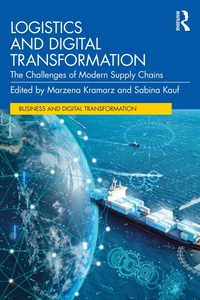
Logistics and Digital Transformation
The Challenges of Modern Supply Chains
Published on 5. December 2025
238 pages
978-1-040-59755-2 (ISBN)
Description

This comprehensive textbook examines the digital maturity of modern supply chains, presenting innovative frameworks for assessing and enhancing digital capabilities across procurement, production, distribution, and city logistics while offering forward-looking scenarios for supply chain evolution.
Logistics and Digital Transformation: The Challenges of Modern Supply Chains leads the reader through the various applications of information and communication technology (ICT) in logistics and suggests how digital logistics systems may develop in the future. These concepts present research conducted at the scale of the entire supply chain, as well as at the scale of individual logistics subsystems (supply logistics, production logistics, distribution logistics), and in the area of city (urban) logistics, which is closely related to the development of modern distribution systems. Unique to this book is its description of the relationship between the digital development of individual subsystems and entire supply chains, to identify the determinants of this development and challenges - this approach has not yet been addressed in the literature.
This book will find an appreciative audience amongst advanced students, researchers, practitioners in logistics, supply chain management, manufacturing, trading, IT companies, and policymakers interested in logistics innovation and digital maturity.
Logistics and Digital Transformation: The Challenges of Modern Supply Chains leads the reader through the various applications of information and communication technology (ICT) in logistics and suggests how digital logistics systems may develop in the future. These concepts present research conducted at the scale of the entire supply chain, as well as at the scale of individual logistics subsystems (supply logistics, production logistics, distribution logistics), and in the area of city (urban) logistics, which is closely related to the development of modern distribution systems. Unique to this book is its description of the relationship between the digital development of individual subsystems and entire supply chains, to identify the determinants of this development and challenges - this approach has not yet been addressed in the literature.
This book will find an appreciative audience amongst advanced students, researchers, practitioners in logistics, supply chain management, manufacturing, trading, IT companies, and policymakers interested in logistics innovation and digital maturity.
Reviews / Votes
"The book tackles a key issue related to using information and communication technologies in supply chain management. Although technological tools have been extensively studied over the past twenty years, their importance has grown significantly today with the adoption of cloud platforms, blockchains, consensus mechanisms, and rapid advances in artificial intelligence. This book aims to address these challenges in supply chain management by presenting the underlying theory, discussing practical examples, and exploring ways for supply chains to implement various tools to enhance efficiency and competitiveness. This makes the book especially valuable for researchers seeking new inspiration, students needing a comprehensive foundation of knowledge, and managers looking for innovative solutions and insights on how to solve decision-making problems."Professor Artur Swierczek, Professor, University of Economics in Katowice
"This book offers a rare yet crucially needed systemic perspective on the digital transformation of logistics. It provides a comprehensive analysis of the impact of digital technologies on relevant links in modern supply chains - from procurement and production logistics, through distribution, to urban logistics. The authors combine theoretical reflection with practical tools: a proprietary digital maturity model and development scenarios, making the publication a valuable resource for researchers, managers, and decision-makers. This book not only summarizes the current state of knowledge but also outlines directions for further research and implementation."
Professor Guenter Prockl, Associate Professor, Copenhagen Business School
More details
Series
Language
English
Place of publication
London
United Kingdom
Publishing group
Taylor & Francis Ltd
Target group
Professional and scholarly
College/higher education
Illustrations
20 Tables, black and white; 53 Line drawings, black and white; 5 Halftones, black and white; 58 Illustrations, black and white
File size
9,83 MB
ISBN-13
978-1-040-59755-2 (9781040597552)
Copyright in bibliographic data and cover images is held by Nielsen Book Services Limited or by the publishers or by their respective licensors: all rights reserved.
Schweitzer Classification
Other editions
Additional editions
Marzena Kramarz | Sabina Kauf
Logistics and Digital Transformation
The Challenges of Modern Supply Chains
Book
approx. 12/2025
1st Edition
Routledge
€200.50
Not yet published
Marzena Kramarz | Sabina Kauf
Logistics and Digital Transformation
The Challenges of Modern Supply Chains
Book
approx. 12/2025
1st Edition
Routledge
€61.40
Not yet published
Persons
Marzena Kramarz is Deputy Head of the Department of Logistics at the Faculty of Organization and Management at the Silesian University of Technology, Poland.
Sabina Kauf is Head of the Department of Marketing and Supply Chain Management at the Faculty of Economics, University of Opole, Poland.
Sabina Kauf is Head of the Department of Marketing and Supply Chain Management at the Faculty of Economics, University of Opole, Poland.
Content
Introduction 1. Digital Transformation of Supply Chains 2. ICT Systems in Logistics Services 3. ICT Systems in Procurement and Production Logistics 4. ICT Systems in Logistics Distribution 5. ICT Systems in Last-Mile Delivery 6. Digital Supply Chain Maturity Model 7. Digital Future of Logistics and Supply Chains Summary and Conclusions
