

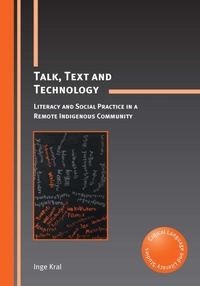
Talk, Text and Technology
Literacy and Social Practice in a Remote Indigenous Community
Published on 26. July 2012
280 pages
978-1-84769-761-5 (ISBN)
Description

Talk, Text and Technology is an ethnographic exploration of language, learning and literacy in remote Indigenous Australia. This unique work traces the historical transformation of one Indigenous group across four generations. The manner in which each generation adopts, adapts and incorporates new innovations and technologies into social practice and cultural processes is illuminated - from first mission contact and the introduction of literacy in the 1930s to youth media practices today. This book examines social, cultural and linguistic practices and addresses the implications for language and literacy socialisation.
Reviews / Votes
Kral claims in her book to try to 'counter sweeping generalisations about youth, social practices, the development of literacy and the cultural and historical production of literate identities in one remote Aboriginal setting'. She does this very well. Her work has implications for how we think about literacy, literate subjects, literacy as social and cultural practice and change. It is a timely book and, in an environment saturated with deficit conceptualisations and simplistic reading of literacy, it is an uplifting and important read. -- Pauline O'Maley, Victoria University, Australia * Fine Print, a journal of adult English language and literacy education, vol: 37 #3 * An absolutely rare study of how technologies have become integrated into the lifeways of youth. The stunning detail, rich history, and keenly etched personalities make this volume a thought-provoking read. This book should be at the top of the list of anyone interested in youth, literacy, and the blend of old and new in cultures around the world. * Shirley Brice Heath, Stanford University, USA * What is literacy for, if it does not bring better material conditions, more opportunities for meaningful work? From inscribing stories in sand to inscribing birthday cakes, from Bible translation to bilingual education, from early morning speeches in camp to formal open letters, a rich and immensely readable description of Ngaanyatjarra reading, writing and image-making practices emerges from this book. Kral shows how literacy has evolved in these remote Western Australian communities since the 1930s, based on a large corpus of interviews, letters, literacy assessments and school population data. She concludes with glimpses of young Ngaanyatjarra learning skills in informal settings, through filming, art and computer work. The book is essential reading for anyone seeking to understand the ambivalence of Indigenous Australians towards formal education. * Jane Simpson, The Australian National University, Australia *More details
Series
Language
English
Place of publication
Bristol
United Kingdom
Publishing group
Channel View Publications Ltd
Target group
Professional and scholarly
Product notice
Reflowable
ISBN-13
978-1-84769-761-5 (9781847697615)
Copyright in bibliographic data and cover images is held by Nielsen Book Services Limited or by the publishers or by their respective licensors: all rights reserved.
Schweitzer Classification
Other editions
Additional editions
Book
07/2012
Multilingual Matters
€48.30
Shipment within 10-20 days
Person
Inge Kral is a Research Fellow at the Centre for Aboriginal Economic Policy Research at The Australian National University. Her work as an educator and researcher in Indigenous Australia for nearly three decades has ranged across literacy, applied linguistics, anthropology and new media.
Content
Introduction
PART I LIVING IN THE NOW
Chapter 1 From Forgetting to Remembering
Chapter 2 Transmitting Orality and Literacy as Cultural Practice
PART II NEW FIGURED WORLDS
Chapter 3 Mission Time: Adapting to the New
Chapter 4 Everything was Different Because of the Changing
Chapter 5 The Cultural Production of Literate Identities
PART III PAST, PRESENT, FUTURE
Chapter 6 The Meaning of Things in Time and Space
Chapter 7 You Fellas Grow up in a Different World
Conclusion
PART I LIVING IN THE NOW
Chapter 1 From Forgetting to Remembering
Chapter 2 Transmitting Orality and Literacy as Cultural Practice
PART II NEW FIGURED WORLDS
Chapter 3 Mission Time: Adapting to the New
Chapter 4 Everything was Different Because of the Changing
Chapter 5 The Cultural Production of Literate Identities
PART III PAST, PRESENT, FUTURE
Chapter 6 The Meaning of Things in Time and Space
Chapter 7 You Fellas Grow up in a Different World
Conclusion
