

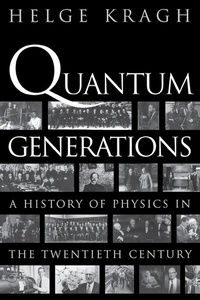
Quantum Generations
A History of Physics in the Twentieth Century
1st Edition
Published on 7. September 2020
512 pages
978-0-691-21419-1 (ISBN)
Description

At the end of the nineteenth century, some physicists believed that the basic principles underlying their subject were already known, and that physics in the future would only consist of filling in the details. They could hardly have been more wrong. The past century has seen the rise of quantum mechanics, relativity, cosmology, particle physics, and solid-state physics, among other fields. These subjects have fundamentally changed our understanding of space, time, and matter. They have also transformed daily life, inspiring a technological revolution that has included the development of radio, television, lasers, nuclear power, and computers. In Quantum Generations, Helge Kragh, one of the world's leading historians of physics, presents a sweeping account of these extraordinary achievements of the past one hundred years.
The first comprehensive one-volume history of twentieth-century physics, the book takes us from the discovery of X rays in the mid-1890s to superstring theory in the 1990s. Unlike most previous histories of physics, written either from a scientific perspective or from a social and institutional perspective, Quantum Generations combines both approaches. Kragh writes about pure science with the expertise of a trained physicist, while keeping the content accessible to nonspecialists and paying careful attention to practical uses of science, ranging from compact disks to bombs. As a historian, Kragh skillfully outlines the social and economic contexts that have shaped the field in the twentieth century. He writes, for example, about the impact of the two world wars, the fate of physics under Hitler, Mussolini, and Stalin, the role of military research, the emerging leadership of the United States, and the backlash against science that began in the 1960s. He also shows how the revolutionary discoveries of scientists ranging from Einstein, Planck, and Bohr to Stephen Hawking have been built on the great traditions of earlier centuries.
Combining a mastery of detail with a sure sense of the broad contours of historical change, Kragh has written a fitting tribute to the scientists who have played such a decisive role in the making of the modern world.
The first comprehensive one-volume history of twentieth-century physics, the book takes us from the discovery of X rays in the mid-1890s to superstring theory in the 1990s. Unlike most previous histories of physics, written either from a scientific perspective or from a social and institutional perspective, Quantum Generations combines both approaches. Kragh writes about pure science with the expertise of a trained physicist, while keeping the content accessible to nonspecialists and paying careful attention to practical uses of science, ranging from compact disks to bombs. As a historian, Kragh skillfully outlines the social and economic contexts that have shaped the field in the twentieth century. He writes, for example, about the impact of the two world wars, the fate of physics under Hitler, Mussolini, and Stalin, the role of military research, the emerging leadership of the United States, and the backlash against science that began in the 1960s. He also shows how the revolutionary discoveries of scientists ranging from Einstein, Planck, and Bohr to Stephen Hawking have been built on the great traditions of earlier centuries.
Combining a mastery of detail with a sure sense of the broad contours of historical change, Kragh has written a fitting tribute to the scientists who have played such a decisive role in the making of the modern world.
More details
Other editions
Additional editions
Book
03/2002
Princeton University Press
€59.60
Article not available at the moment
Book
10/1999
Princeton University Press
€76.88
Article exhausted; check different version
Person
Helge Kragh is Professor of History of Science at Aarhus University, Denmark. His previous books include An Introduction to the Historiography of Science, Dirac: A Scientific Biography, and Cosmology and Controversy: The Historical Development of Two Theories of the Universe (Princeton).
Content
- Cover Page
- Half-title page
- Title page
- Copyright page
- Contents
- Preface
- Part One: From Consolidation To Revolution
- Chapter One: Fin-De-Si`Ecle Physics: A World Picture In Flux
- Chapter Two: The World Of Physics
- Personnel And Resources
- Physics Journals
- A Japanese Look At European Physics
- Chapter Three: Discharges In Gases And What Followed
- A New Kind Of Rays
- From Becquerel Rays To Radioactivity
- Spurious Rays, More Or Less
- The Electron Before Thomson
- The First Elementary Particle
- Chapter Four: Atomic Architecture
- The Thomson Atom
- Other Early Atomic Models
- Rutherford's Nuclear Atom
- A Quantum Theory Of Atomic Structure
- Chapter Five: The Slow Rise Of Quantum Theory
- The Law Of Blackbody Radiation
- Early Discussions Of The Quantum Hypothesis
- Einstein And The Photon
- Specific Heats And The Status Of Quantum Theory By 1913
- Chapter Six: Physics At Low Temperatures
- The Race Toward Zero
- Kammerlingh Onnes And The Leiden Laboratory
- Superconductivity
- Chapter Seven: Einstein's Relativity, And Others'
- The Lorentz Transformations
- Einsteinian Relativity
- From Special To General Relativity
- Reception
- Chapter Eight: A Revolution That Failed
- The Concept Of Electromagnetic Mass
- Electron Theory As A Worldview
- Mass Variation Experiments
- Decline Of A Worldview
- Unified Field Theories
- Chapter Nine: Physics In Industry And War
- Industrial Physics
- Electrons At Work, I: Long-Distance Telephony
- Electrons At Work, Ii: Vacuum Tubes
- Physics In The Chemists' War
- Part Two: From Revolution To Consolidation
- Chapter Ten: Science And Politics In The Weimar Republic
- Science Policy And Financial Support
- International Relations
- The Physics Community
- Zeitgeist And The Physical Worldview
- Chapter Eleven: Quantum Jumps
- Quantum Anomalies
- Heisenberg's Quantum Mechanics
- Schr¨Odinger's Equation
- Dissemination And Receptions
- Chapter Twelve: The Rise Of Nuclear Physics
- The Electron-Proton Model
- Quantum Mechanics And The Nucleus
- Astrophysical Applications
- 1932, Annus Mirabilis
- Chapter Thirteen: From Two To Many Particles
- Antiparticles
- Surprises From The Cosmic Radiation
- Crisis In Quantum Theory
- Yukawa's Heavy Quantum
- Chapter Fourteen: Philosophical Implications Of Quantum Mechanics
- Uncertainty And Complementarity
- Against The Copenhagen Interpretation
- Is Quantum Mechanics Complete?
- Chapter Fifteen: Eddington's Dream And Other Heterodoxies
- Eddington's Fundamentalism
- Cosmonumerology And Other Speculations
- Milne And Cosmophysics
- The Modern Aristotelians
- Chapter Sixteen: Physics And The New Dictatorships
- In The Shadow Of The Swastika
- Aryan Physics
- Physics In Mussolini's Italy
- Physics, Dialectical Materialism, And Stalinism
- Chapter Seventeen: Brain Drain And Brain Gain
- American Physics In The 1930s
- Intellectual Migrations
- Chapter Eighteen: From Uranium Puzzle To Hiroshima
- The Road To Fission
- More Than Moonshine
- Toward The Bomb
- The Death Of Two Cities
- Part Three: Progress And Problems
- Chapter Nineteen: Nuclear Themes
- Physics Of Atomic Nuclei
- Modern Alchemy
- Hopes And Perils Of Nuclear Energy
- Controlled Fusion Energy
- Chapter Twenty: Militarization And Megatrends
- Physics A Branch Of The Military?
- Big Machines
- A European Big Science Adventure
- Chapter Twenty One: Particle Discoveries
- Mainly Mesons
- Weak Interactions
- Quarks
- The Growth Of Particle Physics
- Chapter Twenty Two: Fundamental Theories
- Qed
- The Ups And Downs Of Field Theory
- Gauge Fields And Electroweak Unification
- Quantum Chromodynamics
- Chapter Twenty Three: Cosmology And The Renaissance Of Relativity
- Toward The Big Bang Universe
- The Steady State Challenge
- Cosmology After 1960
- The Renaissance Of General Relativity
- Chapter Twenty Four: Elements Of Solid State Physics
- The Solid State Before 1940
- Semiconductors And The Rise Of The Solid State Community
- Breakthroughs In Superconductivity
- Chapter Twenty Five: Engineering Physics And Quantum Electronics
- It Started With The Transistor
- Microwaves, The Laser, And Quantum Optics
- Optical Fibers
- Chapter Twenty Six: Science Under Attack Physics In Crisis?
- Signs Of Crisis
- A Revolt Against Science
- The End Of Physics?
- Chapter Twenty Seven: Unifications And Speculations
- The Problem Of Unity
- Grand Unified Theories
- Superstring Theory
- Quantum Cosmology
- Part Four: A Look Back
- Chapter Twenty Eight: Nobel Physics
- Chapter Twenty Nine: A Century Of Physics In Retrospect
- Growth And Progress
- Physics And The Other Sciences
- Conservative Revolutions
- Appendix
- Further Reading
- Bibliography
- Index
