

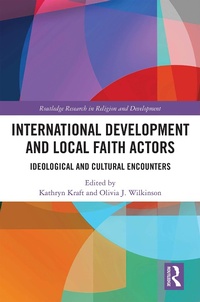
International Development and Local Faith Actors
Ideological and Cultural Encounters
1st Edition
Published on 17. March 2020
278 pages
978-1-000-05327-2 (ISBN)
Description

This book explores the interplay and dialogue between faith communities and the humanitarian-development community. Faith and religion are key influencers of thought and practice in many communities around the world and development practitioners would not be able to change behaviours for improved health and social relations without the understanding and influence of those with authority in communities, such as religious leaders. Equally, religious leaders feel responsibilities to their communities, but do not necessarily have the technical knowledge and resources at hand to provide the information or services needed to promote the well-being of all in their scope of influence. The book demonstrates that partnerships between humanitarian-development practitioners and religious communities can be mutually beneficial exchanges, but that there are also frequently pitfalls along the way and opportunities for lessons to be learned by each party.
Delving into how humanitarians and faith communities engage with one another, the book focuses on building knowledge about how they interact as peers with different yet complementary roles in community development. The authors draw on the Channels of Hope methodology, a tool which seeks to engage faith leaders in addressing social norms and enact social change, as well as other related research in the sector to demonstrate the many ways in which humanitarian and development policy makers and practitioners could achieve more systematic engagement with faith groups. This book is an important contribution to the growing body of literature on faith and development, and will be useful both to researchers, and to practitioners working with faith communities.
Delving into how humanitarians and faith communities engage with one another, the book focuses on building knowledge about how they interact as peers with different yet complementary roles in community development. The authors draw on the Channels of Hope methodology, a tool which seeks to engage faith leaders in addressing social norms and enact social change, as well as other related research in the sector to demonstrate the many ways in which humanitarian and development policy makers and practitioners could achieve more systematic engagement with faith groups. This book is an important contribution to the growing body of literature on faith and development, and will be useful both to researchers, and to practitioners working with faith communities.
Reviews / Votes
"The book is a helpful guide to faith-oriented practitioners who want to work constructively in diverse faith contexts. The stories are mostly empirically based, from a diverse range of global regions, a variety of organizations, and an array of issues." - Roland Hoksbergen, Chief Editor of Christian Relief, Development, and AdvocacyMore details
Series
Edition
1. Auflage
Language
English
Place of publication
London
United Kingdom
Publishing group
Taylor & Francis Ltd
Target group
College/higher education
Professional and scholarly
Product notice
Reflowable
Illustrations
3 Tables, black and white; 4 Line drawings, black and white; 4 Illustrations, black and white
ISBN-13
978-1-000-05327-2 (9781000053272)
Copyright in bibliographic data and cover images is held by Nielsen Book Services Limited or by the publishers or by their respective licensors: all rights reserved.
Schweitzer Classification
Other editions
Additional editions
Kathryn Kraft | Olivia J. Wilkinson
International Development and Local Faith Actors
Ideological and Cultural Encounters
Book
12/2021
1st Edition
Routledge
€65.60
Shipment within 10-20 days
Kathryn Kraft | Olivia J. Wilkinson
International Development and Local Faith Actors
Ideological and Cultural Encounters
Book
03/2020
1st Edition
Routledge
€206.60
Shipment within 15-20 days
Persons
Kathryn Kraft is Senior Lecturer in International Development at the University of East London, and has served as Senior Research Advisor for Faith and Development at World Vision International. Throughout her career she has played various roles negotiating the space between the worlds of humanitarian aid, religious communities and academic research. She has facilitated various initiatives that promote the development of civil society and grassroots efforts for development and humanitarian work through strong research and learning exchange. Her research has focused on faith-based humanitarianism and collaborations between grassroots actors, intermediaries and members of the global humanitarian community.
Olivia J. Wilkinson is the Director of Research at the Joint Learning Initiative on Faith and Local Communities (JLI), based in DC. The JLI works directly with humanitarian and development organizations and academics to convene around discussions of research on religion and development, particularly the role of local faith actors. Olivia is a sociologist and her main research interests focus on the influence of secular and religious values in shaping humanitarian action, with her monograph on this subject to be published by Routledge, titled "Secular and Religious Dynamics in Humanitarian Response". She has a Ph.D. and Master's in humanitarian action from Trinity College Dublin and Universite catholique de Louvain (Network on Humanitarian Action - NOHA) respectively and a Bachelor's degree from the University of Cambridge in Theology and Religious Studies.
Olivia J. Wilkinson is the Director of Research at the Joint Learning Initiative on Faith and Local Communities (JLI), based in DC. The JLI works directly with humanitarian and development organizations and academics to convene around discussions of research on religion and development, particularly the role of local faith actors. Olivia is a sociologist and her main research interests focus on the influence of secular and religious values in shaping humanitarian action, with her monograph on this subject to be published by Routledge, titled "Secular and Religious Dynamics in Humanitarian Response". She has a Ph.D. and Master's in humanitarian action from Trinity College Dublin and Universite catholique de Louvain (Network on Humanitarian Action - NOHA) respectively and a Bachelor's degree from the University of Cambridge in Theology and Religious Studies.
Content
1: Identifying the Encounters between Local Faith Communities and International Development Actors, by Olivia J. Wilkinson and Kathryn Kraft Section 1: Conceptualising Development in the space between faith and secular approaches 2: Mobilisation towards what? Moving beyond an instrumental view of local faith actors in WASH programmes, by Jonathan Wiles and Nathan Mallonee 3: From Principles to Praxis: The Worldwide Baha'i Community's Approach to Social and Economic Development, by Nava Kavelin and Julia Berger 4: The spiritual is political: reflecting on gender, religion and secularism in international development, by Brenda E. Bartelink and Erin K. Wilson 5: Social movement and mobilisation approaches - a case study of Tearfund, by Madleina Daehnhardt 6: Cascading theology: Experiences of the implementation of a training-of-the-trainers model for faith-based gender-based violence intervention, by Elisabet le Roux and Jill Olivier Section 2: Practice-based knowledge on partnerships between INGOs and local faith communities 7: Mobilising Local Faith Communities: A cross-organisational comparison of the main mechanisms and methods, by Olivia J. Wilkinson, Stacy Nam, and Jean Duff 8: Integrating gender-based violence and child protection, an exploration of Islamic Relief's approaches, by Sandra Iman Pertek, Najah Almugahed and Neelam Fida 9: Channels of Hope for Gender: Mobilising Communities to Address GBV across the Pacific and Timor-Leste, by Alina Meyer and Abigail Howe-Will 10: The Potential of Faith Leader's Delivery Platforms: Reaching Underserved Populations in Africa with Reproductive Health Interventions, by Alfonso Rosales and Arielle Dolegui 11: Working with data to evolve a community mobilisation process with pastors in the Philippines, by Lincoln Lau Section 3: Parallel systems: how development actors do and do not engage with each other 12: Local Faith Communities and the Sustainable Development Goals in India and Ethiopia, by Emma Tomalin and Joerg Haustein 13: The encounter between international donors and Christian faith-based organisations in the Cameroonian health system: Assumptions, influence and effects, by Sybille Herzig van Wees 14: "When a child has not made 18 years and you marry her off ... don't bother to invite me! I will not come": the role and involvement of faith leaders' wives in child protection issues, by Carola Eyber and Kanykey Jailobaeva Section 4: Deep engagement in complex issues 15: What's in a name? Identifying the harm in 'harmful traditional practices', by Elisabet le Roux and Brenda E. Bartelink 16: Faith collaborations in promoting tolerance and social cohesion, by Kathryn Kraft 17: Partnering with local faith communities: Learning from the response to internal displacement and sexual violence in Colombia, by Elisabet le Roux and Laura Cadavid Valencia Index
