

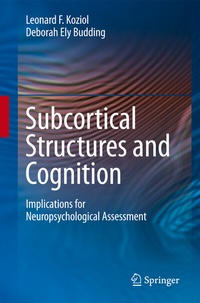
Subcortical Structures and Cognition
Description

Reviews / Votes
From the reviews: "Given its broad coverage and the clarity of writing, it should be very valuable for graduate students and in courses. This book opens the door to creativity by inviting neuropsychologists to develop new methodologies of investigations, following the demonstration that the cortico-centric model of cognition is no longer tenable. The authors have made a great job in bringing complex issues into simple and meaningful lines." (M.-U. Manto, The Cerebellum, Published online: 10 September 2009) "Drs. Koziol and Budding have written a highly readable and thought-provoking book that will challenge the reader's current knowledge and help one to look beneath the surface. It is a must read for . neuropsychologist and should be on the reading list for every neuropsychology graduate student. . It is interesting to ponder . if this text becomes a standard in the neuropsychological training curriculum. . this book will assuredly give the reader a 'deeper' understanding of the brain." (William S. MacAllister, The Clinical Neuropsychologist , Issue 1-3, 2009) "This is a fine summary of a great deal of literature on the basal ganglia and cerebellum and of their intimate relationships with the cortical forebrain. ... This book applies a long overdue corrective to a discipline that in some sense has been blinded by the simplistic corticocentric view of brain function. If the book prompts neuropsychologists to read outside their traditionally rather constricted domains (the neuropsychological testing literature) and to more fully explore other domains of neuroscience, it will have performed a double service. I recommend it highly." (Douglas F. Watt, Harvard Medical School, Archives of Clinical Neuropsychology 25 (2010) 153-155)More details
Other editions
Additional editions
Persons
Dr. Leonard F. Koziol is a clinical psychologist with specialty board certifications in Neuropsychology and Pediatric Neuropsychology. He works with children, adolescents, and adults with attention or concentration problems, memory loss, or learning disabilities. Dr. Koziol has served as a forensic psychologist expert in legal proceedings. Dr. Koziol is currently part of the Clinical Faculty at Chicago Medical School, Finch University Hospital Clinic, North Chicago, IL; the Consulting Neuropsychology Faculty at Fielding Institute, Santa Barbara, CA; and the Adult Faculty at Illinois School of Professional Psychology, IL, from where he is also a Professional Psychology graduate. His awards include: Fellow, National Academy of Neuropsychology - 2004; and Fellow, American College of Professional Neuropsychology - 1995.
Deborah Ely Budding is a clinical neuropsychologist practicing in Southern California. She worked as a writer and editor prior to training as a psychologist and neuropsychologist. She specializes in evaluating children, adolescents and adults with neurodevelopmental disorders and has a particular interest in integrating emotional and cognitive, as well as conscious and unconscious aspects of function. She holds specialty board certifications in Neuropsychologyand Pediatric Neuropsychology.
