

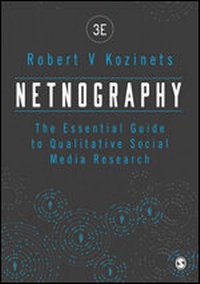
Netnography
The Essential Guide to Qualitative Social Media Research
3rd Edition
Published on 14. October 2019
472 pages
978-1-5264-8236-5 (ISBN)
Description

Netnography is an adaptation of ethnography for the online world, pioneered by Robert Kozinets, and is concerned with the study of online cultures and communities as distinct social phenomena, rather than isolated content. In this landmark third edition, Netnography: The Essential Guide provides the theoretical and methodological groundwork as well as the practical applications, helping students both understand and do netnographic research projects of their own.
Packed with enhanced learning features throughout, linking concepts to structured activities in a step by step way, the book is also now accompanied by a striking new visual design and further case studies, offering the essential student resource to conducting online ethnographic research. Real world examples provided demonstrate netnography in practice across the social sciences, in media and cultural studies, anthropology, education, nursing, travel and tourism, and others.
Packed with enhanced learning features throughout, linking concepts to structured activities in a step by step way, the book is also now accompanied by a striking new visual design and further case studies, offering the essential student resource to conducting online ethnographic research. Real world examples provided demonstrate netnography in practice across the social sciences, in media and cultural studies, anthropology, education, nursing, travel and tourism, and others.
Reviews / Votes
Netnography is a must-read for anyone engaged in or contemplating qualitative research on social media. Online behavior is at once a psychological, social, and technological phenomena, and qualitative approaches require both rigor and context, which Robert V. Kozinets offers in abundance. Both history and methodology are meticulously detailed in what ought to be a guidebook for social media researchers. -- Howard Rheingold If anyone had any doubt that this is the golden age for research, Rob Kozinets has made the case and provided the field guide that shows why this is so. Netnography is a fun locution for a big set of ideas about how to exploit new research methods to explore the biggest social, political and economic issues of our time. -- Lee Rainie Robert Kozinets knows his stuff: over the past 25 years, he has almost single-handedly established netnography as a methodological framework for qualitative Internet research. This third edition of his essential guide to netnographic research practices provides a very welcome update to the framework, taking in even more of the complex and ever-changing landscape of current social media platforms and their uses, and offering a wealth of ideas for working with qualitative social media data. Whether they're already calling themselves netnographers or have yet to discover the field, this book will inspire and enable many more researchers to investigate social media practices from a qualitative perspective. -- Axel Bruns Netnography introduces researchers to the complex social system of people, spaces, and tool interactions existing in social media. Netnographic practices detail ways of understanding and engaging with communities considering the necessary ethics of digital qualitative research. The newest edition includes contemporary examples to support critical methodologies for understanding digital interactions. -- A. Nicole PfannenstielMore details
Edition
Third Edition
Language
English
Place of publication
London
United Kingdom
Target group
College/higher education
ISBN-13
978-1-5264-8236-5 (9781526482365)
Copyright in bibliographic data and cover images is held by Nielsen Book Services Limited or by the publishers or by their respective licensors: all rights reserved.
Schweitzer Classification
Other editions
Additional editions
Book
10/2019
3rd Edition
SAGE Publications Ltd
€57.98
Shipment within 15-20 days
Book
10/2019
3rd Edition
SAGE Publications Ltd
€194.60
Shipment within 15-20 days
Person
Robert Kozinets is the Jayne and Hans Hufschmid Chair of Strategic Public Relations and Business Communication at the University of Southern California's Annenberg School for Communication and Journalism and Marshall School of Business. An academic whose methods and theories are widely used by researchers, in classrooms, and in industry, he has taught digital methods to some of the world's best students and consulted with a range of highly respected global organizations.
Content
Chapter 1: Introducing: Netnography, Qualitative Social Media Research Methods, and This Book
Chapter 2: A History of Social Media
Chapter 3: Media: Communicating and Connecting in the 21st Century
Chapter 4: Socialities: All the Ways We Connect
Chapter 5: Praxis: Introducing Practices and Data Operations
Chapter 6: Ethics: Procedures and Flowcharts, Updates and Rules
Chapter 7: Data: The Methodology of Netnographic Data Collection
Chapter 8: Investigating: Five Steps to Social Media Data Collection
Chapter 9: Interacting: Turning Connection and Communication into Research Data
Chapter 10: Immersing: Journaling and Organizing a Reflective Curation
Chapter 11: Integrating: Combining Telescopic and Microscopic Understandings
Chapter 12: Analyzing: Elemental Data Transformation Operations
Chapter 13: Interpreting: How to Discover and Make Meaning from Netnographic Data
Chapter 14: Communicating: Presenting and Publishing Your Netnography
Chapter 15: The Future of Netnography
Chapter 2: A History of Social Media
Chapter 3: Media: Communicating and Connecting in the 21st Century
Chapter 4: Socialities: All the Ways We Connect
Chapter 5: Praxis: Introducing Practices and Data Operations
Chapter 6: Ethics: Procedures and Flowcharts, Updates and Rules
Chapter 7: Data: The Methodology of Netnographic Data Collection
Chapter 8: Investigating: Five Steps to Social Media Data Collection
Chapter 9: Interacting: Turning Connection and Communication into Research Data
Chapter 10: Immersing: Journaling and Organizing a Reflective Curation
Chapter 11: Integrating: Combining Telescopic and Microscopic Understandings
Chapter 12: Analyzing: Elemental Data Transformation Operations
Chapter 13: Interpreting: How to Discover and Make Meaning from Netnographic Data
Chapter 14: Communicating: Presenting and Publishing Your Netnography
Chapter 15: The Future of Netnography
