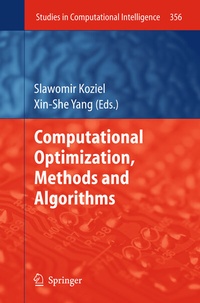
Computational Optimization, Methods and Algorithms
Description

Computational optimization is an important paradigm with a wide range of applications. In virtually all branches of engineering and industry, we almost always try to optimize something - whether to minimize the cost and energy consumption, or to maximize profits, outputs, performance and efficiency. In many cases, this search for optimality is challenging, either because of the high computational cost of evaluating objectives and constraints, or because of the nonlinearity, multimodality, discontinuity and uncertainty of the problem functions in the real-world systems. Another complication is that most problems are often NP-hard, that is, the solution time for finding the optimum increases exponentially with the problem size. The development of efficient algorithms and specialized techniques that address these difficulties is of primary importance for contemporary engineering, science and industry.
This book consists of 12 self-contained chapters, contributed from worldwide experts who are working in these exciting areas. The book strives to review and discuss the latest developments concerning optimization and modelling with a focus on methods and algorithms for computational optimization. It also covers well-chosen, real-world applications in science, engineering and industry. Main topics include derivative-free optimization, multi-objective evolutionary algorithms, surrogate-based methods, maximum simulated likelihood estimation, support vector machines, and metaheuristic algorithms. Application case studies include aerodynamic shape optimization, microwave engineering, black-box optimization, classification, economics, inventory optimization and structural optimization. This graduate level book can serve asan excellent reference for lecturers, researchers and students in computational science, engineering and industry.
More details
Other editions
Additional editions