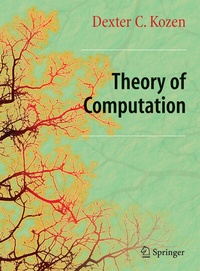
Theory of Computation
Description

This textbook is uniquely written with dual purpose. It covers core material in the foundations of computing for graduate students in computer science and also provides an introduction to some more advanced topics for those intending further study in the area. The book contains an invaluable collection of lectures for first-year graduates on the theory of computation, focusing primarily on computational complexity theory. It also deals with the classification of computational problems in terms of their inherent complexity.
It incorporates rigorous treatment of computational models, such as deterministic, nondeterministic, and alternating Turing machines; circuits; probabilistic machines; interactive proof systems; automata on infinite objects; and logical formalisms. Features include more than 40 lectures for first year graduate students, and a dozen homework sets and exercises. The book is aimed at advanced undergraduates and first-year graduates in Computer Science or Mathematics.
Reviews / Votes
From the reviews:
"This book represents the lecture notes of Dexter Kozen for the first-year graduate students in computer science at Cornell University. The book contains 41 primary lectures and 10 supplementary lectures covering more specialized and advanced topics. There are also 12 homework sets and several miscellaneous homework exercises . many with hints and complete solutions. . there is a bibliography of 127 titles. The book contains a very useful list of notations and abbreviations and an index." (Daniela Marinescu, Zentralblatt MATH, Vol. 1102 (4), 2007)
"The book is a collection of lecture notes based on a one-semester course for first-year graduate students in computer science at Cornell . . The course serves a dual purpose: to cover material in the foundations of computing for graduate students in computer science preparing for their Ph.D. qualifying exams, and to provide an introduction to some more advanced topics in the theory of computational complexity for those intending to pursue further study in the area." (Ulrich Tamm, Mathematical Reviews, Issue 2007 f)
"This textbook covers topics essential to the theory of computation. . In short, this is an interesting and enjoyable book that is strongly recommended to people who appreciate accuracy and concision. It will surely be an important textbook on the theory of computation for years to come. The intended audience is advanced undergraduate and first-year graduate students in computer science. It could also be useful to computer scientists with an interest in the foundation of computing and computational complexity." (G. Ciobanu, Computing Reviews, Vol. 49 (5), May, 2008)
"Kozen does a great job of explaining the material. The book is a continuation of the author's excellent work in the field. The 12 homework sets, along with several miscellaneous problem sets, make this book an excellent pedagogical option for the classroom." (Hector Zenil,ACM Computing Reviews, Vol. 49 (9), September 2008)
More details
Other editions
Additional editions