

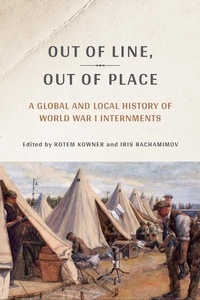
Out of Line, Out of Place
Description

With expert scholars and great sensitivity, Out of Line, Out of Place illuminates and analyzes how the proliferation of internment camps emerged as a biopolitical tool of governance. Although the internment camp developed as a technology of containment, control, and punishment in the latter part of the nineteenth century mainly in colonial settings, it became universal and global during the Great War.
Mass internment has long been recognized as a defining experience of World War II, but it was a fundamental experience of World War I as well. More than eight million soldiers became prisoners of war, more than a million civilians became internees, and several millions more were displaced from their homes, with many placed in securitized refugee camps. For the first time, Out of Line, Out of Place brings these different camps together in conversation. Rotem Kowner and Iris Rachamimov emphasize that although there were differences among camps and varied logic of internment in individual countries, there were also striking similarities in how camps operated during the Great War.
More details
Other editions
Additional editions
Persons
Rotem Kowner is Professor of History and Japanese Studies at the University of Haifa. He is the author of From White to Yellow and Tsushima.
Iris Rachamimov is Associate Professor of History at Tel Aviv University. She is the author of POWs and the Great War.
Content
Introduction: Military, Civilian, and Political Internments: Examining Great War Internments Together, by Iris Rachamimov and Rotem Kowner
Part I: Internments in Europe
1. (Dis)entangling the Local, the National, and the International: Civilian Internment in Germany and in German-Occupied France and Belgium in Global Context, by Matthew Stibbe
2. The Captives of the Kaiser: Schutzhaft and Political Prisoners in Germany, by André Keil
3. Securitized Protection: Health Work in Wartime Austria-Hungary and the Making of Refugee Camps, by Doina Anca Cretu
4. Alexandra Palace: A Concentration Camp in the Heart of London, by Assaf Mond
5. Prisoner-of-War Civilian Experience: The Role of Profession among POWs, by Lena Radauer
6. The Face and Race of the Enemy: German POW Photographs as a Weapon of War, by Nancy Fitch
Part II: Internments Beyond Europe
7. "Enemies of Our Country": Internment in Canada's Rocky Mountains National Park, 1915-1917, by Bohdan S. Kordan
8. Globalizing Captivity: "Little Germany in China", by Naoko Shimazu
9. German Propaganda and the African and Asian Theaters of the War, by Mahon Murphy
Part III: Interwar Repurcussions and Beyond
10. Internment after the War's End: "Humanitarian Camps" in the POW Repatriation Process, 1918-1923, by Hazuki Tate
11. POWs, Civilians, and the Postwar Development of International Humanitarian Law, by Neville Wylie and Sarina Landefeld
Conclusion: World War I and Its Internments: Final Remarks, by Iris Rachamimov and Rotem Kowner
