

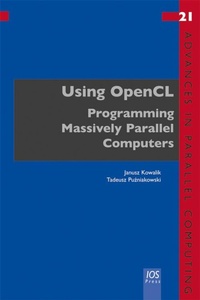
Using OpenCL
Programming Massively Parallel Computers
1st Edition
Published on 15. February 2012
312 pages
978-1-61499-030-7 (ISBN)
Description

In 2011 many computer users were exploring the opportunities and the benefits of the massive parallelism offered by heterogeneous computing. In 2000 the Khronos Group, a not-for-profit industry consortium, was founded to create standard open APIs for parallel computing, graphics and dynamic media. Among them has been OpenCL, an open system for programming heterogeneous computers with components made by multiple manufacturers. This publication explains how heterogeneous computers work and how to program them using OpenCL. It also describes how to combine OpenCL with OpenGL for displaying graphical effects in real time. Chapter 1 describes briefly two older de facto standard and highly successful parallel programming systems: MPI and OpenMP. Collectively, the MPI, OpenMP, and OpenCL systems cover programming of all major parallel architectures: clusters, shared-memory computers, and the newest heterogeneous computers. Chapter 2, the technical core of the book, deals with OpenCL fundamentals: programming, hardware, and the interaction between them. Chapter 3 adds important information about such advanced issues as double-versus-single arithmetic precision, efficiency, memory use, and debugging. Chapters 2 and 3 contain several examples of code and one case study on genetic algorithms. These examples are related to linear algebra operations, which are very common in scientific, industrial, and business applications. Most of the book's examples can be found on the enclosed CD, which also contains basic projects for Visual Studio, MinGW, and GCC. This supplementary material will assist the reader in getting a quick start on OpenCL projects.
More details
Series
Language
English
Place of publication
London
Netherlands
Publishing group
IOS Press
Target group
Professional and scholarly
File size
3,41 MB
ISBN-13
978-1-61499-030-7 (9781614990307)
Copyright in bibliographic data and cover images is held by Nielsen Book Services Limited or by the publishers or by their respective licensors: all rights reserved.
Schweitzer Classification
Other editions
Additional editions
Book
02/2012
1st Edition
IOS Press,US
€170.84
Article exhausted; check different version
Content
- Title Page
- Preface
- Contents
- Introduction
- Existing Standard Parallel Programming Systems
- MPI
- OpenMP
- Two Parallelization Strategies: Data Parallelism and Task Parallelism
- Data Parallelism
- Task Parallelism
- Example
- History and Goals of OpenCL
- Origins of Using GPU in General Purpose Computing
- Short History of OpenCL
- Heterogeneous Computer Memories and Data Transfer
- Heterogeneous Computer Memories
- Data Transfer
- The Fourth Generation CUDA
- Host Code
- Phase a. Initialization and Creating Context
- Phase b. Kernel Creation, Compilation and Preparations for Kernel Execution
- Phase c. Creating Command Queues and Kernel Execution
- Finalization and Releasing Resource
- Applications of Heterogeneous Computing
- Accelerating Scientific/Engineering Applications
- Conjugate Gradient Method
- Jacobi Method
- Power Method
- Monte Carlo Methods
- Conclusions
- Benchmarking CGM
- Introduction
- Additional CGM Description
- Heterogeneous Machine
- Algorithm Implementation and Timing Results
- Conclusions
- OpenCL Fundamentals
- OpenCL Overview
- What is OpenCL
- CPU + Accelerators
- Massive Parallelism Idea
- Work Items and Workgroups
- OpenCL Execution Model
- OpenCL Memory Structure
- OpenCL C Language for Programming Kernels
- Queues, Events and Context
- Host Program and Kernel
- Data Parallelism in OpenCL
- Task Parallelism in OpenCL
- How to Start Using OpenCL
- Header Files
- Libraries
- Compilation
- Platforms and Devices
- OpenCL Platform Properties
- Devices Provided by Platform
- OpenCL Platforms - C++
- OpenCL Context to Manage Devices
- Different Types of Devices
- CPU Device Type
- GPU Device Type
- Accelerator
- Different Device Types - Summary
- Context Initialization - by Device Type
- Context Initialization - Selecting Particular Device
- Getting Information about Context
- OpenCL Context to Manage Devices - C++
- Error Handling
- Checking Error Codes
- Using Exceptions - Available in C++
- Using Custom Error Messages
- Command Queues
- In-order Command Queue
- Out-of-order Command Queue
- Command Queue Control
- Profiling Basics
- Profiling Using Events - C example
- Profiling Using Events - C++ example
- Work-Items and Work-Groups
- Information About Index Space from a Kernel
- NDRange Kernel Execution
- Task Execution
- Using Work Offset
- OpenCL Memory
- Different Memory Regions - the Kernel Perspective
- Relaxed Memory Consistency
- Global and Constant Memory Allocation - Host Code
- Memory Transfers - the Host Code
- Programming and Calling Kernel
- Loading and Compilation of an OpenCL Program
- Kernel Invocation and Arguments
- Kernel Declaration
- Supported Scalar Data Types
- Vector Data Types and Common Functions
- Synchronization Functions
- Counting Parallel Sum
- Parallel Sum - Kernel
- Parallel Sum - Host Program
- Structure of the OpenCL Host Program
- Initialization
- Preparation of OpenCL Programs
- Using Binary OpenCL Programs
- Computation
- Release of Resources
- Structure of OpenCL host Programs in C++
- Initialization
- Preparation of OpenCL Programs
- Using Binary OpenCL Programs
- Computation
- Release of Resources
- The SAXPY Example
- Kernel
- The Example SAXPY Application - C Language
- The example SAXPY application - C++ language
- Step by Step Conversion of an Ordinary C Program to OpenCL
- Sequential Version
- OpenCL Initialization
- Data Allocation on the Device
- Sequential Function to OpenCL Kernel
- Loading and Executing a Kernel
- Gathering Results
- Matrix by Vector Multiplication Example
- The Program Calculating matrix times vector
- Performance
- Experiment
- Conclusions
- Advanced OpenCL
- OpenCL Extensions
- Different Classes of Extensions
- Detecting Available Extensions from API
- Using Runtime Extension Functions
- Using Extensions from OpenCL Program
- Debugging OpenCL codes
- Printf
- Using GDB
- Performance and Double Precision
- Floating Point Arithmetics
- Arithmetics Precision - Practical Approach
- Profiling OpenCL Application
- Using the Internal Profiler
- Using External Profiler
- Effective Use of Memories - Memory Access Patterns
- Matrix Multiplication - Optimization Issues
- OpenCL and OpenGL
- Extensions Used
- Libraries
- Header Files
- Common Actions
- OpenGL Initialization
- OpenCL Initialization
- Creating Buffer for OpenGL and OpenCL
- Kernel
- Generating Effect
- Running Kernel that Operates on Shared Buffer
- Results Display
- Message Handling
- Cleanup
- Notes and Further Reading
- Case Study - Genetic Algorithm
- Historical Notes
- Terminology
- Genetic Algorithm
- Example Problem Definition
- Genetic Algorithm Implementation Overview
- OpenCL Program
- Most Important Elements of Host Code
- Summary
- Experiment Results
- Comparing CUDA with OpenCL
- Introduction to CUDA
- Short CUDA Overview
- CUDA 4.0 Release and Compatibility
- CUDA Versions and Device Capability
- CUDA Runtime API Example
- CUDA Program Explained
- Blocks and Threads Indexing Formulas
- Runtime Error Handling
- CUDA Driver API Example
- Theoretical Foundations of Heterogeneous Computing
- Parallel Computer Architectures
- Clusters and SMP
- DSM and ccNUMA
- Parallel Chip Computer
- Performance of OpenCL Programs
- Combining MPI with OpenCL
- Matrix Multiplication - Algorithm and Implementation
- Matrix Multiplication
- Implementation
- OpenCL Kernel
- Initialization and Setup
- Kernel Arguments
- Executing Kernel
- Using Examples Attached to the Book
- Compilation and Setup
- Linux
- Windows
- Bibliography and References
