

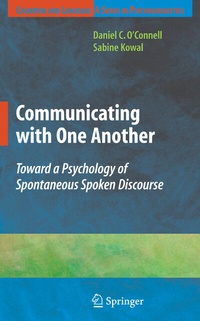
Communicating with One Another
Description

In contrast to traditional approaches of mainstream psycholinguists, the authors of Communicating with One Another approach spontaneous spoken discourse as a dynamic process, rich with structures, patterns, and rules other than conventional grammar and syntax. Daniel C. O'Connell and Sabine Kowal thoroughly critique mainstream psycholinguistics, proposing instead a shift in theoretical focus from experimentation to field observation, from monologue to dialogue, and from the written to the spoken. They invoke four theoretical principles: intersubjectivity, perspectivity, open-endedness, and verbal integrity. Their analyses of historical and original research raise significant questions about the relationship between spoken and written discourse, particularly with regard to transcription and punctuation. With emphasis on political discourse, media interviews, and dramatic performance, the authors review both familiar and unexplored characteristics of spontaneous spoken communication, including: (1) The speaker's use of prosody. (2) The functions of interjections. (3) What fillers do for a living. (4) Turn-taking: Smooth and otherwise. (5) Laughter, applause, and booing: from individual listener to collective audience. (6) Pauses, silence, and the art of listening.
The paradigm shift proposed in Communicating with One Another will interest and provoke readers concerned about communicative language use - including psycholinguists, sociolinguists, and anthropological linguists.
More details
Other editions
Additional editions
Person
The authors are experimental psychologists who have been engaged in research together for 40 years now. Dan O'Connell studied at St. Louis University and did doctoral work at the University of Illinois (Champaign/Urbana), Sabine Kowal studied at the Free University of Berlin and did doctoral work at St. Louis University. O'Connell's career was at St. Louis, Loyola of Chicago, and Georgetown Universities, while Kowal's was at both the Technical University of Berlin and the Anna Freud Oberschule in Berlin. For many years, the team was oriented toward mainstream psycholinguistics and experimental research on speech production. Throughout the last decades of the 20th century, their interest shifted to spontaneous spoken discourse under field observational conditions. This shift had as its origin their observation that professional speakers known for their eloquence in public dialogue violate both ideal delivery and syntactic well-formedness - concepts established in mainstream psycholinguistics as norms for effective communication. O'Connell and Kowal have ascribed the use of these norms to a written language bias and have accordingly turned their attention - both empirically and theoretically -- to the use of genuine spoken discourse. Radio and TV political interviews have provided much of the empirical data base for their recent research, and their emphasis on spontaneous spoken discourse has led to the investigation of neglected speech phenomena such as fillers, pauses, interjections, and laughter in both English- and German-language corpora.
