

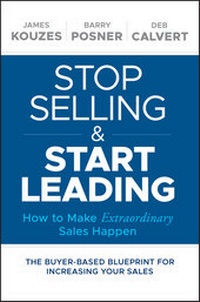
Stop Selling and Start Leading
Description

NAMED THE #3 TOP SALES BOOK OF 2018! Make extraordinary sales happen!
In the Age of the Customer, sales effectiveness depends mightily on the buyer experience. Despite nearly-universal agreement on the need for creating value in every step of the buyer's journey, sellers continue to struggle with how to create that value and connect meaningfully with buyers. New research bridges the gap and reveals the behavioral blueprint for sellers that makes buyers more likely to meet with them - and more likely to buy from them.
In Stop Selling & Start Leading, you'll discover that the very same behaviors that make leaders more effective also work to make sellers more effective, too. This critical shift in the selling mindset, and in the sales role itself, is the key to boosting your overall sales effectiveness.
. Inspire, challenge, and enable buyers . Change your behavior to build trust and increase sales . Step into your leadership potential . See yourself the way your buyers do . Feel good about selling again
When you're aiming for quota attainment and real connections with buyers, this book gives you the confidence and skills you need.
More details
Other editions
Additional editions
Persons
JAMES M. KOUZES is the Dean's Executive Fellow of Leadership, Leavey School of Business, Santa Clara University, and according to the Wall Street Journal, one of the twelve best executive educators in the United States.
BARRY Z. POSNER, PhD, is the Accolti Endowed Professor of Leadership at the Leavey School of Business, Santa Clara University, where he served for twelve years as Dean of the School.
DEB CALVERT is the founder of People First Productivity Solutions and The Sales Experts Channel, and author of one of HubSpot's "Top 20 Most Highly Rated Sales Books of All Time."
Content
INTRODUCTION: HOW YOU MAKE EXTRAORDINARY SALES HAPPEN 1
WHAT IF SELLERS BEHAVED AS LEADERS? 7
CHAPTER ONE: WHEN SELLERS ARE AT THEIR BEST 9
Redefining the B2B Buyer Experience 10
More of the Same Behaviors Results in More of the Same Reactions 10
Something Different, but What? 10
Lessons from the B2C Customer Experience 13
Meeting the Preferences of Today's Buyers 14
Research Provides a Behavioral Blueprint 15
Findings and Implications 16
The Five Practices of Exemplary Leadership 17
Model the Way 18
Inspire a Shared Vision 19
Challenge the Process 20
Enable Others to Act 20
Encourage the Heart 21
It's Time for Real Change 22
CHAPTER TWO: CREDIBILITY IS THE FOUNDATION OF BOTH LEADERSHIP AND MAKING THE SALE 23
Stereotypical Sales Behaviors Diminish Seller Credibility 24
Credibility Makes a Difference 25
The Prescription for Strengthening Your Personal Credibility 28
PRACTICE 1: MODEL THE WAY 31
CHAPTER THREE: CLARIFY VALUES 33
Find Your Voice 34
Affirm Shared Values 38
Take Action: Clarify Values 44
CHAPTER FOUR: SET THE EXAMPLE 45
Live the Shared Values 47
Teach Others to Model the Values 52
Take Action: Set the Example 57
PRACTICE 2: INSPIRE A SHARED VISION 59
CHAPTER FIVE: ENVISION THE FUTURE 61
Imagine the Possibilities 63
Find a Common Purpose 68
Take Action: Envision the Future 72
CHAPTER SIX: ENLIST OTHERS 73
Appeal to Common Ideals 75
Animate the Vision 79
Take Action: Enlist Others 84
PRACTICE 3: CHALLENGE THE PROCESS 85
CHAPTER SEVEN: SEARCH FOR OPPORTUNITIES 87
Seize the Initiative 90
Exercise Outsight 93
Take Action: Search for Opportunities 99
CHAPTER EIGHT: EXPERIMENT AND TAKE RISKS 101
Generate Small Wins 103
Learn from Experience 107
Take Action: Experiment and Take Risks 112
PRACTICE 4: ENABLE OTHERS TO ACT 113
CHAPTER NINE: FOSTER COLLABORATION 115
Create a Climate of Trust 118
Facilitate Relationships 124
Take Action: Foster Collaboration 128
CHAPTER TEN: STRENGTHEN OTHERS 129
Develop Competence and Confidence 133
Take Action: Strengthen Others 139
PRACTICE 5: ENCOURAGE THE HEART 141
CHAPTER ELEVEN: RECOGNIZE CONTRIBUTIONS 143
Expect the Best 145
Personalize Recognition 150
Take Action: Recognize Contributions 155
CHAPTER TWELVE: CELEBRATE THE VALUES AND VICTORIES 157
Create a Spirit of Community 160
Be Personally Involved 164
Take Action: Celebrate the Values and the Victories 169
CHAPTER THIRTEEN: LEADERSHIP IS EVERYONE'S BUSINESS 171
SOURCES AND NOTES 179
Introduction: How You Make Extraordinary Sales Happen 179
Chapter 1: When Sellers Are at Their Best 179
Chapter 2: Credibility Is the Foundation of Both Leadership and Making the Sale 180
Chapter 3: Clarify Values 181
Chapter 4: Set the Example 181
Chapter 5: Envision the Future 182
Chapter 6: Enlist Others 182
Chapter 7: Search for Opportunities 183
Chapter 8: Experiment and Take Risks 183
Chapter 9: Foster Collaboration 184
Chapter 10: Strengthen Others 185
Chapter 11: Recognize Contributions 186
Chapter 12: Celebrate the Values and Victories 186
Chapter 13: Leadership Is Everyone's Business 188
Acknowledgments 189
About the Authors 191
Index 197
Introduction:
How You Make Extraordinary Sales Happen
STOP SELLING & START LEADING is a book about how to make more sales. How? Our research shows you can make more sales by abandoning sales-y behaviors buyers resist and replacing them with leadership behaviors buyers desire. This book is about the extraordinary things sellers do when they stop pushing people to buy before they're ready, and they start guiding buyers by transforming values into actions, visions into realities, obstacles into innovations, separateness into solidarity, and risks into rewards. Stop Selling & Start Leading is about ennobling the sales profession and dignifying buyers, a shift that turns tedious transactions into exciting customer experiences.
This book is focused as much on buyers as it is on sellers, which represents a truth every exemplary leader understands: it's not about you, it's about your constituents-their needs, hopes, dreams, and aspirations-and leaders can't make anything happen all by themselves. Today buyers have enormous power and information and more choices than ever before. They dodge sellers, delay decisions, demand price concessions, and expect more but give less. Buyers scarcely tolerate sellers and often unfairly stereotype them, erecting barriers to entry without giving sellers a fair chance.
Stop Selling & Start Leading is aimed directly at sellers. It's for sellers who work diligently but still struggle to mobilize buyers and meet ever-increasing quotas. It's for sellers who face buyer cynicism, despite their best efforts to differentiate themselves and their sincere intent to help their buyers. This is a book for sellers who are looking for ways to build relationships with buyers and to succeed in reaching mutual goals.
This is also a book about leadership. Leadership is not a formal position or an official place in the organizational hierarchy. Leadership is not a genetic trait or limited by gender, ethnic or racial background, family or social status, appearance, or nationality. Leadership is an observable and learnable set of skills and abilities that is accessible to everyone. Research clearly shows that in the highest performing organizations leadership is everyone's business.1 Similarly, evidence abounds that the most exemplary sellers engage most frequently in the practices of leadership. Leaders, like extraordinary sellers, are change brokers. They are guides who show people the way from where they are now to where they aspire to be in the future. Leaders make extraordinary things happen. We believe you can, too.
When you lay down your old-school selling behaviors and mindset, buyers will see you as something more than the stereotypical fast-talking, high-pressure, know-it-all seller. When you choose, instead, to behave as a leader, buyers will respond favorably. Buyers will want you to lead them to an ideal place.
How do we know what behaviors buyers want to see from sellers? We asked them. Our groundbreaking research with more than five hundred B2B buyers provides a blueprint of behaviors sellers can follow to book more meetings and close more sales. We also asked hundreds of sellers to tell us stories about their own personal-best experiences in selling. In story after story, the same behaviors appeared. Sellers succeeded the most when they demonstrated behaviors associated with leadership.
Our research with buyers and sellers is new and reveals some surprising findings; however, the research we'll share about leadership is not new. Long before we asked buyers to tell us what behaviors they wanted to see more frequently from sellers, Jim and Barry started conducting research with leaders from around the world, in every industry and discipline. Their research pinpoints the behaviors exhibited by people when they were at their personal best as leaders-when they made extraordinary things happen. It also shows the impact of these behaviors on constituent engagement. In other words, we know through this research what makes leadership effective. Jim and Barry call this framework The Five Practices of Exemplary Leadership®, and it consists of ten leadership commitments.2
The Five Practices gave us a great starting point and foundation for investigating the relationships between sellers and buyers. In our research with buyers, we asked what would happen if sellers exhibited these same leadership behaviors in their relationship with buyers. We also asked how frequently sellers already behave in these ways and how often buyers would ideally like to see these behaviors used by sellers. The findings make a compelling case for a behavioral shift. Sales effectiveness, like leadership effectiveness, can be significantly increased by choosing to behave differently.
We use the terms buyers, sellers, leaders, and behaviors deliberately throughout this book. Buyers is used to represent all people at all phases of the sales cycle, from suspects to prospects to clients. Sellers refers to everyone who sells, regardless of role, from Sales Development Rep to Major Accounts Manager. Leaders refers to everyone who makes a choice to lead. This word is not intended to suggest a management-level role in the organization. We're using the word leader to talk about you, a seller, who decides to utilize the behaviors of exemplary leadership when working with your buyers. Finally, we talk a great deal in this book about behaviors, the actions people perform when they are leading. That's because the actions you take matter much more than what you think, feel, say, or intend.
As you read sellers' stories and buyers' comments, you'll get first-hand examples of how to modify your behaviors to be more effective with buyers. You'll see what it means to become an exemplary seller who guides buyers to a better place.
In Chapter One we review shifts in buyer desires and demands. We identify the five buyer preferences that originally led to our hypothesis that sellers would be more successful if they replaced traditional selling behaviors with the behaviors of exemplary leaders. This is where you'll find a deeper dive into the research that proved this hypothesis.
Selling, like leading, is based on relationships with people. To go straight to the core of what people need in order to follow someone willingly, we devote Chapter Two to a single characteristic that is the cornerstone of leadership: credibility. It's also the one characteristic that buyers most emphatically told us was lacking in sellers. We describe what it is, why it matters so much, and how buyers assess-beginning with the first encounter-whether a seller has this essential quality.
The ten chapters that follow describe the Ten Commitments of Leadership-the essential behaviors that leaders employ to make extraordinary things happen-and explain what sellers must do to shift their behaviors within each of The Five Practices. Stories from sellers describing their personal bests provide examples of these Ten Commitments in action, and buyers' comments magnify the key points. Evidence from our studies and sellers' reports make the case for adopting these behaviors. Each of these leadership practice sections ends with ideas for you to Take Action, suggestions you can implement immediately to liberate the leader inside you. None of the recommendations in this book requires a budget, hierarchical approval, or organization-wide change. All that's required is your commitment and discipline. It's all up to you.
In Chapter Thirteen, we talk more about that choice. Your choice. We call on every seller to be a leader, to rise to the challenge of becoming the leader that buyers are looking for. Sellers shouldn't feel ashamed of the work they do and the profession they represent. You can choose to shed the stereotypes and become a different kind of seller, one who leads with pride and serves as a partner with buyers.
We recommend you first read Chapter One for the background information. As you do, think about the reception you've had from buyers and put yourself in their shoes. Consider the case for changing your behavior. When you're ready to take the plunge, move on to Chapter Two to understand why this behavioral shift is critical. As you proceed through the remaining chapters, look for ways to become a leader with your buyers, with your internal partners, and even with yourself. Even though buyers rank some leadership practices as more important than others, remember that buyers want to see something more or different from sellers in every one of the practices. Each leadership practice and commitment is essential.
Your buyers are eager to see you make these changes. The sales profession needs more people to step into their full leadership potential. The world beyond selling needs leaders, too, in every sector, in every community, in every country. We need extraordinary leadership, and we need people to provide leadership now more than ever. There is so much amazing work yet to do. We need leaders who can ignite and unite us.
When you stop selling and start leading, buyers will respond. You will, too. Becoming a leader is one of the noblest and most energizing things you will ever do. We fervently hope this book will enrich your life and the lives of your buyers, your family, your colleagues, and your community. Are you ready?
James Kouzes
Orinda,...
