

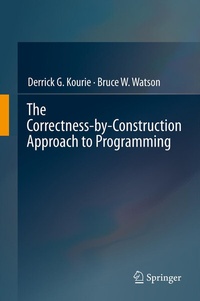
The Correctness-by-Construction Approach to Programming
Description

The focus of this book is on bridging the gap between two extreme methods for developing software. On the one hand, there are texts and approaches that are so formal that they scare off all but the most dedicated theoretical computer scientists. On the other, there are some who believe that any measure of formality is a waste of time, resulting in software that is developed by following gut feelings and intuitions.
Kourie and Watson advocate an approach known as "correctness-by-construction," a technique to derive algorithms that relies on formal theory, but that requires such theory to be deployed in a very systematic and pragmatic way. First they provide the key theoretical background (like first-order predicate logic or refinement laws) that is needed to understand and apply the method. They then detail a series of graded examples ranging from binary search to lattice cover graph construction and finite automata minimization in order to show how it can be applied to increasingly complex algorithmic problems.
The principal purpose of this book is to change the way software developers approach their task at programming-in-the-small level, with a view to improving code quality. Thus it coheres with both the IEEE's Guide to the Software Engineering Body of Knowledge (SWEBOK) recommendations, which identifies themes covered in this book as part of the software engineer's arsenal of tools and methods, and with the goals of the Software Engineering Method and Theory (SEMAT) initiative, which aims to "refound software engineering based on a solid theory."Reviews / Votes
"This book is a must-read for every computer science student and every computing professional involved in software development. Based on a set of simple but powerful formal rules originally invented by computing pioneers E. W. Dijkstra and C. A. R. Hoare, the authors introduce the reader to the development of elegant and provably correct software. By emphasizing construction with a priori built-in correctness, the book goes one decisive step beyond formal verification. The goal is ambitious but the authors fully deliver. With a minimum of formalistic overhead, they walk the reader through a series of carefully chosen examples and use cases, thereby gradually unleashing the full power of the methodology. The book´s main merit, however, lies in the fact that it convincingly disproves the common belief that formal methods are not practicable in the "real" world." (Jürg Gutknecht, ETH Zurich, Switzerland)
More details
Other editions
Additional editions
Persons
Derrick G. Kourie is a full professor in the Department of Computer Science at the University of Pretoria in South Africa. He has published extensively on software engineering, algorithm construction and analysis, and formal methods and specification languages. His goal is to combine theory and practice in a way that impacts the efficiency and effectiveness of the software process.
Bruce W. Watson is a full professor in the Department of Information Science at Stellenbosch University, and professor extraordinary at the University of Pretoria and director of the FASTAR (Finite Automata Systems - Theoretical and Applied Research) group, spanning the Netherlands, South Africa, the USA, and Finland. His research and development activities cover programming languages, automata and their applications, algorithms, parallelism, and reconfigurable computing.