

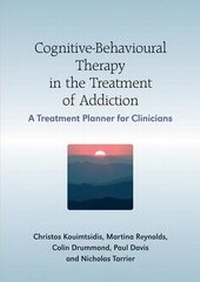
Cognitive-Behavioural Therapy in the Treatment of Addiction
Description

Reviews / Votes
"The manual provides comprehensive information regarding CBTapproaches to substance use ... .One of its strengths is thatthe authors propose that their model and techniques can betransferred to all substances." (Drug and Alcohol Review,January 2009) "This book is likely to be a well-used resource for cliniciansto establish individualized CBT treatments for all types ofaddiction." (Behavioural & Cognitive Psychotherapy, July2008) "I cannot praise this book highly enough. I would thinkthat anyone at whatever level of experience will gain somethingfrom the book." (Clinical Psychology Forum) "A comprehensive manual ... It provides clear guidelines andinformation in relation to addiction and CBT and is both useful andinformative." (Journal of Analytical Psychology)More details
Other editions
Additional editions
Persons
Martina Reynolds, MA, PhD, is a Senior Lecturer at the School of Social Sciences of Brunel University. Prior to this she was research lecturer in Addiction at St George's, University of London, where she developed her interest in the topic. She obtained her BA/MA in Psychology from the University of Oxford and her PhD from the University of London. She has extensive research experience and has published in the fields of substance use, trauma, post-traumatic stress disorders and depression. She has also convened and taught both undergraduate and postgraduate modules on addiction and related areas.
Colin Drummond, MBChB, MD, FRCPsych, is Professor of Addiction Psychiatry and Consultant Psychiatrist at St George's Hospital Medical School and South West London and Head of Addiction Behaviour at St George's NHS Trust, where he has been since 1993. Before that he was Lecturer and later Senior Lecturer in Addiction Behaviour at the Medical Research Council Addiction Research Unit, National Addiction Centre, Institute of Psychiatry from 1987.His doctorate was on the subject of alcohol and public health. He is Principal Investigator on several research grants including the Department ofHealth funded national alcohol needs assessment project and a new national research programme on screening and brief alcohol intervention, also funded by the Department of Health. Professor Drummond is also Assistant Editor of the journal Addiction.He has published papers on a wide range of topics including epidemiology, clinical trials, drug and alcohol policy and theories of craving. He leads the alcohol treatment service in South West London providing inpatient and community-based interventions. He has been closely involved in providing advice to government on alcohol and drug misuse strategy. He is a member of the Models of Care working group which has produced a national framework for drug and alcohol services in England. He is a member of the Faculty of Substance Misuse of the Royal College of Psychiatrists and served as the Academic Secretary. He is also the Director of the Specialist Clinical Addiction Network based at the National Treatment Agency. He is a member of the American Psychiatric Association/World Health Organization Substance Use Disorders Working Group on the fifth revision of the Diagnostic and Statistical Manual. He is also a member of the WHO Expert Committee on Drug Dependence and Alcohol Problems.
Paul Davis has worked in the NHS for over 30 years, the majority of which has been as a specialist clinician in alcohol and drug work. He is Consultant Clinical Psychologist and Honorary Senior Lecturer at University College London, and Camden and Islington Mental Health and Social Care Trust, London, where he is also Head of Substance Misuse Psychology Services. His clinical interests include the practice and development of cognitive and behavioural therapies with complex cases, and psychological assessment and management of patients with a dual diagnosis. His main areas of research have focused on evaluating the efficacy and effectiveness of NHS interventions in clinical settings, outcome monitoring, prevention outcome evaluation, forensic aspects of drug abuse and neuropsychological changes in people with drug addiction. Dr Davis is a practitioner and trainer in CBT and he has presented over 100 invited workshops in CBT and motivational interviewing (MI) applied in the field of substance misuse. He provides supervision and consultation in MI and CBT to health professionals from a number of NHS Trusts. He has co-authored and contributed to treatment research manuals in this field and has conducted treatment outcome trials on psychological interventions with problem drug and alcohol users. Dr Davis has served on the British Psychological Society Faculty of Addiction Committee for over 10 years and was Chair for several years. He is a National Assessor for Consultant Psychology posts in the NHS and has served on numerous national committees on substance misuse, most recently on the National Institute for Health and Clinical Excellence Guidance Development Groups in substance misuse.
Nicholas Tarrier is Professor of Clinical Psychology, Head of the Division of Clinical Psychology and Research Director of the School of Psychological Sciences, University of Manchester, UK, and Honorary Consultant Clinical Psychologist in the Manchester Mental Health and Social Care NHS Trust. He has held academic posts at universities in Brazil and Australia.He has a long-standing interest in the practice and evaluation of Cognitive-Behaviour Therapy and its application to a wide range of disorders.
