

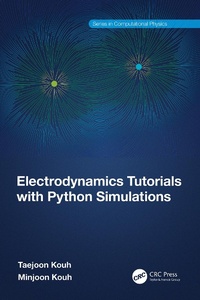
Electrodynamics Tutorials with Python Simulations
1st Edition
Published on 8. April 2024
294 pages
978-1-040-00931-4 (ISBN)
Description

This book provides an accessible introduction to intermediate-level electrodynamics with computa- tional approaches to complement a traditional mathematical treatment of the subject. It covers key topics in electrodynamics, such as electromagnetic fields, forces, potentials, and waves as well as Special Theory of Relativity.
Through intuition-building examples and visualizations in the Python programming language, it helps readers to develop technical computing skills in numerical and symbolic calculations, modeling and simulations, and visualizations. Python is a highly readable and practical programming language, making this book appropriate for students without extensive programming experience.
This book can serve as an electrodynamics textbook for undergraduate physics and engineering students in their second or third years, who are studying intermediate- or advanced-level electrodynamics and who want to learn techniques for scientific computing at the same time. This book will also appeal to computer science students who want to see how their computer programming skills may be applied to science, particularly to physics, without needing too much background physics knowledge.
Key features
Major concepts in classical electrodynamics are introduced cohesively through computational and mathematical treatments
Computational examples in Python programming language guide students on how to simulate and visualize electrodynamic principles and phenomena for themselves
Through intuition-building examples and visualizations in the Python programming language, it helps readers to develop technical computing skills in numerical and symbolic calculations, modeling and simulations, and visualizations. Python is a highly readable and practical programming language, making this book appropriate for students without extensive programming experience.
This book can serve as an electrodynamics textbook for undergraduate physics and engineering students in their second or third years, who are studying intermediate- or advanced-level electrodynamics and who want to learn techniques for scientific computing at the same time. This book will also appeal to computer science students who want to see how their computer programming skills may be applied to science, particularly to physics, without needing too much background physics knowledge.
Key features
Major concepts in classical electrodynamics are introduced cohesively through computational and mathematical treatments
Computational examples in Python programming language guide students on how to simulate and visualize electrodynamic principles and phenomena for themselves
More details
Series
Edition
1. Auflage
Language
English
Place of publication
London
United Kingdom
Publishing group
Taylor & Francis Ltd
Target group
College/higher education
Professional and scholarly
Illustrations
106 Line drawings, black and white; 4 Halftones, black and white; 110 Illustrations, black and white
ISBN-13
978-1-040-00931-4 (9781040009314)
Copyright in bibliographic data and cover images is held by Nielsen Book Services Limited or by the publishers or by their respective licensors: all rights reserved.
Schweitzer Classification
Other editions
Additional editions
Taejoon Kouh | Minjoon Kouh
Electrodynamics Tutorials with Python Simulations
Book
04/2024
1st Edition
CRC Press
€186.50
Shipment within 10-20 days
Taejoon Kouh | Minjoon Kouh
Electrodynamics Tutorials with Python Simulations
Book
04/2024
1st Edition
CRC Press
€73.80
Shipment within 10-20 days
Persons
Taejoon Kouh is a Professor of Nano and Electronic Physics at Kookmin University, Republic of Korea. He earned his B.A. in physics from Boston University and Sc.M. and Ph.D. degrees in physics from Brown University. After his study in Providence, RI, he returned to Boston, MA, and worked as a postdoctoral research associate in the Department of Aerospace and Mechanical Engineering at Boston University. He is a full faculty member in the Department of Nano and Electronic Physics at Kookmin University in Seoul, Korea, teaching and supervising undergraduate and graduate students. His current research involves the dynamics of nanoelectromechanical systems and the development of fast and reliable transduction methods and innovative applications based on tiny motion.
Minjoon Kouh is a program scientist for a philanthropic initiative. He was a Professor of Physics and Neuroscience at Drew University, USA, where he taught more than 30 distinct types of courses. He holds Ph.D. and B.S. degrees in physics from MIT and an M.A. from UC Berkeley. He completed a postdoctoral research fellowship at the Salk Institute for Biological Studies in La Jolla, CA. His research includes computational modeling of the primate visual cortex, information-theoretic analysis of neural responses, machine learning, and pedagogical innovations in undergraduate science education.
Minjoon Kouh is a program scientist for a philanthropic initiative. He was a Professor of Physics and Neuroscience at Drew University, USA, where he taught more than 30 distinct types of courses. He holds Ph.D. and B.S. degrees in physics from MIT and an M.A. from UC Berkeley. He completed a postdoctoral research fellowship at the Salk Institute for Biological Studies in La Jolla, CA. His research includes computational modeling of the primate visual cortex, information-theoretic analysis of neural responses, machine learning, and pedagogical innovations in undergraduate science education.
Content
Chapter 1: Hills and Valleys. Chapter 2: Vector. Chapter 3: Vector Field. Chapter 4: Electric Field. Chapter 5: Magnetic Field. Chapter 6: Force. Chapter 7: Special Relativity. Chapter 8: Potential. Chapter 9: Electromagnetic Induction. Chapter 10: Maxwell's Equations and Electromagnetic Wave. Appendix. Epilogue. Index.
