

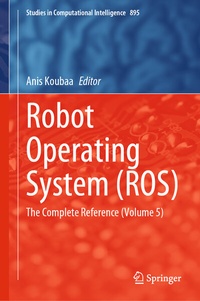
Robot Operating System (ROS)
Description

This book is the fifth volume in the successful book series Robot Operating System: The Complete Reference.
The objective of the book is to provide the reader with comprehensive coverage on the Robot Operating System (ROS), which is currently considered to be the primary development framework for robotics applications, and the latest trends and contributing systems.The content is divided into six parts. Pat I presents for the first time the emerging ROS 2.0 framework, while Part II focuses on multi-robot systems, namely on SLAM and Swarm coordination. Part III provides two chapters on autonomous systems, namely self-driving cars and unmanned aerial systems. In turn, Part IV addresses the contributions of simulation frameworks for ROS. In Part V, two chapters explore robotic manipulators and legged robots. Finally, Part VI presents emerging topics in monocular SLAM and a chapter on fault tolerance systems for ROS. Given its scope, the book will offer a valuable companion for ROS users and developers, helping them deepen their knowledge of ROS capabilities and features.
More details
Other editions
Additional editions
Person
Anis Koubaa is a Professor of Computer Science, Aide to the Rector of Research Governance, Director of the Research and Initiatives Center, and Leader of the Robotics and Internet of Things Research Lab, at Prince Sultan University. He is also an R&D Consultant at Gaitech Robotics in China and Senior Researcher in CISTER/INESC TEC and ISEP-IPP, Porto, Portugal. He has been the Chair of the ACM Chapter in Saudi Arabia since 2014. He is also a Senior Fellow of the Higher Education Academy (HEA) in the UK.
His current research deals with providing solutions for the integration of robots and drones into the Internet of Things (IoT) and clouds for deep learning applications. He has developed several real-world applications and prototypes such as Dronemap Planner, a cloud-based management system for drones and robots, and ROSLink, which is a messaging protocol for integrating the Robot Operating System with the IoT. His research interests also include the Robot Operating System (ROS), robotic software engineering, wireless communication for the IoT, real-time communication, safety and security for cloud robotics, intelligent algorithm design for mobile robots, and multi-robot task allocation.
Content
Development of an Industry 4.0 demonstrator using Sequence Planner and ROS2.- ROS2 for ROS1 users.- Multi-Robot SLAM framework for ROS with Efficient Information Sharing.- Agile experimentation of robot swarms in large scale.- Lessons learned building a self-driving car on top of ROS.- Landing a UAV on a moving platform using a front facing camera.- Integrating the Functional Mock-up Interface with ROS and Gazebo.- An ARVA sensor simulator.- ROS Implementation for Untethered Microrobot Manipulation.- ClegS: A package to develop C-legged robots.- Video frames selection method for 3D Reconstruction depending on ROS-based monocular SLAM.- ROS Rescue: Fault Tolerance System for ROS.
