

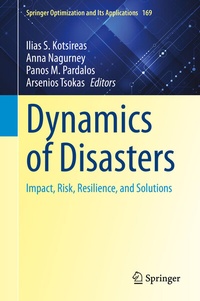
Dynamics of Disasters
Description

Based on the "Fourth International Conference on Dynamics of Disasters" (Kalamata, Greece, July 2019), this volume includes contributions from experts who share their latest discoveries on natural and unnatural disasters. Authors provide overviews of the tactical points involved in disaster relief, outlines of hurdles from mitigation and preparedness to response and recovery, and uses for mathematical models to describe natural and man-made disasters. Topics covered include economics, optimization, machine learning, government, management, business, humanities, engineering, medicine, mathematics, computer science, behavioral studies, emergency services, and environmental studies will engage readers from a wide variety of fields and backgrounds.
More details
Other editions
Additional editions
Persons
Anna Nagurney is the John F. Smith Memorial Professor in the Department of Operations and Information Management at the Isenberg School of Management at the University of Massachusetts Amherst and is also the Founding Director of the Virtual Center for Supernetworks. Anna received her AB, ScB, ScM, and PhD degrees from Brown University in Providence, Rhode Island. She is the author/co-author of over 190 refereed journal articles and 14 books and has been recognized for her research with honors and awards, including being elected an INFORMS Fellow in 2013 and an RSAI Fellow in 2007. She is the recipient of a 2016 INFORMS Volunteer Service Award for Distinguished Service, the 2007 WORMS Award, and the 2005 Moving Spirit Award of INFORMS. Anna has held a variety of visiting positions, including being a Science Fellow at the Radcliffe Institute for Advanced Study at Harvard University, a Visiting Fellow at All Souls College at Oxford University in the UK, a Visiting Professor at the University of Gothenburg and at the Royal Institute of Technology in Sweden. She has also been a Fulbrighter twice - in Austria and Italy and her research has received support from the National Science Foundation and the Rockefeller Foundation.
Panos M. Pardalos serves as distinguished professor of industrial and systems engineering at the University of Florida. Additionally, he is the Paul and Heidi Brown Preeminent Professor of industrial and systems engineering. Pardalos is also an affiliated faculty member of the computer and information science department, the Hellenic Studies Center, and the biomedical engineering program. Additionally, he serves as the director of the Center for Applied Optimization. Pardalos is a world leading expert in global and combinatorial optimization. His recent research interests include network design problems, optimization in telecommunications, e-commerce, data mining, biomedical applications, and massive computing. Pardalos is a prolific author who lectures all over the world. He is the recipient of a multitude of fellowships and awards, the most recent of which is the Humboldt Research Award (2018).
Content
Preface.- DEA for the Assessment of Regions Ability to Cope with Disasters (F. Aleskerov, S. Demin).- Perishable Food Supply Chain Networks with Labor in the Covid-19 Pandemic (A. Nagurney).- Capacitated Human Migration Networks and Subsidization (A. Nagurney, P. Daniele, G. Cappello).- Drone Routing for Post-disaster Damage Assessment (B. Adsanver, E. Coban, B. Balcik).- A simulation model for the Analysis of the consequences of extreme weather conditions to the traffic status of the city of Thessaloniki, Greece (G. Tsaples, J.M.S. Grau, G. Aifadopoulou, P. Tzenos).- The Crisis Classification component to strengthen the early warning, risk assessment and decision support in extreme climate events.- (G. Antzoulatos, A. Karakostas, S. Vrochidis, I. Kompatsiaris).- Toward Decentralized Decision Making for Interdependent Infrastructure Network Resilience (B. Cilalia, N. Ghorbani-Renania, K. Barkera, A.D. Gonzáleza).- Natural disasters and their impact on business units: The Greek case (J.A. Mpekiaris, G.D. Tsiotras).- Land Property Data Logging on Blockchain Ledger (S. Papangelou, Z.A. Charalampidis).- A General Framework and Control Theoretic Approach for Adaptive Interactive Learning Environments (A. Streicher, R. Schonbein, S.W. Pickl).- Disaster Preparedness at the Municipality Level: A Scenario-Based Multi-stage Measurement Methodology (M. Ghazanfari, M. Hakimifar, T. Wakolbinger, F. Toyasaki).- Wavelets in multiscale time series analysis: an application to seismic data? (S. Corsaro, P. L. De Angelis, U. Fiore, Z. Marino, F. Perla, M. Pietroluongo).- Effectiveness of investments in prevention of geological disasters? (U. Fiore, Z. Marino, F. Perla, M. Pietroluongo, S. Scognamiglio, P. Zanetti).- Universal Maximum Flow with Intermediate Storage for Evacuation Planning (U. Pyakurel, S. Dempe).- Development of Flood Disaster Prevention Simulation Smartphone Application Using Gamification (Y. Matsuno, F. Fukanuma, S. Tsuruoka).-Cyber Crises and Disaster Preparation in Austria: A Survey of Research Projects (B. Garn, K. Kieseberg, D. Schreiber, D.E. Simos)
