

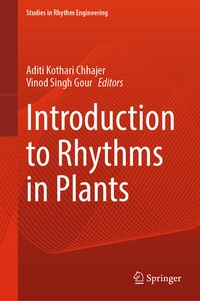
Introduction to Rhythms in Plants
Description

The book covers a wide array of rhythmic phenomena in plants, ranging from diurnal and circadian rhythms to underexplored topics such as rhizomicrobiome and algae rhythms. It also includes contemporary molecular biology topics, such as clock genes, photoreceptors, and hormonal pathways. The book connects plant rhythms to agricultural applications, such as controlled environment farming and crop optimization. These practical insights make it valuable for applied plant science professionals. This thematic diversity caters to a broad audience, including students, researchers, and agricultural professionals.
More details
Other editions
Additional editions
Persons
Dr. Aditi Kothari Chhajer has been working as an Assistant Professor at Sri Venkateswara College, Delhi University South Campus. She has been actively involved in teaching plant physiology, genetic engineering, economic botany and intellectual property rights at undergraduate level for the last 14 years. As an academic, she is dedicated to nurturing the next generation of scientists and researchers, imparting her knowledge through both teaching and mentoring. Her research focus has been on tissue culture, abiotic stress tolerance and Agrobacterium mediated genetic transformation in plants, particularly cereals and millets. Her research work is published in journals of national and international repute. She has done part of her doctoral research at Rothamsted Research Institute, UK as a Commonwealth Split Site Doctoral Fellow. She has been awarded a doctorate in Botany from University of Rajasthan, Jaipur. She was also awarded the Sakura Science Fellowship (Japan).
Dr. Vinod Singh Gour has been awarded a doctorate in Forest Genetics from Forest Research Institute, University Dehradun (India) in 2009. He has teaching experience of 14 years at UG and PG levels. He has guided five doctorate students and more than 15 masters projects. His areas of expertise include plant tissue culture, genetic diversity of trees, applied microbiology and plant ecology. He has published more than 40 research and review articles in prestigious journals. Besides, he has published ten book chapters and one book. He handled projects funded by ICMR, SERB, DST (GoI), DST (GoR) and NCERT. He has been awarded CSIR Junior Research fellowship, Willey Research Academy award and Sakura Science Fellowship (Japan). He is a life time member of Society of Plant Biochemistry and Biotechnology (India).
Content
The Circadian rhythms in plants.- Plant response to environmental Periodicity.- Environmental rhythms and regulation of plant morphogenesis.- Circadian regulation of rhizomicrobiome.- Circadian rhythms in the algal world.
