

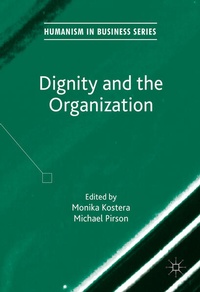
Dignity and the Organization
Description

This important book focuses on the role of human dignity, its protection and promotion in the context of organization and Humanistic Management. The recent phenomenon of humanism in management already has a rich body of literature and takes up many themes both theoretically, and from a practitioner perspective. Dignity and the Organization is the first book to explicitly deal with the topic of human dignity and management. The chapters address various aspects and problems from a humanistically-oriented perspective, taking up issues relevant for the contemporary management theorists and practitioners, and are concerned with organization, management and the social and cultural context. The book develops the notion of human dignity in conceptual and theoretical terms in its practical application, within the context of organizations.
More details
Other editions
Additional editions
Persons
Monika Kostera is Professor Ordinaria and Chair of Management at the Jagiellonian University in Kraków, Poland, and Professor and Chair in Management at Durham University, UK. She has authored and edited over 35 books in Polish and English, and a number of articles published in scholarly journals.
Michael Pirson is Associate Professor and Director of the Center for Humanistic Management at Fordham University, US. He is a Research Fellow at Harvard University, a distinguished fellow at Case Western Reserve University, and the Interim President of the Humanistic Management Network. He is a full member of the Club of Rome and has received various awards for his work, including from the Academy of Management.
Content
Introduction: Dignity and Organization (Michael Pirson and Monika Kostera).- Chapter 1: Dignity in organizing from the perspective of Hannah Arendt's worldliness (Sissi Ingman).- Chapter 2: Dignity and membership: a route to the heart of how dignity is done in everyday interaction (Laura Mitchell).- Chapter 3: Dignity and species difference within organizations (Lindsay Hamilton and Laura Mitchell).- Chapter 4: Dignity at the level of the firm: beyond the stakeholder approach (Ricardo Aguado, Jose Luis Retolaza and Leire Alcaniz).- Chapter 5: Marx, alienation and the denial of dignity at work in the ICT sector (Michael Healy).- Chapter 6: Dignity restoration: the indirect goal of social enterprises' activity (Aneta Milczarczyk).- Chapter 7: Dignity and leadership: Implications of leaders' language and their assumptions of human nature (Greg Latemore).- Chapter 8: From Human Resource Management to Human Dignity Development: A Dignity perspective on HRM and the Role of Workplace Democracy (Matthijs Bal and Simon B. de Jong).- Chapter 9: Office Design and Dignity at Work in the Knowledge Economy (Ralitza Nikolaeva and Silvia Dello Russo).- Chapter 10: Dignity by design: A shift from formalistic to humanistic design in organization (Delia Mannen and Lorissa MacAllister).- Chapter 11: Concluding Remarks (Michael Pirson and Monika Kostera).
