

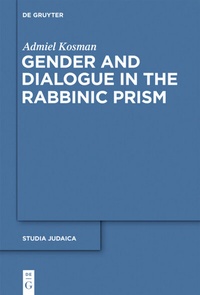
Gender and Dialogue in the Rabbinic Prism
Description

The author applies the fields of gender studies, psychoanalysis, and literature to Talmudic texts. In opposition to the perception of Judaism as a legal system, he argues that the Talmud demands inner spiritual effort, to which the trait of humility and the refinement of the ego are central. This leads to the question of the attitude to the Other, in general, and especially to women. The author shows that the Talmud places the woman (who represents humility and good-heartedness in the Talmudic narratives) above the character of the male depicted in these narratives as a scholar with an inflated sense of self-importance.
In the last chapter (that in terms of its scope and content could be a freestanding monograph) the author employs the insights that emerged from the preceding chapters to present a new reading of the Creation narrative in the Bible and the Rabbinic commentaries. The divine act of creation is presented as a primal sexual act, a sort of dialogic model of the consummate sanctity that takes its place in man's spiritual life when the option of opening one's heart to the other in a male-female dialogue is realized.
More details
Other editions
Additional editions
Persons
Content
1.1 - "Masculinity" and "Femininity" in the Psychosexual Theory of Freud and Nancy Chodorow [Seite 9]
1.2 - Lacan's Interpretation of the Freudian Theory [Seite 13]
1.3 - The Drawbacks of the Freudian Approach [Seite 15]
1.4 - Sara Ruddick and the Care Experience [Seite 18]
1.5 - Between Freud and Buber: Between Psychoanalysis and Dialogue [Seite 19]
1.6 - A Note on the Relationship between "I-Thou" and Halakhah and "Law" [Seite 26]
1.7 - Phallicism, Humility, and the Tension between "Masculinity" and "Femininity" in the Aggadic Narratives [Seite 28]
1.8 - The Chapters of the Book [Seite 33]
2 - Chapter One. The Woman's Spiritual Place in the Talmudic Story: A Reading of the Narrative of Mar Ukba and His Wife [Seite 37]
2.1 - An Introduction to the Discussion of the Narrative [Seite 37]
2.2 - The Text of the Narrative [Seite 39]
2.3 - The Reading of the Narrative [Seite 42]
2.4 - Why Was Mar Ukba Insulted? [Seite 47]
2.5 - The Leitmotiv of the Heel [Seite 53]
2.6 - On the Feminine and Masculine Associations in the Narrative [Seite 55]
3 - Chapter Two. Rabbi Akiva and the Daughter of Ben Kalba Savua: On the Conception of Love in the Spiritual World of the Talmudic Story [Seite 64]
3.1 - The Narrative of Akiva and His Mate, according to the Version of Ketubot 62b-63a [Seite 64]
3.2 - The Versions of the Narrative [Seite 66]
3.3 - The Love of Akiva and His Mate [Seite 71]
3.4 - Structure of the Narrative [Seite 76]
3.5 - The Waves of Opposition and Their Significance [Seite 77]
3.6 - Inner and Outer [Seite 85]
3.7 - Stability and Mobility [Seite 89]
3.8 - Is This a Romantic Love Story? [Seite 91]
3.9 - Against Boyarin's Political Reading [Seite 97]
3.10 - Appendix A: On the Nature of Relationship between Akiva and His Mate in the Later Versions [Seite 102]
3.11 - Appendix B: On the Character of Ben Kalba Savua in the Later Versions [Seite 110]
3.12 - Appendix C: On the Character of "That Old Man" in the Later Versions [Seite 114]
3.13 - Appendix D: On the Conversation with the Women Neighbors in the Later Versions [Seite 115]
4 - Chapter 3. "Internal Homeland" and "External Homeland": A Literary and Psychoanalytical Study of the Narrative of R. Assi and His Aged Mother [Seite 117]
4.1 - The Complex Relationship between Halakhah and Aggadah, as Background to a Reading of the Narrative [Seite 117]
4.2 - The Text of the Narrative [Seite 119]
4.3 - A Proposed Psychoanalytical Reading [Seite 130]
4.4 - On the Transformation of the Text from the Land of Israel to Babylonia [Seite 134]
5 - Chapter 4. The Female Breast and the Mouth Opened in Prayer [Seite 141]
5.1 - The Narrative of the Intervention by the Mother of R. Ahadboi in the Study Hall Quarrel [Seite 141]
5.2 - A Discussion of the Elements of the Narrative [Seite 147]
5.3 - Baring One's Breasts as an Act of Protest [Seite 151]
5.4 - Baring One's Breast as a Spiritual Expression [Seite 154]
5.5 - Baring One's Breasts as an Act of Entreaty [Seite 157]
5.6 - Exposing One's Breasts in the Midrashic Picture: A Gesture of Love and Giving [Seite 158]
6 - Chapter Five. A Reading of the Creation Narrative: Femininity and Masculinity in the Prism of the Bible and the Midrash [Seite 162]
6.1 - The Mythological Background and Gender Aspects [Seite 163]
6.2 - In the Beginning God Created [Seite 173]
6.3 - Creation Ex Nihilo or Ex Materia? [Seite 179]
6.4 - The Midrashic Sources, and Their Relation to the Proposed Dialogic Reading [Seite 185]
6.5 - On Building God's Palace in the Garbage in Gen. Rabbah [Seite 187]
6.6 - On the End of the Creation Passage: The Elements of the Sabbath and Sanctity [Seite 193]
6.7 - Buber's Comments on the Creation Passage [Seite 200]
6.8 - The Gender Significance of the Moderation in the Biblical Portrayal [Seite 202]
6.9 - The Dialogic Significance of the Creation Episode: Love as a Procreative and Creative Force [Seite 213]
7 - Afterword [Seite 222]
8 - Bibliography [Seite 223]
