

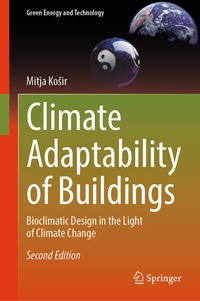
Climate Adaptability of Buildings
Description

This book, now in an updated second edition, discusses bioclimatic building design, focusing on climate-adapted and climate-resilient buildings. It addresses the challenge of designing new buildings and renovating existing ones within the constraints of global warming to achieve the desired performance today and in the future. This goal necessitates a paradigm shift in the building design process, as most contemporary buildings are designed according to past climate conditions and design preconceptions rooted in tradition, which might not result in the desired performance as they did in previous decades.
The book is divided into six chapters that guide the reader from basic concepts through specific climate adaptation building design strategies, toward their application and impact in the context of projected climate change. Unlike traditional approaches, the book focuses on the analytical bioclimatic design process that enables future climate adaptation. It presents bioclimatic design as an engineering practice of designing buildings and building envelopes as environmental modulators between the natural environment and building occupants.
The process and impacts of designing with climate are discussed by introducing bioclimatic potential analysis, which enables the designer to identify suitable climate-adapted design features at the onset of the design process. Finally, the implications of designing for the future projected climate are discussed and illustrated through representative examples, diagrams, and illustrations. The book concludes that today's design solutions might not be as efficient in the future and that the bioclimatic design approach can be utilised to create buildings better adapted to current and future climates.
This new edition reflects the latest state-of-the-art knowledge in climate change-adapted and climate-resilient buildings. The chapters have been updated and revised in light of the latest literature and to frame the book's content against the main drivers behind the development of contemporary buildings.
More details
Other editions
Additional editions
Person
Mitja Kosir's primary research interest is in building energy performance and daylighting, with a focus on the design of high-performance buildings. His work emphasises the need for building adaptation, particularly through adaptive building envelopes and their coupled thermal and visual performance. In recent years, his research has intensified around bioclimatic climatological analysis to assess buildings' current and future energy performance. This work centres on establishing new design solutions for climate-adapted and climate-resilient buildings. His research also addresses the critical interconnectedness between embodied and operational emissions in the pursuit of zero-emission buildings.
Content
Why do Buildings Matter?.- Bioclimatic Design - Where to Start?.- Climate - Bioclimatic Opportunities and Possibilities.- Bioclimatic Potential - A Way to Determine Climate Adaptability.- Bioclimatic Strategies - A Way to Attain Climate Adaptability.- Climate Change and Its Implications for Bioclimatic Design.- Afterword.
