

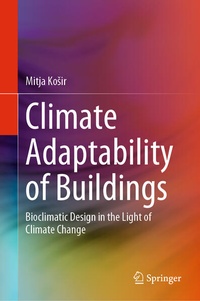
Climate Adaptability of Buildings
Description

This book examines bioclimatic design with a focus on the application of climate adaptability in the design of future buildings and renovation of existing energy-efficient buildings. It addresses the challenge of how to construct and renovate buildings so that they maintain desired performance even as the climate changes in future decades. The book is divided into six chapters that guide the reader from basic concepts to discussions on specific aspects of bioclimatic design, including:
- Why do we construct buildings and why do they matter?
- Where should we get started with bioclimatic design?
- The opportunities and potential held by climate for the by bioclimatic architecture and design.
- How and why should we design bioclimatic buildings to accommodate future climatic conditions?
- Climatic changes and implications for the bioclimatic design of buildings.
The author presents an overview of effective bioclimatic design strategies that enable climate-adaptable buildings. He also addresses the problems of designing with climate, which are relevant for all types of building design-in particular, the implications for bioclimatic buildings that are intrinsically connected to the climate they were adapted to. The book combines representative examples, diagrams, and illustrations, and concludes each chapter by reviewing the most important findings and concepts discussed.
More details
Other editions
Additional editions
Person
Mitja Kosir's primary research interest is in the field of building energy performance and daylighting in connection with the design of high-performance buildings. In recent years his work has broadened to the field of bioclimatic climatological analysis with respect to the past, present and future energy performance of buildings. He has authored or co-authored numerous research papers, and has actively taught at the Faculty of Civil and Geodetic Engineering and Faculty of Health Sciences, University of Ljubljana, Slovenia, where he chiefly focuses on bioclimatic design, energy efficiency in buildings, daylighting and smart buildings. As part of his research and teaching activities, he has been involved in the development of several simple design tools for bioclimatic and energy performance analysis.
Content
1.Why Do Buildings Matter?.- 2.Bioclimatic Design - Where to Start?.- 3.Climate - Bioclimatic Opportunities and Possibilities.- 4.Bioclimatic Potential - A Way to Determine Climate Adaptability.- 5. Bioclimatic strategies - a way to attain climate adaptability.- 6. Climate change and its implications for bioclimatic design.
