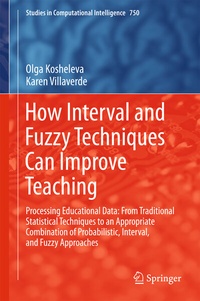
How Interval and Fuzzy Techniques Can Improve Teaching
Description

This book explains how to teach better and presents the latest research on processing educational data and presents traditional statistical techniques as well as probabilistic, interval, and fuzzy approaches. Teaching is a very rewarding activity; it is also a very difficult one - because it is largely an art. There is a lot of advice on teaching available, but it is usually informal and is not easy to follow. To remedy this situation, it is reasonable to use techniques specifically designed to handle such imprecise knowledge: the fuzzy logic techniques.
Since there are a large number of statistical studies of different teaching techniques, the authors combined statistical and fuzzy approaches to process the educational data in order to provide insights into improving all the stages of the education process: from forming a curriculum to deciding in which order to present the material to grading the assignments and exams.
The authors do not claim to have solved all the problems of education. Instead they show, using numerous examples, that an innovative combination of different uncertainty techniques can improve teaching. The book offers teachers and instructors valuable advice and provides researchers in pedagogical and fuzzy areas with techniques to further advance teaching.
Reviews / Votes
"The book is an attempt to present a unifying view of the papers on fuzzy techniques in different aspects of education . Given that the references come from conference proceedings on computational intelligence, fuzzy systems, or informatics and publications like IEEE Transactions on Education, academics who attend such conferences seem to be the most likely readers, as well as any mathematicians interested in potential, if somewhat theoretical, applications of fuzzy sets and interval techniques." (Annie Selden, MAA Reviews, December, 2017)More details
Other editions
Additional editions