

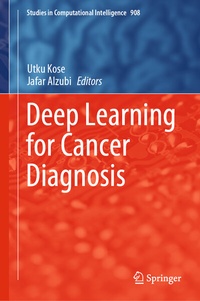
Deep Learning for Cancer Diagnosis
Description

Accordingly, the objective of this book is to highlight recent advanced applications of deep learning for diagnosing different types of cancer. The target audience includes scientists, experts, MSc and PhD students, postdocs, and anyone interested in the subjects discussed. The book can be used as a reference work to support courses on artificial intelligence, medical and biomedicaleducation.
More details
Other editions
Additional editions
Persons
Utku Kose received his Ph. D. degree in 2017 from Selcuk University, Turkey in the field of computer engineering. Currently, he is an Associate Professor in Suleyman Demirel University, Turkey. He has more than 100 publications to his credit. His research interests include artificial intelligence, machine ethics, artificial intelligence safety, optimization, the chaos theory, distance education, e-learning, computer education, and computer science.
Jafar Alzubi received his PhD in Advanced Telecommunications Engineering from Swansea University, UK, in 2012. He is currently an associate professor at the Computer Engineering Dept., Al-Balqa Applied University, Jordan. His research focuses on Elliptic curves cryptography and cryptosystems, classifications and detection of web scams, using Algebraic-Geometric theory in channel coding for wireless networks. He is currently working jointly with Wake Forest University, NC-USA as a visiting associate professor.
