

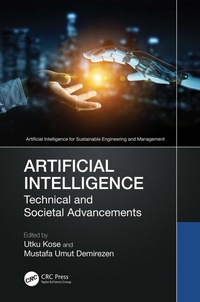
Artificial Intelligence
Technical and Societal Advancements
1st Edition
Published on 29. November 2024
348 pages
978-1-040-20388-0 (ISBN)
Description

This book provides an examination of cutting-edge research and developments in the field of artificial intelligence. It seeks to extend the view in both technical and societal evaluations to ensure a well-defined balance for societal outcomes. It explores hot topics such as generative artificial intelligence, artificial intelligence in law, education, and climate change.
Artificial Intelligence: Technical and Societal Advancements seeks to bridge the gap between theory and practical applications of AI by giving readers insight into recent advancements. It offers readers a deep dive into the transformative power of AI for the present and future world. As artificial intelligence continues to revolutionize various sectors, the book discusses applications from healthcare to finance and from entertainment to industrial areas. It discusses the technical aspects of intelligent systems and the effects of these aspects on humans. To this point, this book considers technical advancements while discussing the societal pros and cons in terms of human-machine interaction in critical applications. The authors also stress the importance of deriving policies and predictions about how to make future intelligent systems compatible with humans through a necessary level of human management. Finally, this book provides the opinions and views of researchers and experts (from public/private sector) including educators, lawyers, policymakers, managers, and business-related representatives.
The target readers of this book include academicians; researchers; experts; policymakers; educators; and B.S., M.S., and Ph.D. students in the context of target problem fields. It can be used accordingly as a reference source and even supportive material for artificial intelligence-oriented courses.
Artificial Intelligence: Technical and Societal Advancements seeks to bridge the gap between theory and practical applications of AI by giving readers insight into recent advancements. It offers readers a deep dive into the transformative power of AI for the present and future world. As artificial intelligence continues to revolutionize various sectors, the book discusses applications from healthcare to finance and from entertainment to industrial areas. It discusses the technical aspects of intelligent systems and the effects of these aspects on humans. To this point, this book considers technical advancements while discussing the societal pros and cons in terms of human-machine interaction in critical applications. The authors also stress the importance of deriving policies and predictions about how to make future intelligent systems compatible with humans through a necessary level of human management. Finally, this book provides the opinions and views of researchers and experts (from public/private sector) including educators, lawyers, policymakers, managers, and business-related representatives.
The target readers of this book include academicians; researchers; experts; policymakers; educators; and B.S., M.S., and Ph.D. students in the context of target problem fields. It can be used accordingly as a reference source and even supportive material for artificial intelligence-oriented courses.
More details
Series
Edition
1. Auflage
Language
English
Place of publication
London
United Kingdom
Publishing group
Taylor & Francis Ltd
Target group
College/higher education
Professional and scholarly
Illustrations
24 Tables, black and white; 47 Line drawings, black and white; 14 Halftones, black and white; 61 Illustrations, black and white
ISBN-13
978-1-040-20388-0 (9781040203880)
Copyright in bibliographic data and cover images is held by Nielsen Book Services Limited or by the publishers or by their respective licensors: all rights reserved.
Schweitzer Classification
Other editions
Additional editions
Book
approx. 07/2026
1st Edition
CRC Press
€66.00
Not yet published
Book
11/2024
1st Edition
CRC Press
€166.60
Available immediately
Persons
Dr. Utku Kose received a B.S. degree in computer education from Gazi University, Turkey, as a faculty valedictorian in 2008. He received an M.S. degree in computer education from Afyon Kocatepe University, Turkey, in 2010 and a D.S./Ph.D. degree in computer engineering from Selcuk University, Turkey, in 2017. Between 2009 and 2011, he worked as a Research Assistant at Afyon Kocatepe University. He is a Visiting Researcher at the University of North Dakota, USA, and an Associate Professor at Suleyman Demirel University, Turkey. His research interests include artificial intelligence, machine ethics, artificial intelligence safety, biomedical applications, optimization, chaos theory, distance education, e-learning, computer education, and computer science.
Dr. Mustafa Umut Demirezen received B.S., M.Sc., and Ph.D. degrees in electrical and electronics engineering from Gazi University in 2000, 2002, and 2015, respectively. Since 2023, he has been with the Department of Data Products, UDemy Inc., as the Senior Manager of Machine Learning Engineering. He also holds the title of Associate Professor. His research interests include artificial intelligence, deep learning, neuromorphic computing, spiking neural networks, scientific machine learning, and physics-informed neural networks.
Dr. Mustafa Umut Demirezen received B.S., M.Sc., and Ph.D. degrees in electrical and electronics engineering from Gazi University in 2000, 2002, and 2015, respectively. Since 2023, he has been with the Department of Data Products, UDemy Inc., as the Senior Manager of Machine Learning Engineering. He also holds the title of Associate Professor. His research interests include artificial intelligence, deep learning, neuromorphic computing, spiking neural networks, scientific machine learning, and physics-informed neural networks.
Content
Chapter 1- Advancements in Remote Sensing of the Cryosphere in Polar Regions: Contributions of Artificial Intelligence Techniques Over the Last Decade
Chapter 2- An Empirical Study on Climate Change Using Geospatial Artificial Intelligence: Analysis of Particulate Matter 2.5
Chapter 3- Artificial Intelligence in Gaming
Chapter 4- Artificial Intelligence in Education and Its Applications in The World - Measurement and Assessment
Chapter 5- Positioning AI in Creative Industries: Challenges and Opportunities for Workforce
Chapter 6- Dynamical Systems and Artificial Intelligence
Chapter 7- Emerging Technologies and Power Asymmetry in International System: An Analysis over Artificial Intelligence
Chapter 8- Looking at Artificial Intelligence (AI) From Social Relations: Social Influence, Conformity and Bias
Chapter 9- Legal Aspects of Artificial Intelligence in Health: An Overview under Turkish and Comparative Law
Chapter 10- GPT-based Audience Attention and Emotion Analysis
Chapter 11- Artificial Intelligence and Patent Law: Patent Applications for DABUS
Chapter 12- Combining Blockchain and AI: The Two Disruptive Technology Cooperation Reshaping the New Era
Chapter 13- The Transformative Role of Artificial Intelligence in Finance and Economics
Chapter 14- Ex Machine, Next Machine, Still Biased Machine
Chapter 15- Artificial Intelligence in Education: Transformation and Opportunities
Chapter 16- Artificial Intelligence in Nuclear Physics and Its Worldwide Applications
Chapter 17- In Vitro Fertilization and Artificial Intelligence
Chapter 18- Towards Automatic Cybertroll Detection in Social Media: A Transformer-based Framework
Chapter 19- Assessment of Various Deep Learning Algorithms' Performance in Forecasting Stock Market Prices
Chapter 20- Artificial Intelligence Patentability Criteria of Countries and Country-Based Artificial Intelligence Statistics
Chapter 21- Artificial Intelligence in the World Energy Outlook
Chapter 2- An Empirical Study on Climate Change Using Geospatial Artificial Intelligence: Analysis of Particulate Matter 2.5
Chapter 3- Artificial Intelligence in Gaming
Chapter 4- Artificial Intelligence in Education and Its Applications in The World - Measurement and Assessment
Chapter 5- Positioning AI in Creative Industries: Challenges and Opportunities for Workforce
Chapter 6- Dynamical Systems and Artificial Intelligence
Chapter 7- Emerging Technologies and Power Asymmetry in International System: An Analysis over Artificial Intelligence
Chapter 8- Looking at Artificial Intelligence (AI) From Social Relations: Social Influence, Conformity and Bias
Chapter 9- Legal Aspects of Artificial Intelligence in Health: An Overview under Turkish and Comparative Law
Chapter 10- GPT-based Audience Attention and Emotion Analysis
Chapter 11- Artificial Intelligence and Patent Law: Patent Applications for DABUS
Chapter 12- Combining Blockchain and AI: The Two Disruptive Technology Cooperation Reshaping the New Era
Chapter 13- The Transformative Role of Artificial Intelligence in Finance and Economics
Chapter 14- Ex Machine, Next Machine, Still Biased Machine
Chapter 15- Artificial Intelligence in Education: Transformation and Opportunities
Chapter 16- Artificial Intelligence in Nuclear Physics and Its Worldwide Applications
Chapter 17- In Vitro Fertilization and Artificial Intelligence
Chapter 18- Towards Automatic Cybertroll Detection in Social Media: A Transformer-based Framework
Chapter 19- Assessment of Various Deep Learning Algorithms' Performance in Forecasting Stock Market Prices
Chapter 20- Artificial Intelligence Patentability Criteria of Countries and Country-Based Artificial Intelligence Statistics
Chapter 21- Artificial Intelligence in the World Energy Outlook
