

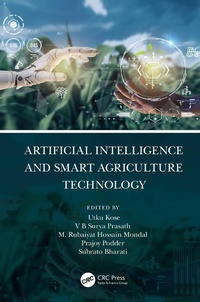
Artificial Intelligence and Smart Agriculture Technology
1st Edition
Published on 27. June 2022
318 pages
978-1-000-60434-4 (ISBN)
Description

This book was created with the intention of informing an international audience about the latest technological aspects for developing smart agricultural applications. As artificial intelligence (AI) takes the main role in this, the majority of the chapters are associated with the role of AI and data analytics components for better agricultural applications.
The first two chapters provide alternative, wide reviews of the use of AI, robotics, and the Internet of Things as effective solutions to agricultural problems. The third chapter looks at the use of blockchain technology in smart agricultural scenarios. In the fourth chapter, a future view is provided of an Internet of Things-oriented sustainable agriculture. Next, the fifth chapter provides a governmental evaluation of advanced farming technologies, and the sixth chapter discusses the role of big data in smart agricultural applications. The role of the blockchain is evaluated in terms of an industrial view under the seventh chapter, and the eighth chapter provides a discussion of data mining and data extraction, which is essential for better further analysis by smart tools. The ninth chapter evaluates the use of machine learning in food processing and preservation, which is a critical issue for dealing with issues concerns regarding insufficient foud sources. The tenth chapter also discusses sustainability, and the eleventh chapter focuses on the problem of plant disease prediction, which is among the critical agricultural issues. Similarly, the twelfth chapter considers the use of deep learning for classifying plant diseases. Finally, the book ends with a look at cyber threats to farming automation in the thirteenth chapter and a case study of India for a better, smart, and sustainable agriculture in the fourteenth chapter.
This book presents the most critical research topics of today's smart agricultural applications and provides a valuable view for both technological knowledge and ability that will be helpful to academicians, scientists, students who are the future of science, and industrial practitioners who collaborate with academia.
The first two chapters provide alternative, wide reviews of the use of AI, robotics, and the Internet of Things as effective solutions to agricultural problems. The third chapter looks at the use of blockchain technology in smart agricultural scenarios. In the fourth chapter, a future view is provided of an Internet of Things-oriented sustainable agriculture. Next, the fifth chapter provides a governmental evaluation of advanced farming technologies, and the sixth chapter discusses the role of big data in smart agricultural applications. The role of the blockchain is evaluated in terms of an industrial view under the seventh chapter, and the eighth chapter provides a discussion of data mining and data extraction, which is essential for better further analysis by smart tools. The ninth chapter evaluates the use of machine learning in food processing and preservation, which is a critical issue for dealing with issues concerns regarding insufficient foud sources. The tenth chapter also discusses sustainability, and the eleventh chapter focuses on the problem of plant disease prediction, which is among the critical agricultural issues. Similarly, the twelfth chapter considers the use of deep learning for classifying plant diseases. Finally, the book ends with a look at cyber threats to farming automation in the thirteenth chapter and a case study of India for a better, smart, and sustainable agriculture in the fourteenth chapter.
This book presents the most critical research topics of today's smart agricultural applications and provides a valuable view for both technological knowledge and ability that will be helpful to academicians, scientists, students who are the future of science, and industrial practitioners who collaborate with academia.
More details
Edition
1. Auflage
Language
English
Place of publication
London
United Kingdom
Publishing group
Taylor & Francis Ltd
Target group
Professional and scholarly
Illustrations
45 Line drawings, black and white; 45 Illustrations, black and white
ISBN-13
978-1-000-60434-4 (9781000604344)
Copyright in bibliographic data and cover images is held by Nielsen Book Services Limited or by the publishers or by their respective licensors: all rights reserved.
Schweitzer Classification
Other editions
Additional editions
Utku Kose | V. B. Prasath | M. Mondal
Artificial Intelligence and Smart Agriculture Technology
Book
10/2024
1st Edition
Auerbach
€72.90
Shipment within 10-20 days
Utku Kose | V. B. Prasath | M. Mondal
Artificial Intelligence and Smart Agriculture Technology
Book
06/2022
1st Edition
Auerbach
€186.70
Shipment within 10-20 days
Persons
Dr. Utku Kose is an Associate Professor in Suleyman Demirel University, Turkey. He has more than 100 publications including articles, books, proceedings, and reports.
Surya Prasath, PhD, is a mathematician with expertise in the application areas of image processing and computer vision. He received his PhD in mathematics from the Indian Institute of Technology Madras, India.
M. Rubaiyat Hossain Mondal, PhD is currently working as a Professor in the Institute of Information and Communication Technology (IICT) at Bangladesh University of Engineering and Technology (BUET).
Prajoy Podder is currently a researcher at the Institute of Information and Communication Technology, Bangladesh University of Engineering and Technology.
Subrato Bharati is currently a researcher at the Institute of Information and Communication Technology, Bangladesh University of Engineering and Technology.
Surya Prasath, PhD, is a mathematician with expertise in the application areas of image processing and computer vision. He received his PhD in mathematics from the Indian Institute of Technology Madras, India.
M. Rubaiyat Hossain Mondal, PhD is currently working as a Professor in the Institute of Information and Communication Technology (IICT) at Bangladesh University of Engineering and Technology (BUET).
Prajoy Podder is currently a researcher at the Institute of Information and Communication Technology, Bangladesh University of Engineering and Technology.
Subrato Bharati is currently a researcher at the Institute of Information and Communication Technology, Bangladesh University of Engineering and Technology.
Content
1. Smart Farming Using Artificial Intelligence, Internet of Things and Robotics: A Comprehensive Review 2. Towards theTechnological Adaptation of Advanced Farming Through Artificial Intelligence, the Internet of Things, and Robotics: A Comprehensive Overview 3. Artificial Intelligence and Blockchain in Smart Agriculture: Emergence, Opportunities, and Challenges 4. Artificial Intelligence and
Internet of Things Enabled Smart Farming for Sustainable Development: The Future of Agriculture 5. A Science, Technology, and Soocietay Approach to Studying the Cumin Revolution in Western India 6. The Role of Big Data in Agriculture 7. Blockchain-Based Agri Manufacture Industry 8. Agricultural Data Mining and Information Extraction 9. Machine Learning and Its Application in Food Processing and Preservation 10. Study of Disruptive Technologies for Sustainable Agriculture 11. Role of Dimensionality Reduction Techniques for Plant Disease Prediction 12. A Review of Deep Learning Approaches for Plant Disease Detection and Classification 13. Cyber Threats in Farming Automation 14. Prospects of Smart Farming as a Key to Sustainable Agricultural Development: A Case Study of India
Internet of Things Enabled Smart Farming for Sustainable Development: The Future of Agriculture 5. A Science, Technology, and Soocietay Approach to Studying the Cumin Revolution in Western India 6. The Role of Big Data in Agriculture 7. Blockchain-Based Agri Manufacture Industry 8. Agricultural Data Mining and Information Extraction 9. Machine Learning and Its Application in Food Processing and Preservation 10. Study of Disruptive Technologies for Sustainable Agriculture 11. Role of Dimensionality Reduction Techniques for Plant Disease Prediction 12. A Review of Deep Learning Approaches for Plant Disease Detection and Classification 13. Cyber Threats in Farming Automation 14. Prospects of Smart Farming as a Key to Sustainable Agricultural Development: A Case Study of India
