

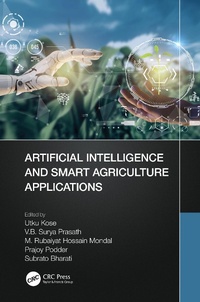
Artificial Intelligence and Smart Agriculture Applications
1st Edition
Published on 7. September 2022
355 pages
978-1-000-64437-1 (ISBN)
Description

An essential resource work for understanding how to design and develop smart applications for present and future problems of the field of agriculture.- Dr. Deepak Gupta, Maharaja Agrasen Institute of Technology, Delhi, India
As a result of the advances in Artificial Intelligence (AI), many aspects of daily life have been transformed by smart digital technology. Advanced intelligent algorithms can provide powerful solutions to real-world problems. Smart applications have become commonplace. All areas of life are being changed by smart tools developed to deal with complex issues challenging both humanity and the earth.
Artificial Intelligence and Smart Agriculture Applications presents the latest smart agriculture applications developed across the globe. It covers a broad array of solutions using data science and AI to attack problems facing agriculture worldwide.
Features:
Application of drones and sensors in advanced farming
A cloud-computing model for implementing smart agriculture
Conversational AI for farmer's advisory communications
Intelligent fuzzy logic to predict global warming's effect on agriculture
Machine learning algorithms for mapping soil macronutrient elements variability
A smart IoT framework for soil fertility enhancement
AI applications in pest management
A model using Python for predicting rainfall
The book examines not only present solutions but also potential future outcomes. It looks at the role of AI-based algorithms and the almost infinite combinations of variables for agricultural applications. Researchers, public and private sector representatives, agriculture scientists, and students can use this book to develop sustainable and solutions for smart agriculture. This book's findings are especially important as the planet is facing unprecedented environmental challenges from over-farming and climate change due to global warming.
As a result of the advances in Artificial Intelligence (AI), many aspects of daily life have been transformed by smart digital technology. Advanced intelligent algorithms can provide powerful solutions to real-world problems. Smart applications have become commonplace. All areas of life are being changed by smart tools developed to deal with complex issues challenging both humanity and the earth.
Artificial Intelligence and Smart Agriculture Applications presents the latest smart agriculture applications developed across the globe. It covers a broad array of solutions using data science and AI to attack problems facing agriculture worldwide.
Features:
Application of drones and sensors in advanced farming
A cloud-computing model for implementing smart agriculture
Conversational AI for farmer's advisory communications
Intelligent fuzzy logic to predict global warming's effect on agriculture
Machine learning algorithms for mapping soil macronutrient elements variability
A smart IoT framework for soil fertility enhancement
AI applications in pest management
A model using Python for predicting rainfall
The book examines not only present solutions but also potential future outcomes. It looks at the role of AI-based algorithms and the almost infinite combinations of variables for agricultural applications. Researchers, public and private sector representatives, agriculture scientists, and students can use this book to develop sustainable and solutions for smart agriculture. This book's findings are especially important as the planet is facing unprecedented environmental challenges from over-farming and climate change due to global warming.
More details
Edition
1. Auflage
Language
English
Place of publication
London
United Kingdom
Publishing group
Taylor & Francis Ltd
Target group
Professional and scholarly
Product notice
Reflowable
Illustrations
73 Line drawings, color; 19 Line drawings, black and white; 49 Halftones, color; 4 Halftones, black and white; 122 Illustrations, color; 23 Illustrations, black and white
ISBN-13
978-1-000-64437-1 (9781000644371)
Copyright in bibliographic data and cover images is held by Nielsen Book Services Limited or by the publishers or by their respective licensors: all rights reserved.
Schweitzer Classification
Other editions
Additional editions
Utku Kose | V.B. Surya Prasath | M.Rubaiyat Hossain Mondal
Artificial Intelligence and Smart Agriculture Applications
Book
10/2024
1st Edition
Auerbach
€68.10
Shipment within 10-20 days
Utku Kose | V.B. Surya Prasath | M.Rubaiyat Hossain Mondal
Artificial Intelligence and Smart Agriculture Applications
Book
09/2022
1st Edition
Auerbach
€207.20
Shipment within 10-20 days
Persons
Dr. Utku Kose is Associate Professor in Suleyman Demirel University, Turkey. He has more than 100 publications including articles, authored and edited books, proceedings, and reports.
V.B. Surya Prasath is an assistant professor in the Division of Biomedical Informatics at the Cincinnati Children's Hospital Medical Center, and at the Departments of Biomedical Informatics, Electrical Engineering and Computer Science, University of Cincinnati from 2018.
M. Rubaiyat Hossain Mondal is a faculty member at the Institute of Information and Communication Technology (IICT) in BUET, Bangladesh. He has published a number of papers in journals of IEEE, IET, Elsevier, Springer, Wiley, De Gruyter, PLOS, and MDPI.
Prajoy Podder is currently a researcher at the Institute of Information and Communication Technology, Bangladesh University of Engineering and Technology. He worked as a lecturer in the department of Electrical and Electronic Engineering, Ranada Prasad Shaha University, Narayanganj, Bangladesh.
Subrato Bharati is a researcher in the Institute of Information and Communication Technology, Bangladesh University of Engineering and Technology, Dhaka, Bangladesh. He is a regular reviewer of a number of international journal including Elsevier, Springer, and Wiley.
V.B. Surya Prasath is an assistant professor in the Division of Biomedical Informatics at the Cincinnati Children's Hospital Medical Center, and at the Departments of Biomedical Informatics, Electrical Engineering and Computer Science, University of Cincinnati from 2018.
M. Rubaiyat Hossain Mondal is a faculty member at the Institute of Information and Communication Technology (IICT) in BUET, Bangladesh. He has published a number of papers in journals of IEEE, IET, Elsevier, Springer, Wiley, De Gruyter, PLOS, and MDPI.
Prajoy Podder is currently a researcher at the Institute of Information and Communication Technology, Bangladesh University of Engineering and Technology. He worked as a lecturer in the department of Electrical and Electronic Engineering, Ranada Prasad Shaha University, Narayanganj, Bangladesh.
Subrato Bharati is a researcher in the Institute of Information and Communication Technology, Bangladesh University of Engineering and Technology, Dhaka, Bangladesh. He is a regular reviewer of a number of international journal including Elsevier, Springer, and Wiley.
Content
1. Application of Drone and Sensors in Advanced Farming: The Future Smart Farming Technology. 2. Development and Research of a Greenhouse Monitoring System. 3. A Cloud-Computing Model for Implementing Smart Agriculture. 4. Application of Conversational Artificial Intelligence for Farmer's Advisory and Communication. 5. The Use of an Intelligent Fuzzy Logic Controller to Predict the Global Warming Effect on Agriculture: The Case of Chickpea (Cicer arietinum L.) 6. Using Machine Learning Algorithms for Mapping Soil Macronutrient Elements Variability with Digital Environmental Data in an Alluvial Plain. 7. A Smart IoT Framework for Soil Fertility Enhancement Assisted via Deep Neural Networks. 8. Plant Disease Detection with the Help of Advanced Imaging Sensors. 9. Artificial Intelligence-Aided Phenomics in High throughput Stress Phenotyping of Plants. 10. Plant Disease Detection using Hybrid Deep Learning Architecture in Smart Agriculture Application. 11. Classification of Coffee Leaf Diseases through Image Processing Techniques. 12. The Use of Artificial Intelligence to Model Oil Extraction Yields from Seeds and Nuts. 13. Applications of Artificial Intelligence in Pest Management. 14. Applying Clustering Technique for Rainfall Received by Different District of Maharashtra State. 15. Predicting Rainfall for Aurangabad Division of Maharashtra by Applying Auto-Regressive Moving Average Model (ARIMA) Using Python Programming.
