

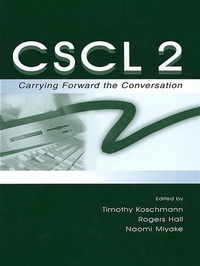
Cscl 2
Carrying Forward the Conversation
1st Edition
Published on 13. May 2013
592 pages
978-1-135-66123-6 (ISBN)
Description

CSCL 2: Carrying Forward the Conversation is a thorough and up-to-date survey of recent developments in Computer Supported Collaborative Learning, one of the fastest growing areas of research in the learning sciences. A follow-up to CSCL: Theory and Practice of an Emerging Paradigm (1996), this volume both documents how the field has grown and fosters a meaningful discussion of how the research program might be advanced in substantive ways.
Recognizing the long-standing traditions of CSCL work in Europe and Japan, the editors sought to broaden and expand the conversation both geographically and topically. The 45 participating authors represent a range of disciplinary backgrounds, including anthropology, communication studies, computer science, education, psychology, and philosophy, and offer international perspectives on the field. For each chapter, the goal was not only to show how it connects to past and future work in CSCL, but also how it contributes to the interests of other research communities. Toward this end, the volume features a "conversational structure" consisting of target chapters, invited commentaries, and author responses. The commentaries on each chapter were solicited from a diverse collection of writers, including prominent scholars in anthropology of education, social studies of science, CSCW, argumentation, activity theory, language and social interaction, ecological psychology, and other areas.
The volume is divided into three sections:
*Part I explores four case studies of technology transfer involving CSILE, one of the most prominent CSCL projects.
*Part II focuses on empirical studies of learning in collaborative settings.
*Part III describes novel CSCL technologies and the theories underlying their design.
Historically, there has been a certain amount of controversy as to what the second "C" in CSCL should represent. The conventional meaning is "collaborative" but there are many C-words that can be seen as relevant. With the publication of this volume, "conversational" might be added to the list and, in this spirit, the book might be viewed as an invitation to join a conversation in progress and to carry it forward.
Recognizing the long-standing traditions of CSCL work in Europe and Japan, the editors sought to broaden and expand the conversation both geographically and topically. The 45 participating authors represent a range of disciplinary backgrounds, including anthropology, communication studies, computer science, education, psychology, and philosophy, and offer international perspectives on the field. For each chapter, the goal was not only to show how it connects to past and future work in CSCL, but also how it contributes to the interests of other research communities. Toward this end, the volume features a "conversational structure" consisting of target chapters, invited commentaries, and author responses. The commentaries on each chapter were solicited from a diverse collection of writers, including prominent scholars in anthropology of education, social studies of science, CSCW, argumentation, activity theory, language and social interaction, ecological psychology, and other areas.
The volume is divided into three sections:
*Part I explores four case studies of technology transfer involving CSILE, one of the most prominent CSCL projects.
*Part II focuses on empirical studies of learning in collaborative settings.
*Part III describes novel CSCL technologies and the theories underlying their design.
Historically, there has been a certain amount of controversy as to what the second "C" in CSCL should represent. The conventional meaning is "collaborative" but there are many C-words that can be seen as relevant. With the publication of this volume, "conversational" might be added to the list and, in this spirit, the book might be viewed as an invitation to join a conversation in progress and to carry it forward.
Reviews / Votes
"...an excellent example of a good means-end methodology....This approach gives a good overview of what educators, educational technologists and educational researchers are doing and is well in keeping with the ideas behind collaboration and knowledge construction."-British Journal of Educational Technology
"The contribution of this book is manifold. 'CSCL 2' provides a crucial link between theory and practice, between innovation and theorizing, between work in CSCL and work in related disciplines. The book essentially delivers what the title promises in that it carries the conversation forward by providing a state of the art account and by advancing our understanding of CSCL."
-Mind, Culture and Activity
More details
Language
English
Place of publication
London
United Kingdom
Publishing group
Taylor & Francis Ltd
Target group
Professional and scholarly
Product notice
Reflowable
File size
21,87 MB
ISBN-13
978-1-135-66123-6 (9781135661236)
Copyright in bibliographic data and cover images is held by Nielsen Book Services Limited or by the publishers or by their respective licensors: all rights reserved.
Schweitzer Classification
Other editions
Additional editions
Book
03/2002
Routledge
€267.41
Shipment within 10-20 days
Book
03/2002
Routledge
€130.82
Shipment within 10-20 days
Persons
Timothy Koschmann, Rogers P. Hall, Naomi Miyake
Content
Contents: G.M. Olson, J.S Olson, R. Kraut, Series Editors' Comments. Preface. Part I:Case Studies of Technology Transfer.N. Miyake, T. Koschmann, Realizations of CSCL Conversations: Technology Transfer and the CSILE Project. J. Hewitt, From a Focus on Tasks to a Focus on Understanding: The Cultural Transformation of a Toronto Classroom. J. Oshima, R. Oshima, Coordination of Asynchronous and Synchronous Communication: Differences in Qualities of Knowledge Advancement Discourse Between Experts and Novices. F.P.C.M. de Jong, E. Veldhuis-Diermanse, G. Lutgens, Computer-Supported Collaborative Learning in University and Vocational Education. K. Hakkarainen, L. Lipponen, S. Jaervelae, Epistemology of Inquiry and Computer-Supported Collaborative Learning. Part II:Empirical Studies of Learning in Collaborative Settings.R. Hall, Collaboration and Learning as Contingent Responses to Designed Environments. D.W. Shaffer, Design, Collaboration, and Computation: The Design Studio as a Model for Computer-Supported Collaboration in Mathematics. R.R. Stevens, Divisions of Labor in School and in the Workplace: Comparing Computer- and Paper-Supported Activities Across Settings. H. Suzuki, H. Kato, Identity Formation/Transformation as a Process of Collaborative Learning of Programming Using AlgoArena. V. Kaptelinin, M. Cole, Individual and Collective Activities in Educational Computer Game Playing. Part III:Technologies for Collaboration and Learning.T. Koschmann, Becoming More Articulate About the Theories That Motivate Our Work. V. Colella, Participatory Simulations: Building Collaborative Understanding Through Immersive Dynamic Modeling. H. Kato, K. Yamazaki, H. Suzuki, H. Kuzuoka, H. Miki, A. Yamazaki, Designing a Video-Mediated Collaboration System Based on a Body Metaphor. P. Bell, Using Argument Map Representations to Make Thinking Visible for Individuals and Groups. G. Gay, R. Rieger, T. Bennington, Using Mobile Computing to Enhance Field Study.
