

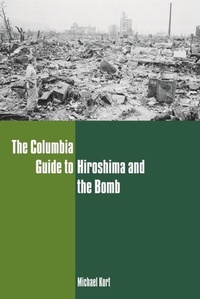
The Columbia Guide to Hiroshima and the Bomb
Columbia Guide to Hiroshima and the Bomb
1st Edition
Published on 23. September 2020
456 pages
978-0-231-52758-3 (ISBN)
Description

Few aspects of American military history have been as vigorously debated as Harry Truman's decision to use atomic bombs against Japan. In this carefully crafted volume, Michael Kort describes the wartime circumstances and thinking that form the context for the decision to use these weapons, surveys the major debates related to that decision, and provides a comprehensive collection of key primary source documents that illuminate the behavior of the United States and Japan during the closing days of World War II.
Kort opens with a summary of the debate over Hiroshima as it has evolved since 1945. He then provides a historical overview of thye events in question, beginning with the decision and program to build the atomic bomb. Detailing the sequence of events leading to Japan's surrender, he revisits the decisive battles of the Pacific War and the motivations of American and Japanese leaders. Finally, Kort examines ten key issues in the discussion of Hiroshima and guides readers to relevant primary source documents, scholarly books, and articles.
Kort opens with a summary of the debate over Hiroshima as it has evolved since 1945. He then provides a historical overview of thye events in question, beginning with the decision and program to build the atomic bomb. Detailing the sequence of events leading to Japan's surrender, he revisits the decisive battles of the Pacific War and the motivations of American and Japanese leaders. Finally, Kort examines ten key issues in the discussion of Hiroshima and guides readers to relevant primary source documents, scholarly books, and articles.
All prices
More details
Other editions
Additional editions
Michael Kort
The Columbia Guide to Hiroshima and the Bomb
Book
04/2007
Columbia University Press
€76.82
Article not available at the moment
Person
Michael Kort is professor of social science at Boston University's College of General Studies. He received his B.A. in history from Johns Hopkins University and his M.A. and Ph.D. in Russian history from New York University. He is the author of several books on the history of the Soviet Union and the Cold War, including The Soviet Colossus: History and Aftermath (sixth edition, 2006) and The Columbia Guide to the Cold War (1998).
Michael Kort is a professor of social science at Boston University's College of General Studies. He is the author of several books on the Soviet Union and Cold War history including The Handbook of the Former Soviet Union; The Soviet Colossus: History and Aftermath; and The Columbia Guide to the Cold War.
Michael Kort is a professor of social science at Boston University's College of General Studies. He is the author of several books on the Soviet Union and Cold War history including The Handbook of the Former Soviet Union; The Soviet Colossus: History and Aftermath; and The Columbia Guide to the Cold War.
Content
Acknowledgments
Introduction
Part I. Historical Narrative
1. The Debate Over Hiroshima
2. Building the Atomic Bomb
3. The Pacific War
4. The Decision to Drop the Bomb
5. The Japanese Government, Ketsu-Go, and Potsdam
6. Hiroshima, Nagasaki, and Japan's Surrender
7. Hiroshima and American Power
Part II. Key Questions and Interpretations
Part III. Resources
Chronology
Glossary of Military Terms and Abbreviations
Glossary of Names
Selected Bibliography
Part IV. Documents
Guide to the Documents
A. American Civilian Documents
B. American Military Documents
C. MAGIC Diplomatic Summaries
D. Japanese Government Documents, Military Documents, and Diary Entries
E. Japanese Surrender Documents
F. United States Strategic Bombing Survey: Summary Report and Interrogations of Japanese Officials
G. Statements of Japanese Officials on World War II, Military Intelligence Section, Historical Division, U.S. Army
Notes
Index
Introduction
Part I. Historical Narrative
1. The Debate Over Hiroshima
2. Building the Atomic Bomb
3. The Pacific War
4. The Decision to Drop the Bomb
5. The Japanese Government, Ketsu-Go, and Potsdam
6. Hiroshima, Nagasaki, and Japan's Surrender
7. Hiroshima and American Power
Part II. Key Questions and Interpretations
Part III. Resources
Chronology
Glossary of Military Terms and Abbreviations
Glossary of Names
Selected Bibliography
Part IV. Documents
Guide to the Documents
A. American Civilian Documents
B. American Military Documents
C. MAGIC Diplomatic Summaries
D. Japanese Government Documents, Military Documents, and Diary Entries
E. Japanese Surrender Documents
F. United States Strategic Bombing Survey: Summary Report and Interrogations of Japanese Officials
G. Statements of Japanese Officials on World War II, Military Intelligence Section, Historical Division, U.S. Army
Notes
Index

