

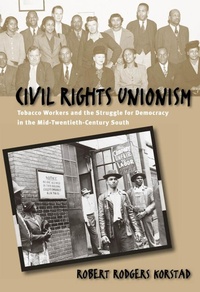
Civil Rights Unionism
Description

Drawing on scores of interviews with black and white tobacco workers in Winston-Salem, North Carolina, Robert Korstad brings to life the forgotten heroes of Local 22 of the Food, Tobacco, Agricultural and Allied Workers of America-CIO. These workers confronted a system of racial capitalism that consigned African Americans to the basest jobs in the industry, perpetuated low wages for all southerners, and shored up white supremacy. Galvanized by the emergence of the CIO, African Americans took the lead in a campaign that saw a strong labor movement and the reenfranchisement of the southern poor as keys to reforming the South — and a reformed South as central to the survival and expansion of the New Deal. In the window of opportunity opened by World War II, they blurred the boundaries between home and work as they linked civil rights and labor rights in a bid for justice at work and in the public sphere. But civil rights unionism foundered in the maelstrom of the Cold War. Its defeat undermined later efforts by civil rights activists to raise issues of economic equality to the moral high ground occupied by the fight against legalized segregation and, Korstad contends, constrains the prospects for justice and democracy today.
More details
Other editions
Additional editions
Person
Robert Rodgers Korstad is associate professor of public policy studies and history at Duke University. He is a coauthor of Like a Family: The Making of a Southern Cotton Mill World and a coeditor of Remembering Jim Crow: African Americans Talk about Life in the Segregated South.
Content
- Intro
- Contents
- Illustrations and Maps
- Abbreviations
- Introduction
- Notes
- 1. Those Who Were Not Afraid
- Sit-down
- Marching, Marching
- Anatomy of a Sit-down Strike
- Notes
- 2. Industrial and Political Revolutions
- The Rise of R. J. Reynolds Tobacco Company
- "Prejudice and Passion"
- The Political Economy of White Supremacy
- Notes
- 3. Winston-Salem, North Carolina: Country Small Town Grown Big Town Rich-and Poor
- "The Solidarity of the Solidly Fixed"
- The Making of a Black Urban Working-Class World
- Notes
- 4. R. J. Reynolds Tobacco Company: A Moneymaking Place
- The Division of Labor
- Early Organizing Campaigns and the Rise of Welfare Capitalism
- Race, Gender, and Authority
- Resistance
- Notes
- 5. Social Learning
- Southern Labor Stirs
- New Deal Reforms
- An Important Training Ground
- Political Openings
- Notes
- 6. Talking Union
- The CIO and the Southern Front
- Building a Social Movement
- Notes
- 7. A Dream Come True
- Negotiation
- A War of Words
- "A Contract to Protect Our People"
- Notes
- 8. Like Being Reconstructed
- The First Contract
- Shop Floor Democracy
- Industrial Jurisprudence
- Notes
- 9. In Dreams Begin Responsibilities
- Creating a Union Culture
- Notes
- 10. There Was Nothing in the City That Didn't Concern the Tobacco Union
- Civic Unionism and Civil Rights
- Running for Congress
- The Communist Party
- Notes
- 11. It Wasn't Just Wages We Wanted, but Freedom
- Mechanization
- The Leaf House Strike
- Operation Dixie
- Notes
- 12. Fighting the Fire
- Local Politics
- The 1947 Strike
- Exposé
- Notes
- 13. Jim Crow Must Go
- The HUAC Hearings
- Recruiting White Workers
- The Progressive Party Campaign
- Notes
- 14. If You Beat the White Man at One Trick, He Will Try Another
- Taking on City Hall
- The Metamorphosis of White Supremacy
- Human Relations Techniques
- Notes
- 15. Trust the Bridge That Carried Us Over
- The 1949 Organizing Campaign
- The Final Vote
- Notes
- Epilogue
- Notes
- Notes
- Bibliography
- Acknowledgments
- Index
- A
- B
- C
- D
- E
- F
- G-H
- I
- J-K
- L
- M
- N
- O-P
- R
- S
- T
- U
- V-W
- Y-Z
