

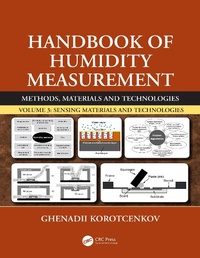
Handbook of Humidity Measurement, Volume 3
Sensing Materials and Technologies
1st Edition
Published on 24. January 2020
502 pages
978-1-351-05649-6 (ISBN)
Description

Because of unique water properties, humidity affects materials and many living organisms, including humans. Humidity control is important in various fields, from production management to creating a comfortable living environment. The range of materials that can be used in the development of humidity sensors is very broad, and the third volume of the Handbook of Humidity Measurement offers an analysis on various humidity-sensitive materials and sensor technologies used in the fabrication of humidity sensors and methods acceptable for their testing.
Additional features include:
numerous strategies for the fabrication and characterization of humidity-sensitive materials and sensing structures used in sensor applications,
methods and properties to develop smaller, cheaper, more robust, and accurate devices with better sensitivity and stability,
a guide to sensor selection and an overview of the humidity sensor market, and
new technology solutions for integration, miniaturization, and specificity of the humidity sensor calibration.
Handbook of Humidity Measurement, Volume 3: Sensing Materials and Technologies provides valuable information for practicing engineers, measurement experts, laboratory technicians, project managers in industries and national laboratories, and university students and professors interested in solutions to humidity measurement tasks. Despite the fact that this book is devoted to the humidity sensors, it can be used as a basis for understanding fundamentals of any gas sensor operation and development.
Additional features include:
numerous strategies for the fabrication and characterization of humidity-sensitive materials and sensing structures used in sensor applications,
methods and properties to develop smaller, cheaper, more robust, and accurate devices with better sensitivity and stability,
a guide to sensor selection and an overview of the humidity sensor market, and
new technology solutions for integration, miniaturization, and specificity of the humidity sensor calibration.
Handbook of Humidity Measurement, Volume 3: Sensing Materials and Technologies provides valuable information for practicing engineers, measurement experts, laboratory technicians, project managers in industries and national laboratories, and university students and professors interested in solutions to humidity measurement tasks. Despite the fact that this book is devoted to the humidity sensors, it can be used as a basis for understanding fundamentals of any gas sensor operation and development.
More details
Edition
1. Auflage
Language
English
Place of publication
London
United Kingdom
Publishing group
Taylor & Francis Ltd
Target group
College/higher education
Illustrations
153 Tables, black and white; 427 Illustrations, black and white
ISBN-13
978-1-351-05649-6 (9781351056496)
Copyright in bibliographic data and cover images is held by Nielsen Book Services Limited or by the publishers or by their respective licensors: all rights reserved.
Schweitzer Classification
Other editions
Additional editions
Book
12/2021
1st Edition
CRC Press
€72.40
Shipment within 10-20 days
Book
02/2020
1st Edition
CRC Press
€260.41
Shipment within 10-20 days
Person
Ghenadii Korotcenkov earned his PhD in material sciences from the Technical University of Moldova, Chisinau, Moldova in 1976 and his doctor of science degree (doctor habilitate) in physics from the Academy of Science of Moldova in 1990 (Highest Qualification Committee of the USSR, Moscow). He has more than 45 years of experience as a scientific researcher. For a long time, he has been the leader of the gas sensor group and manager of various national and international scientific and engineering projects carried out in the Laboratory of Micro- and Optoelectronics, Technical University of Moldova. His research has been receiving a financial support from international foundations and programs such as the CRDF, the MRDA, the ICTP, the INTAS, the INCO-COPERNICUS, the COST, and the NATO. From 2007 to 2008, he was an invited scientist in Korean Institute of Energy Research, Daejeon, South Korea. Then, until the end of 2017 Dr. G. Korotcenkov was a research professor at the School of Materials Science and Engineering at Gwangju Institute of Science and Technology, Gwangju, South Korea. Currently Dr. G. Korotcenkov is the chief scientific researcher at the Department of Physics and Engineering at the Moldova State University, Chisinau, the Rep. of Moldova.
Specialists from the former Soviet Union know Dr. G. Korotcenkov's research results in the field of study Schottky barriers, MOS structures, native oxides, and photoreceivers on the basis of III-Vs compounds such as InP, GaP, AlGaAs, and InGaAs. His present scientific interests starting from 1995 include material science, focusing on the metal oxide film deposition and characterization, surface science, and the design of thin film gas sensors and thermoelectric convertors. These studies were carried out in cooperation with scientific teams from Ioffe Institute (St. Petersburg, Russia), University of Michigan (Ann Arbor, USA), Kiev State University (Kiev, Ukraine), Charles University (Prague, Czech Republic), St. Petersburg State University (St. Petersburg, Russia), Illinois Institute of Technology (Chicago, USA), University of Barcelona (Barcelona, Spain), Moscow State University (Moscow, Russia), University of Brescia (Brescia, Italy), Belarus State University (Minsk, Belarus), South-Ukrainian University (Odessa, Ukraine).
Dr. G. Korotcenkov is either the author or editor of 39 books, including the 11-volume Chemical Sensors series published by the Momentum Press (USA), 15-volume Chemical Sensors series published by Harbin Institute of Technology Press (China), 3-volume Porous Silicon: From Formation to Application published by CRC Press (USA), 2-volume Handbook of Gas Sensor Materials published by Springer (USA), and 3-volume Handbook of Humidity Measurements published by CRC Press (USA). In addition, at present, Dr. G. Korotcenkov is a series' editor of Metal Oxides series, which is being published by Elsevier. Starting from 2017, already 16 volumes have been published within the framework of that series.
Dr. G. Korotcenkov is the author and coauthor of more than 600 scientific publications, including 30 review papers, 38 book chapters, and more than 200 articles published in peer-reviewed scientific journals (h-factor = 42 [Scopus] and h-factor = 51 [Google Scholar citation]).
In the majority of publications, he is the first author. Besides, Dr. G. Korotchenkov is a holder of 17 patents. He has presented more than 250 reports at national and international conferences, including 17 invited talks. Dr. G. Korotcenkov was co-organizer of more than 10 international scientific conferences. His name and activities have been listed by many biographical publications, including Who's Who. His research activities are honored by the Prize of the Academy of Sciences of Moldova for a significant contribution to the development of exact and engineering sciences (2019), an Award of the Supreme Council of Science and Advanced Technology of the Republic of Moldova (2004); Prize of the Presidents of the Ukrainian, Belarus, and Moldovan Academies of Sciences (2003); and National Youth Prize of the Republic of Moldova in the field of science and technology (1980), among others. Dr. G. Korotcenkov also received a fellowship from the International Research Exchange Board (IREX, United States, 1998), Brain Korea 21 Program (2008-2012), and Brainpool Program (Korea, 2007-2008 and 2015-2017).
Specialists from the former Soviet Union know Dr. G. Korotcenkov's research results in the field of study Schottky barriers, MOS structures, native oxides, and photoreceivers on the basis of III-Vs compounds such as InP, GaP, AlGaAs, and InGaAs. His present scientific interests starting from 1995 include material science, focusing on the metal oxide film deposition and characterization, surface science, and the design of thin film gas sensors and thermoelectric convertors. These studies were carried out in cooperation with scientific teams from Ioffe Institute (St. Petersburg, Russia), University of Michigan (Ann Arbor, USA), Kiev State University (Kiev, Ukraine), Charles University (Prague, Czech Republic), St. Petersburg State University (St. Petersburg, Russia), Illinois Institute of Technology (Chicago, USA), University of Barcelona (Barcelona, Spain), Moscow State University (Moscow, Russia), University of Brescia (Brescia, Italy), Belarus State University (Minsk, Belarus), South-Ukrainian University (Odessa, Ukraine).
Dr. G. Korotcenkov is either the author or editor of 39 books, including the 11-volume Chemical Sensors series published by the Momentum Press (USA), 15-volume Chemical Sensors series published by Harbin Institute of Technology Press (China), 3-volume Porous Silicon: From Formation to Application published by CRC Press (USA), 2-volume Handbook of Gas Sensor Materials published by Springer (USA), and 3-volume Handbook of Humidity Measurements published by CRC Press (USA). In addition, at present, Dr. G. Korotcenkov is a series' editor of Metal Oxides series, which is being published by Elsevier. Starting from 2017, already 16 volumes have been published within the framework of that series.
Dr. G. Korotcenkov is the author and coauthor of more than 600 scientific publications, including 30 review papers, 38 book chapters, and more than 200 articles published in peer-reviewed scientific journals (h-factor = 42 [Scopus] and h-factor = 51 [Google Scholar citation]).
In the majority of publications, he is the first author. Besides, Dr. G. Korotchenkov is a holder of 17 patents. He has presented more than 250 reports at national and international conferences, including 17 invited talks. Dr. G. Korotcenkov was co-organizer of more than 10 international scientific conferences. His name and activities have been listed by many biographical publications, including Who's Who. His research activities are honored by the Prize of the Academy of Sciences of Moldova for a significant contribution to the development of exact and engineering sciences (2019), an Award of the Supreme Council of Science and Advanced Technology of the Republic of Moldova (2004); Prize of the Presidents of the Ukrainian, Belarus, and Moldovan Academies of Sciences (2003); and National Youth Prize of the Republic of Moldova in the field of science and technology (1980), among others. Dr. G. Korotcenkov also received a fellowship from the International Research Exchange Board (IREX, United States, 1998), Brain Korea 21 Program (2008-2012), and Brainpool Program (Korea, 2007-2008 and 2015-2017).
Content
Section i Humidity-Sensitive Materials
Chapter 1 Polymers .................................................................................................................................................................. 3
Chapter 2 Metal Oxide in Humidity Sensors ......................................................................................................................... 23
Chapter 3 Al2O3 as a Humidity-Sensitive Material ............................................................................................................... 35
Chapter 4 Carbon-Based Materials ........................................................................................................................................ 51
Chapter 5 Semiconductor-Based Humidity Sensors .............................................................................................................. 91
Chapter 6 Porous Silicon ...................................................................................................................................................... 109
Chapter 7 Mesoporous Silica and Its Prospects for Humidity Sensor Application ............................................................ 139
Chapter 8 Aluminosilicate (Zeolites)-Based Humidity Sensors ........................................................................................ 151
Chapter 9 Metal Phosphate-Based Humidity Sensitive Materials ...................................................................................... 163
Chapter 10 Black Phosphorus and Phosphorene-Based Humidity Sensors ..........................................................................171
Chapter 11 Metal-Organic Framework-Based Humidity Sensors ........................................................................................ 187
Chapter 12 Supramolecular Materials .................................................................................................................................. 209
Chapter 13 Biomaterials as Sensing Elements of Humidity Sensors ................................................................................... 223
Section ii Sensor technologies and Related Materials
Chapter 14 Substrates and Electrodes in Humidity Sensors ................................................................................................ 229
Chapter 15 Fundamentals of Microfabrication Technologies...............................................................................................
Chapter 16 Micromachining Platforms for Humidity Sensors and Examples of Their Fabrication .................................... 263
Chapter 17 Platforms and Materials for QCM and SAW-Based Humidity Sensors ............................................................ 271
Chapter 18 Technologies Suitable for Fabrication of Humidity Sensing Layers: General Consideration ............................ 281
Chapter 19 Polymer Technologies ........................................................................................................................................ 305
Chapter 20 Synthesis of Humidity-Sensitive Metal Oxides: Powder Technologies ............................................................. 339
Chapter 27 Comparative Analysis of Humidity Sensors and Their Advantages and Shortcomings ................................... 445
Chapter 28 Market of Electronic Humidity Sensors ............................................................................................................ 453
Chapter 1 Polymers .................................................................................................................................................................. 3
Chapter 2 Metal Oxide in Humidity Sensors ......................................................................................................................... 23
Chapter 3 Al2O3 as a Humidity-Sensitive Material ............................................................................................................... 35
Chapter 4 Carbon-Based Materials ........................................................................................................................................ 51
Chapter 5 Semiconductor-Based Humidity Sensors .............................................................................................................. 91
Chapter 6 Porous Silicon ...................................................................................................................................................... 109
Chapter 7 Mesoporous Silica and Its Prospects for Humidity Sensor Application ............................................................ 139
Chapter 8 Aluminosilicate (Zeolites)-Based Humidity Sensors ........................................................................................ 151
Chapter 9 Metal Phosphate-Based Humidity Sensitive Materials ...................................................................................... 163
Chapter 10 Black Phosphorus and Phosphorene-Based Humidity Sensors ..........................................................................171
Chapter 11 Metal-Organic Framework-Based Humidity Sensors ........................................................................................ 187
Chapter 12 Supramolecular Materials .................................................................................................................................. 209
Chapter 13 Biomaterials as Sensing Elements of Humidity Sensors ................................................................................... 223
Section ii Sensor technologies and Related Materials
Chapter 14 Substrates and Electrodes in Humidity Sensors ................................................................................................ 229
Chapter 15 Fundamentals of Microfabrication Technologies...............................................................................................
Chapter 16 Micromachining Platforms for Humidity Sensors and Examples of Their Fabrication .................................... 263
Chapter 17 Platforms and Materials for QCM and SAW-Based Humidity Sensors ............................................................ 271
Chapter 18 Technologies Suitable for Fabrication of Humidity Sensing Layers: General Consideration ............................ 281
Chapter 19 Polymer Technologies ........................................................................................................................................ 305
Chapter 20 Synthesis of Humidity-Sensitive Metal Oxides: Powder Technologies ............................................................. 339
Chapter 27 Comparative Analysis of Humidity Sensors and Their Advantages and Shortcomings ................................... 445
Chapter 28 Market of Electronic Humidity Sensors ............................................................................................................ 453
