

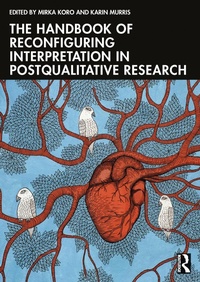
The Handbook of Reconfiguring Interpretation in PostQualitative Research
1st Edition
Published on 30. December 2025
272 pages
978-1-040-40271-9 (ISBN)
Description

The Handbook of Reconfiguring Interpretation in PostQualitative Research addresses different roles, functions, and reconfigurations of interpretation in qualitative and postqualitative research.
This book connects interpretation to its histories while revisioning and reconfiguring what the future of interpretation and interpretive practices could be like and how different interpretations can shape qualitative and postqualitative relationalities, discourses, affects, and materialities. It addresses different roles, functions, and reconfigurations of interpretation in qualitative and postqualitative research. What happens to interpretation when it is put into different theoretical frames including postmodernism, posthumanism, postcolonialism? What has changed and how do different epistemological and ontological spaces offer different insights about interpretation and shape diverse uses for interpretation? How does interpretation function and what does it produce during these rapidly shifting cultural and political times?
This Handbook can be used as a main text for introduction to qualitative research courses, advanced courses focusing on interpretation, post qualitative research practices, or social science methodologies. It could also be used as a supplementary textbook for qualitative methods courses including qualitative design, representation, and (post)practices courses.
This book connects interpretation to its histories while revisioning and reconfiguring what the future of interpretation and interpretive practices could be like and how different interpretations can shape qualitative and postqualitative relationalities, discourses, affects, and materialities. It addresses different roles, functions, and reconfigurations of interpretation in qualitative and postqualitative research. What happens to interpretation when it is put into different theoretical frames including postmodernism, posthumanism, postcolonialism? What has changed and how do different epistemological and ontological spaces offer different insights about interpretation and shape diverse uses for interpretation? How does interpretation function and what does it produce during these rapidly shifting cultural and political times?
This Handbook can be used as a main text for introduction to qualitative research courses, advanced courses focusing on interpretation, post qualitative research practices, or social science methodologies. It could also be used as a supplementary textbook for qualitative methods courses including qualitative design, representation, and (post)practices courses.
More details
Edition
1. Auflage
Language
English
Place of publication
London
United Kingdom
Publishing group
Taylor & Francis Ltd
Target group
College/higher education
Illustrations
3 Tables, black and white; 22 Halftones, black and white; 22 Illustrations, black and white
File size
5,73 MB
ISBN-13
978-1-040-40271-9 (9781040402719)
Copyright in bibliographic data and cover images is held by Nielsen Book Services Limited or by the publishers or by their respective licensors: all rights reserved.
Schweitzer Classification
Other editions
Additional editions
Mirka Koro | Karin Murris
The Handbook of Reconfiguring Interpretation in PostQualitative Research
Book
approx. 12/2025
1st Edition
Routledge
€335.30
Not yet published
Persons
Mirka Koro is Professor of Qualitative Research at the Mary Lou Fulton College for Teaching and Learning Innovation, Arizona State University, USA.
Karin Murris is Professor of Early Childhood Education at the University of Oulu, Finland, and Emerita Professor of Pedagogy and Philosophy, University of Cape Town, South Africa.
Karin Murris is Professor of Early Childhood Education at the University of Oulu, Finland, and Emerita Professor of Pedagogy and Philosophy, University of Cape Town, South Africa.
Content
Part I: Conceptualizing Interpretation 1. Diverse Lives of Interpretation 2. Interpretation in Qualitative Research: Historical Roots 3. Multispecies as a Concept and Method; Part II: Interpretive Practices and Processes 4. Wriggling with Data and Interpretation 5. Amoeba in the Academia: Interpreting the Landscapes of Digitalized Higher Education 6. Doing Interpretation Differently with Posthumanism and New Materialism: Reconceptualizing what Data does in Postqualitative Research 7. Mountains and Geological Time: A Qualitative Quest; Part III: Interpretation Diffracted 8. Diffraction 9. Diffractive Analysis and Interpretation 10. Reconfiguring Interpretation in Relation to Reflexivity and Diffraction in (Post) Qualitative Research; Part IV: The Interpretation Question? 11. Criticality and Critical Interpretation as Intra-pretation in Post-Qualitative Research 12. A Childlike Questioning Exercise on Method for Researchers 13. Childing Methodologies: Image-ning without a Subject in Performative Videography 14. Making Care: Multimodalities and Interpretations, Methods and Becomings; Part V: Collective Interpretations 15. Collective Biography in Education Research: Exploring Feminist, Decolonial, Poststructuralist, and Posthumanist Perspectives 16. (Re)engaging Feminist Collective Interpretation Towards Ecosystems of Sustainability 17. Interpretation and Intra-pretation in Communities of Philosophical Enquiry: A Post/qualitative Research Methodology
