

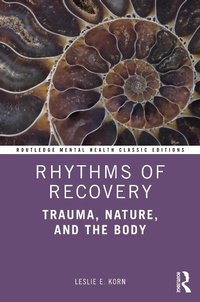
Rhythms of Recovery
Trauma, Nature, and the Body
1st Edition
Published on 28. September 2021
340 pages
978-1-000-44952-5 (ISBN)
Description

The classic edition of Rhythms of Recovery sheds light on rhythm, one of the most important components of our survival and well-being. It governs the patterns of our sleep and respiration and is profoundly tied to our relationships with friends and family. But what happens when these rhythms are disrupted by traumatic events? Can balance be restored, and if so, how? What insights do eastern, natural, and modern western healing traditions have to offer, and how can practitioners put these lessons to use? Is it possible to do this in a way that's culturally sensitive, multidisciplinary, and grounded in research?
Rhythms of Recovery
examines and answers these questions and provides clinicians with effective, time-tested tools for alleviating the destabilizing effects of traumatic events. It also explores integrative medicine, East/West medicine, herbal medicine, psychedelic medicine, complex trauma, yoga, and somatic and feminist therapies. For practitioners and students interested in integrating the insights of complementary/alternative medicine and 21st-century science, this deeply appealing book is an ideal guide.
Rhythms of Recovery
examines and answers these questions and provides clinicians with effective, time-tested tools for alleviating the destabilizing effects of traumatic events. It also explores integrative medicine, East/West medicine, herbal medicine, psychedelic medicine, complex trauma, yoga, and somatic and feminist therapies. For practitioners and students interested in integrating the insights of complementary/alternative medicine and 21st-century science, this deeply appealing book is an ideal guide.
Reviews / Votes
"This book broadens contemporary understandings of trauma beyond the current confines of academic discourse to complex real-world issues of culture and spirit. I strongly recommend this book as an essential resource and guide for clinicians and their patients who have experienced trauma."James Lake, MD, author of Integrative Mental Health Care: A Therapist's Handbook
"In Rhythms of Recovery, Leslie Korn provides a unique review of the historical and cultural roots of trauma. She forcefully endorses the role of the body in defining the traumatic experience, and its essential inclusion in the healing process. Finally, Korn presents a thorough review of behavioral, somatic and nutritional avenues to healing. Her depth of knowledge, clarity of presentation and rich fund of supportive references make this a unique contribution to the literature addressing the understanding and healing of trauma."
Robert C. Scaer, MD, author of The Body Bears the Burden and The Trauma Spectrum
"Rhythms of Recovery is brilliant and comprehensive. Integrating work from numerous disciplines, Dr. Korn brings profound insight into the impact of trauma and the body. She guides us in listening to voice of the body and provides extraordinary guidance with practical and alternative forms for health and healing. This is a long awaited and needed book-amazing work!"
Lisa Machoian, EdD, author of The Disappearing Girl: Learning the Language of Teenage Depression
"It is one thing to say that Descartes mistook the body and the mind for two different ontological substances. Putting the body (including the brain) and the mind together again, and regarding them as expressions of one substance, is a much more demanding matter. Still, trauma experts become ever more convinced that the consequences of severe neglect, abuse or still other horrors affect individuals at the level of the whole organism. Leslie Korn is certainly one of them. In this intriguing book she thus addresses the whole person, clinically, empirically, and therapeutically. I highly recommend trauma therapists to test the integrative path to understanding and healing she invites us to tread."
Ellert Nijenhuis, PhD, coauthor of The Haunted Self: Structural Dissociation and the Treatment of Chronic Traumatization
"In this phenomenal book, Leslie Korn explores ever-more important processes of self-regulation and offers insights of great practical-as well as philosophical-value."
Leon Chaitow, DO, Journal of Bodywork and Movement Therapies
"The longer we study the effects of traumatization, the more we see the impact on the body. Leslie Korn shows us how the body operates rhythmically, how trauma disrupts that rhythmic functioning and, most importantly, how a plethora of new (and old) methods can be used to help the body restore its balance. This book is a must read for every therapist who deals with trauma."
Don R. Catherall, PhD, Northwestern University
"Rhythms of Recovery masterfully weaves the history of medicine as it relates to trauma and gender with ancient and contemporary interventions using the power of touch. Thoroughly researched, this book offers an integrated approach to treating trauma, and its therapeutic protocols and interventions advance a holistic approach to treating trauma."
Patrisia Gonzales, PhD, author of Red Medicine: Traditional Indigenous Rites of Birthing and Healing
"All emotional disorders are the result of trauma, mostly from in utero through the first seven years of life. The modern uncivilized practices of unlimited wars and repeated forceful immersion of soldiers in barbarian trauma has produced an epidemic of PTSD. Rhythms of Recovery offers a road out of the insanity."
C. Norman Shealy, MD, PhD, president of Holos University Graduate Seminary
"As a psychologist and dance movement therapist, I am happy to see Leslie Korn's book Rhythms of Recovery: Trauma, Nature, and the Body, appropriate for people who have experienced trauma as well as for therapists working with trauma victims. Most books on trauma are one-dimensional; they may deal with emotions and cognitions but leave out consideration of the body. Or they may deal with the body but leave out consideration of the environment around the body or omit a broad cultural context. Korn's book manages to integrate psyche, soma, and spirit as well as nature, physiology, and culture through the theme of rhythm."
Ilene Serlin, PhD, PsycCRITIQUES
More details
Series
Edition
1. Auflage
Language
English
Place of publication
London
United Kingdom
Publishing group
Taylor & Francis Ltd
Target group
College/higher education
Professional and scholarly
Illustrations
3 Tables, black and white; 6 Line drawings, black and white; 10 Halftones, black and white; 16 Illustrations, black and white
ISBN-13
978-1-000-44952-5 (9781000449525)
Copyright in bibliographic data and cover images is held by Nielsen Book Services Limited or by the publishers or by their respective licensors: all rights reserved.
Schweitzer Classification
Other editions
New editions
E-Book
06/2023
2nd Edition
Routledge
€44.99
Available for download
Additional editions
Book
09/2021
1st Edition
Routledge
€53.80
Shipment within 15-20 days
Book
09/2021
1st Edition
Routledge
€196.90
Shipment within 15-20 days
Person
Leslie E. Korn, PhD, MPH, has worked for over forty years in private practice and community mental health, specializing in integrating psychotherapy and complementary and alternative medicine for the treatment of traumatic stress and chronic physical illness. She introduced somatic psychotherapy at Harvard Medical School, where she was a clinical fellow and faculty in the department of psychiatry. She conducts training programs and supervision for clinicians in nutrition and integrative medicine for mental health. She is the author of nine books.
Content
Preface to the Classic Edition. 1. The Rhythms of Life 2. Paradigms of Dis-ease and Diagnosis 3. Soma and Psyche 4. Dissociation 5. Somatic Empathy: The Template of Touch 6. Integrative Assessment 7. Transmutation of Trauma 8. Nutrition 9. Botanical Medicines 10. Detoxification 11. Spirit Molecules.
