

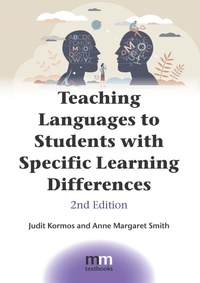
Teaching Languages to Students with Specific Learning Differences
2nd Edition
Published on 10. October 2023
264 pages
978-1-80041-863-9 (ISBN)
Description

This book is intended to help language teachers to work effectively and successfully with students who have Specific Learning Differences (SpLDs). It enables teachers to gain a thorough understanding of the nature of SpLDs and how these affect both general learning processes and the mechanisms of second language acquisition. In addition, the book explores the particular inclusive methods and techniques of teaching and assessment that foster success in language learning. Language teaching is embedded in a wider social and educational context, and therefore the book also provides an in-depth discussion of general educational issues related to identifying and disclosing disabilities and to making transitions from one institution to the other.
The content has been thoroughly updated and revised for the second edition, particularly in the areas of inclusive pedagogies, new evidence-based methods and tools for identifying SpLDs, and new conceptualisations of neurodiversity. The book also includes the latest research on assessment, transition and progression, and the impact of SpLDs on additional language learning.
The content has been thoroughly updated and revised for the second edition, particularly in the areas of inclusive pedagogies, new evidence-based methods and tools for identifying SpLDs, and new conceptualisations of neurodiversity. The book also includes the latest research on assessment, transition and progression, and the impact of SpLDs on additional language learning.
Reviews / Votes
This timely and informative book addresses the impact of specific learning differences (SpLDs) on learning additional languages and the knowledge and teaching strategies that teachers need to enhance the language learning of SpLDs. This accessible volume promises to be a useful companion for teacher educators in teacher training and in-service contexts. * Esther Geva, University of Toronto, Canada * This book provides a comprehensive overview of how to teach languages to learners with SpLDs. The practical tips included are immensely beneficial for anyone engaged in language teaching. This is a book that every language teacher should keep as a guide for everyday use, and an extremely valuable resource for teacher education programmes. * Bimali Indrarathne, University of York, UK * I am excited about the second edition of this book, and I am truly looking forward to using it in my teaching! The writing style is very accessible, even for those for whom English is not their L1, and the summary of key points at the end of each chapter will be a useful tool for students. * J. Buendgens-Kosten, Goethe University Frankfurt, Germany * Along with research and historical perspectives, this book includes plenty of practical tips. For example, the authors provide suggestions on classroom management with ideas for classroom layout, student groupings and pace of instruction. There are also classroom-ready ideas for how to teach pronunciation, spelling, vocabulary, comprehension, reading and writing more effectively. The end of each chapter includes activity suggestions forthe reader to practise concepts and expand their thinking, making the book a perfect addition for a book club or teacher training course. The book is a valuable resource for teachers, teacher educators, language testers and academics. * Jennifer Preschern Johannes Kepler University, Linz, Austria, IATEFL VOICES 299 - July/August 2024 * This book promotes a refreshing 'can do' positive approach where readers are encouraged to focus on differences experienced by learners rather than deficiencies. The book rigorously explores theoretical underpinnings in the belief that teachers need to have a thorough understanding of the nature of SpLDs, how these may affect learning, together with a sound understanding of the mechanisms of second language acquisition [...] This book provides a wealth of theoretical and practical information, and I would thoroughly recommend it as a valuable resource for teacher trainers and their students, CPD courses and all those who may be involved in teaching languages to learners with SpLDs. * Julia Kender, PATOSS Bulletin, Summer 2024, Volume 37 No. 1 *
More details
Series
Edition
2nd edition
Language
English
Place of publication
Bristol
United Kingdom
Target group
College/higher education
Professional and scholarly
Product notice
Reflowable
Dimensions
Height: 245 mm
Width: 174 mm
File size
3,70 MB
ISBN-13
978-1-80041-863-9 (9781800418639)
Copyright in bibliographic data and cover images is held by Nielsen Book Services Limited or by the publishers or by their respective licensors: all rights reserved.
Schweitzer Classification
Other editions
Additional editions
Judit Kormos | Anne Margaret Smith
Teaching Languages to Students with Specific Learning Differences
Book
10/2023
2nd Edition
Multilingual Matters
€42.30
Shipment within 10-20 days
Persons
Judit Kormos is a Professor in the Department of Linguistics and English Language, Lancaster University, UK. She is the author of The Second Language Acquisition Process of Students with Specific Learning Difficulties (Routledge, 2017). She was a key partner in the ELTon award-winning DysTEFL and Comics for Inclusive Language Learning Erasmus+ projects and is the lead educator of the Dyslexia and Foreign Language Teaching massive open online learning course offered by Future Learn.
Anne Margaret Smith is a specialist tutor and assessor for students with SpLDs. She is the editor of Activities for Inclusive Language Teaching: Valuing Diversity in the ELT Classroom (Delta Publishing, 2020). Her company ELT Well offers advice and training for teachers and assessors who want to explore the overlap between language learning and SpLDs.
Anne Margaret Smith is a specialist tutor and assessor for students with SpLDs. She is the editor of Activities for Inclusive Language Teaching: Valuing Diversity in the ELT Classroom (Delta Publishing, 2020). Her company ELT Well offers advice and training for teachers and assessors who want to explore the overlap between language learning and SpLDs.
Content
Preface
Chapter 1. Discourses of Disability in Education
Chapter 2. What are Specific Learning Differences?
Chapter 3. The Impact of SpLDs on Learning Additional Languages
Chapter 4. Identification and Disclosure
Chapter 5. Inclusive Language Teaching
Chapter 6. Techniques for Inclusive Language Teaching
Chapter 7. Assessment of the Language Skills of Language Learners with SpLDs
Chapter 8. Transition and Progression
Appendices
References
Index
Chapter 1. Discourses of Disability in Education
Chapter 2. What are Specific Learning Differences?
Chapter 3. The Impact of SpLDs on Learning Additional Languages
Chapter 4. Identification and Disclosure
Chapter 5. Inclusive Language Teaching
Chapter 6. Techniques for Inclusive Language Teaching
Chapter 7. Assessment of the Language Skills of Language Learners with SpLDs
Chapter 8. Transition and Progression
Appendices
References
Index
