

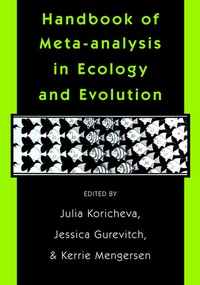
Handbook of Meta-analysis in Ecology and Evolution
1st Edition
Published on 16. June 2015
520 pages
978-1-4008-4618-4 (ISBN)
Description

Meta-analysis is a powerful statistical methodology for synthesizing research evidence across independent studies. This is the first comprehensive handbook of meta-analysis written specifically for ecologists and evolutionary biologists, and it provides an invaluable introduction for beginners as well as an up-to-date guide for experienced meta-analysts.
The chapters, written by renowned experts, walk readers through every step of meta-analysis, from problem formulation to the presentation of the results. The handbook identifies both the advantages of using meta-analysis for research synthesis and the potential pitfalls and limitations of meta-analysis (including when it should not be used). Different approaches to carrying out a meta-analysis are described, and include moment and least-square, maximum likelihood, and Bayesian approaches, all illustrated using worked examples based on real biological datasets. This one-of-a-kind resource is uniquely tailored to the biological sciences, and will provide an invaluable text for practitioners from graduate students and senior scientists to policymakers in conservation and environmental management.
- Walks you through every step of carrying out a meta-analysis in ecology and evolutionary biology, from problem formulation to result presentation
- Brings together experts from a broad range of fields
- Shows how to avoid, minimize, or resolve pitfalls such as missing data, publication bias, varying data quality, nonindependence of observations, and phylogenetic dependencies among species
- Helps you choose the right software
- Draws on numerous examples based on real biological datasets
The chapters, written by renowned experts, walk readers through every step of meta-analysis, from problem formulation to the presentation of the results. The handbook identifies both the advantages of using meta-analysis for research synthesis and the potential pitfalls and limitations of meta-analysis (including when it should not be used). Different approaches to carrying out a meta-analysis are described, and include moment and least-square, maximum likelihood, and Bayesian approaches, all illustrated using worked examples based on real biological datasets. This one-of-a-kind resource is uniquely tailored to the biological sciences, and will provide an invaluable text for practitioners from graduate students and senior scientists to policymakers in conservation and environmental management.
- Walks you through every step of carrying out a meta-analysis in ecology and evolutionary biology, from problem formulation to result presentation
- Brings together experts from a broad range of fields
- Shows how to avoid, minimize, or resolve pitfalls such as missing data, publication bias, varying data quality, nonindependence of observations, and phylogenetic dependencies among species
- Helps you choose the right software
- Draws on numerous examples based on real biological datasets
More details
Edition
Core Textbook
Language
English
Place of publication
Princeton, NJ
United States
Publishing group
De Gruyter
Target group
Professional and scholarly
Edition type
Digital original
Illustrations
51 line illus. 45 tables.
File size
6,12 MB
ISBN-13
978-1-4008-4618-4 (9781400846184)
Schweitzer Classification
Other editions
Additional editions
Julia Koricheva | Jessica Gurevitch | Kerrie Mengersen
Handbook of Meta-analysis in Ecology and Evolution
Book
04/2013
Princeton University Press
€94.50
Shipment within 10-20 days
Julia Koricheva | Jessica Gurevitch | Kerrie Mengersen
Handbook of Meta-analysis in Ecology and Evolution
Book
04/2013
Princeton University Press
€154.50
Shipment within 10-20 days
Persons
Julia Koricheva is Professor of Ecology at Royal Holloway, University of London. Jessica Gurevitch is Professor of Ecology and Evolution at Stony Brook University, State University of New York. Kerrie Mengersen is Research Professor of Statistics at Queensland University of Technology.
Content
Preface xi
SECTION I: Introduction & Planning
1.Place of Meta-analysis among Other Methods of Research Synthesis 3
Julia Koricheva & Jessica Gurevitch
2.The Procedure of Meta-analysis in a Nutshell 14
Isabelle M. Côté & Michael D. Jennions
SECTION II: Initiating a Meta-analysis
3.First Steps in Beginning a Meta-analysis 27
Gavin B. Stewart, Isabelle M. Côté, Hannah R. Rothstein, & Peter S. Curtis
4.Gathering Data: Searching Literature & Selection Criteria 37
Isabelle M. Côté, Peter S. Curtis, Hannah R. Rothstein, & Gavin B. Stewart
5.Extraction & Critical Appraisal of Data 52
Peter S. Curtis, Kerrie Mengersen, Marc J. Lajeunesse, Hannah R. Rothstein, & Gavin B. Stewart
6.Effect Sizes: Conventional Choices & Calculations 61
Michael S. Rosenberg, Hannah R. Rothstein, & Jessica Gurevitch
7.Using Other Metrics of Effect Size in Meta-analysis 72
Kerrie Mengersen & Jessica Gurevitch
SECTION III: Essential Analytic Models & Methods
8.Statistical Models & Approaches to Inference 89
Kerrie Mengersen, Christopher H. Schmid, Michael D. Jennions, & Jessica Gurevitch
9.Moment & Least-Squares Based Approaches to Meta-analytic Inference 108
Michael S. Rosenberg
10.Maximum Likelihood Approaches to Meta-analysis 125
Kerrie Mengersen & Christopher H. Schmid
11.Bayesian Meta-analysis 145
Christopher H. Schmid & Kerrie Mengersen
12.Software for Statistical Meta-analysis 174
Christopher H. Schmid, Gavin B. Stewart, Hannah R. Rothstein, Marc J. Lajeunesse, & Jessica Gurevitch
SECTION IV: Statistical Issues & Problems
13.Recovering Missing or Partial Data from Studies: A Survey of Conversions & Imputations for Meta-analysis 195
Marc J. Lajeunesse
14.Publication & Related Biases 207
Michael D. Jennions, Christopher J. Lortie, Michael S. Rosenberg, & Hannah R. Rothstein
15.Temporal Trends in Effect Sizes: Causes, Detection, & Implications 237
Julia Koricheva, Michael D. Jennions, & Joseph Lau
16.Statistical Models for the Meta-analysis of Nonindependent Data 255
Kerrie Mengersen, Michael D. Jennions, & Christopher H. Schmid
17.Phylogenetic Nonindependence & Meta-analysis 284
Marc J. Lajeunesse, Michael S. Rosenberg, & Michael D. Jennions
18.Meta-analysis of Primary Data 300
Kerrie Mengersen, Jessica Gurevitch, & Christopher H. Schmid
19.Meta-analysis of Results from Multisite Studies 313
Jessica Gurevitch
SECTION V: Presentation & Interpretation of Results
20.Quality St&ards for Research Syntheses 323
Hannah R. Rothstein, Christopher J. Lortie, Gavin B. Stewart, Julia Koricheva, & Jessica Gurevitch
21.Graphical Presentation of Results 339
Christopher J. Lortie, Joseph Lau, & Marc J. Lajeunesse
22.Power Statistics for Meta-analysis: Tests for Mean Effects & Homogeneity 348
Marc J. Lajeunesse
23.Role of Meta-analysis in Interpreting the Scientific Literature 364
Michael D. Jennions, Christopher J. Lortie, & Julia Koricheva
24.Using Meta-analysis to Test Ecological & Evolutionary Theory 381
Michael D. Jennions, Christopher J. Lortie, & Julia Koricheva
SECTION VI: Contributions of Meta-analysis in Ecology & Evolution
25.History & Progress of Meta-analysis 407
Joseph Lau, Hannah R. Rothstein, & Gavin B. Stewart
26.Contributions of Meta-analysis to Conservation & Management 420
Isabelle M. Côté & Gavin B. Stewart
27.Conclusions: Past, Present, & Future of Meta-analysis in Ecology & Evolution 426
Jessica Gurevitch & Julia Koricheva
Glossary 433
Frequently Asked Questions 441
References 447
List of Contributors 487
Subject Index 489
SECTION I: Introduction & Planning
1.Place of Meta-analysis among Other Methods of Research Synthesis 3
Julia Koricheva & Jessica Gurevitch
2.The Procedure of Meta-analysis in a Nutshell 14
Isabelle M. Côté & Michael D. Jennions
SECTION II: Initiating a Meta-analysis
3.First Steps in Beginning a Meta-analysis 27
Gavin B. Stewart, Isabelle M. Côté, Hannah R. Rothstein, & Peter S. Curtis
4.Gathering Data: Searching Literature & Selection Criteria 37
Isabelle M. Côté, Peter S. Curtis, Hannah R. Rothstein, & Gavin B. Stewart
5.Extraction & Critical Appraisal of Data 52
Peter S. Curtis, Kerrie Mengersen, Marc J. Lajeunesse, Hannah R. Rothstein, & Gavin B. Stewart
6.Effect Sizes: Conventional Choices & Calculations 61
Michael S. Rosenberg, Hannah R. Rothstein, & Jessica Gurevitch
7.Using Other Metrics of Effect Size in Meta-analysis 72
Kerrie Mengersen & Jessica Gurevitch
SECTION III: Essential Analytic Models & Methods
8.Statistical Models & Approaches to Inference 89
Kerrie Mengersen, Christopher H. Schmid, Michael D. Jennions, & Jessica Gurevitch
9.Moment & Least-Squares Based Approaches to Meta-analytic Inference 108
Michael S. Rosenberg
10.Maximum Likelihood Approaches to Meta-analysis 125
Kerrie Mengersen & Christopher H. Schmid
11.Bayesian Meta-analysis 145
Christopher H. Schmid & Kerrie Mengersen
12.Software for Statistical Meta-analysis 174
Christopher H. Schmid, Gavin B. Stewart, Hannah R. Rothstein, Marc J. Lajeunesse, & Jessica Gurevitch
SECTION IV: Statistical Issues & Problems
13.Recovering Missing or Partial Data from Studies: A Survey of Conversions & Imputations for Meta-analysis 195
Marc J. Lajeunesse
14.Publication & Related Biases 207
Michael D. Jennions, Christopher J. Lortie, Michael S. Rosenberg, & Hannah R. Rothstein
15.Temporal Trends in Effect Sizes: Causes, Detection, & Implications 237
Julia Koricheva, Michael D. Jennions, & Joseph Lau
16.Statistical Models for the Meta-analysis of Nonindependent Data 255
Kerrie Mengersen, Michael D. Jennions, & Christopher H. Schmid
17.Phylogenetic Nonindependence & Meta-analysis 284
Marc J. Lajeunesse, Michael S. Rosenberg, & Michael D. Jennions
18.Meta-analysis of Primary Data 300
Kerrie Mengersen, Jessica Gurevitch, & Christopher H. Schmid
19.Meta-analysis of Results from Multisite Studies 313
Jessica Gurevitch
SECTION V: Presentation & Interpretation of Results
20.Quality St&ards for Research Syntheses 323
Hannah R. Rothstein, Christopher J. Lortie, Gavin B. Stewart, Julia Koricheva, & Jessica Gurevitch
21.Graphical Presentation of Results 339
Christopher J. Lortie, Joseph Lau, & Marc J. Lajeunesse
22.Power Statistics for Meta-analysis: Tests for Mean Effects & Homogeneity 348
Marc J. Lajeunesse
23.Role of Meta-analysis in Interpreting the Scientific Literature 364
Michael D. Jennions, Christopher J. Lortie, & Julia Koricheva
24.Using Meta-analysis to Test Ecological & Evolutionary Theory 381
Michael D. Jennions, Christopher J. Lortie, & Julia Koricheva
SECTION VI: Contributions of Meta-analysis in Ecology & Evolution
25.History & Progress of Meta-analysis 407
Joseph Lau, Hannah R. Rothstein, & Gavin B. Stewart
26.Contributions of Meta-analysis to Conservation & Management 420
Isabelle M. Côté & Gavin B. Stewart
27.Conclusions: Past, Present, & Future of Meta-analysis in Ecology & Evolution 426
Jessica Gurevitch & Julia Koricheva
Glossary 433
Frequently Asked Questions 441
References 447
List of Contributors 487
Subject Index 489
