

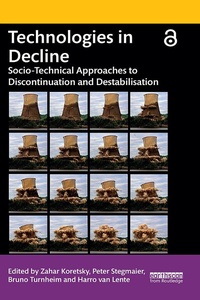
Technologies in Decline
Socio-Technical Approaches to Discontinuation and Destabilisation
1st Edition
Published on 30. December 2022
294 pages
978-1-000-83141-2 (ISBN)
Description

The central questions of this book are how technologies decline, how societies deal with technologies in decline, and how governance may be explicitly oriented towards parting with 'undesirable' technology.
Surprisingly, these questions are fairly novel. Thus far, the dominant interest in historical, economic, sociological and political studies of technology has been to understand how novelty emerges, how innovation can open up new opportunities and how such processes may be supported. This innovation bias reflects how in the last centuries modern societies have embraced technology as a vehicle of progress. It is timely, however, to broaden the social study of technology and society: next to considering the rise of technologies, their fall should be addressed, too. Dealing with technologies in decline is an important challenge or our times, as socio-technical systems are increasingly part of the problems of climate change, biodiversity loss, social inequalities and geo-political tensions. This volume presents empirical studies of technologies in decline, as well as conceptual clarifications and theoretical deepening. Technologies in Decline presents an emerging research agenda for the study of technological decline, emphasising the need for a plurality of perspectives.
Given that destabilisation and discontinuation are seen as a way to accelerate sustainability transitions, this book will be of interest to academics, students and policy makers researching and working in the areas of sustainability science and policy, economic geography, innovation studies, and science and technology studies.
The Open Access version of this book, available at http://www.taylorfrancis.com, has been made available under a Creative Commons [Attribution-Non Commercial-No Derivatives (CC-BY-NC-ND)] 4.0 license.
Surprisingly, these questions are fairly novel. Thus far, the dominant interest in historical, economic, sociological and political studies of technology has been to understand how novelty emerges, how innovation can open up new opportunities and how such processes may be supported. This innovation bias reflects how in the last centuries modern societies have embraced technology as a vehicle of progress. It is timely, however, to broaden the social study of technology and society: next to considering the rise of technologies, their fall should be addressed, too. Dealing with technologies in decline is an important challenge or our times, as socio-technical systems are increasingly part of the problems of climate change, biodiversity loss, social inequalities and geo-political tensions. This volume presents empirical studies of technologies in decline, as well as conceptual clarifications and theoretical deepening. Technologies in Decline presents an emerging research agenda for the study of technological decline, emphasising the need for a plurality of perspectives.
Given that destabilisation and discontinuation are seen as a way to accelerate sustainability transitions, this book will be of interest to academics, students and policy makers researching and working in the areas of sustainability science and policy, economic geography, innovation studies, and science and technology studies.
The Open Access version of this book, available at http://www.taylorfrancis.com, has been made available under a Creative Commons [Attribution-Non Commercial-No Derivatives (CC-BY-NC-ND)] 4.0 license.
More details
Edition
1. Auflage
Language
English
Place of publication
London
United Kingdom
Publishing group
Taylor & Francis Ltd
Target group
College/higher education
Adult education
Illustrations
15 Tables, black and white; 21 Line drawings, black and white; 21 Illustrations, black and white
File size
12,13 MB
ISBN-13
978-1-000-83141-2 (9781000831412)
Copyright in bibliographic data and cover images is held by Nielsen Book Services Limited or by the publishers or by their respective licensors: all rights reserved.
Schweitzer Classification
Other editions
Additional editions
Zahar Koretsky | Peter Stegmaier | Bruno Turnheim
Technologies in Decline
Socio-Technical Approaches to Discontinuation and Destabilisation
Book
12/2022
1st Edition
Routledge
€58.60
Shipment within 10-20 days
Zahar Koretsky | Peter Stegmaier | Bruno Turnheim
Technologies in Decline
Socio-Technical Approaches to Discontinuation and Destabilisation
Book
12/2022
1st Edition
Routledge
€207.98
Shipment within 10-20 days
Persons
Zahar Koretsky is post-doctoral researcher in STS and transition studies at the French Research Institute for Agriculture, Food and the Environment (INRAE) and Gustave Eiffel University in Paris. He works on sustainability transitions, focusing on a critical take on it. His current research lies within sustainability transitions in the extractive sector. Zahar has published on the history of various declined technologies across the world and on the EU's climate change mitigation.
Peter Stegmaier is assistant professor at the Department of Technology, Policy and Society, section Science, Technology and Policy Studies (STePS) of the University of Twente, the Netherlands. Peter has worked as researcher and lecturer at the Universities of Dortmund, Hagen and Duesseldorf, carrying out at the latter two the project 'Law as a social practice-from everyday legal methods to a legal methodology for everyday work' (2000-2004); and as lecturer and researcher in criminal and police sociology at the Ruhr University of Bochum, focusing especially on public security institutions (2004-2006).
Bruno Turnheim is INRAE Research Scientist at the Interdisciplinary Laboratory on Sciences, Innovations and Societies (LISIS, Universite Gustave Eiffel, France) and Honorary Research Fellow at the Manchester Institute of Innovation Research (MIoIR, University of Manchester, UK). His research focuses on socio-technical innovation and transition processes, particularly in relation to grand societal challenges.
Harro van Lente is full professor of Science and Technology Studies at the Faculty of Arts and Social Science, Maastricht University. He is one of the founding fathers of the Sociology of Expectations, which studies how representations of the future shape current socio-technical developments. He has published more than 100 journal articles, book chapters and edited volumes on technology dynamics, innovation policy and knowledge production. He is recipient of the 2018 EASST Freeman Award with the co-edited book (with Marianne Boenink and Ellen Moors), Emerging Technologies for Diagnosing Alzheimer's Disease: Innovating with Care.
Peter Stegmaier is assistant professor at the Department of Technology, Policy and Society, section Science, Technology and Policy Studies (STePS) of the University of Twente, the Netherlands. Peter has worked as researcher and lecturer at the Universities of Dortmund, Hagen and Duesseldorf, carrying out at the latter two the project 'Law as a social practice-from everyday legal methods to a legal methodology for everyday work' (2000-2004); and as lecturer and researcher in criminal and police sociology at the Ruhr University of Bochum, focusing especially on public security institutions (2004-2006).
Bruno Turnheim is INRAE Research Scientist at the Interdisciplinary Laboratory on Sciences, Innovations and Societies (LISIS, Universite Gustave Eiffel, France) and Honorary Research Fellow at the Manchester Institute of Innovation Research (MIoIR, University of Manchester, UK). His research focuses on socio-technical innovation and transition processes, particularly in relation to grand societal challenges.
Harro van Lente is full professor of Science and Technology Studies at the Faculty of Arts and Social Science, Maastricht University. He is one of the founding fathers of the Sociology of Expectations, which studies how representations of the future shape current socio-technical developments. He has published more than 100 journal articles, book chapters and edited volumes on technology dynamics, innovation policy and knowledge production. He is recipient of the 2018 EASST Freeman Award with the co-edited book (with Marianne Boenink and Ellen Moors), Emerging Technologies for Diagnosing Alzheimer's Disease: Innovating with Care.
Content
1 Introduction: The relevance of technologies in decline; 2 Dynamics of technological decline as socio-material unravelling; 3 Destabilisation, decline and phase-out in transitions research; 4 Conceptual aspects of discontinuation governance: An exploration; 5 Discourses around decline: Comparing the debates on coal phase-out in the UK, Germany and Finland; 6 Mapping the territorial adaptation of technological trajectories: The phase-out of the internal combustion engine; 7 The role of alternative technologies in the enactment of (dis)continuities; 8 Caring for decline: The case of 16mm film artworks of Tacita Dean; 9 Implementing exnovation?: Exnovation ambitions and governance complexity in the case of the Brussels Low Emission Zone; 10 Phase-out as a policy approach to address sustainability challenges: A systematic review; 11 The end of the world's leaded petrol era: Reflections on the final four decades of a century-long campaign; 12 Conclusions and continuations: Horizons for studying technologies in decline
