

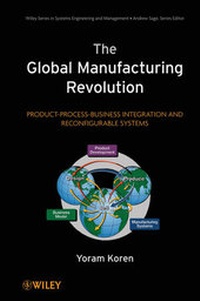
The Global Manufacturing Revolution
Description

Reviews / Votes
"This edition contains new data and examples, plus b&w drawings. The book can be used as a text for a class in global manufacturing for graduate engineering and business students; it will also be helpful for engineers pursuing managerial careers in manufacturing, and for leaders of global enterprises." (Book News Inc, November 2010)More details
Other editions
Additional editions
Person
Content
Acknowledgments.
1 Globalization and Manufacturing Paradigms.
1.1 The Importance of Manufacturing to Society.
1.2 The Basics of Manufacturing in Large Quantities.
1.3 The 1990s: A Decade of Intensified Globalization.
1.4 The Global Manufacturing Revolution.
1.5 The Manufacturing Paradigm Model.
1.6 Four Major Manufacturing Paradigms.
1.7 Paradigm Transitions Over Time.
Problems.
References.
2 Product Invention Strategy.
2.1 Technology-Driven Products.
2.2 Customer-Driven Products.
2.3 Competition-Driven Products.
2.4 Classification of Product Inventions.
2.5 Product Development for Globalization.
2.6 The Product Development Process.
2.7 Head in the Sky, Feet on the Ground-Be a Dreamer on a Solid Foundation.
Problems.
References.
3 Customized, Personalized and Reconfigurable Products.
3.1 Introduction to Customization.
3.2 Design for Mass Customization.
3.3 Personalized Products.
3.4 Product Modularity.
3.5 Reconfigurable Products.
3.6 Design of Customized and Reconfigurable Products.
Problems.
References.
4 Mass Production and Lean Manufacturing.
4.1 The Principles of Mass Production.
4.2 Supply and Demand.
4.3 The Mathematical Model of Mass Production.
4.4 Lean Production-Goals and Benefits.
4.5 The Principles of Lean Production.
Problems.
References.
5 Analysis of Mass Customization.
5.1 Introduction to Mass Customization.
5.2 Business Strategies of Mass Customization.
5.3 Manufacturing System Characteristics.
5.4 Economics of Product Variation.
5.5 Mathematical Analysis of Mass Customization.
5.6 Summary.
Problems.
6 Traditional Manufacturing Systems.
6.1 Manufacturing Systems.
6.2 Production of Complex Products.
6.3 The State of Art at the End of the Twentieth Century.
6.4 Assembly Systems.
6.5 Industry Experience with FMS-A Survey.
Problems.
References.
7 Economics of System Design.
7.1 Life-Cycle Economics.
7.2 Capacity Planning Strategies.
7.3 Economics of System Configurations.
7.4 The Economics of Buffers.
7.5 Batch Production.
7.6 Optimal Cutting Speeds.
Problems.
References.
8 Reconfigurable Machines.
8.1 The Rationale for Reconfigurable Machines.
8.2 Characteristics and Principles of Reconfigurable Machines.
8.3 Reconfigurable Machine Tools.
8.4 Reconfigurable Fixtures.
8.5 Reconfigurable Inspection Machines.
8.6 Open-Architecture Controllers.
Problems.
References.
9 Reconfigurable Manufacturing Systems.
9.1 The Challenges of Globalization.
9.2 RMS-A New Class of Systems.
9.3 Characteristics and Principles of Reconfiguration.
9.4 Integrated RMS Configurations.
9.5 System Rapid Ramp-Up.
9.6 Hexagonal RMS Configurations.
Problems.
References.
10 System Configuration Analysis.
10.1 Classification of Configurations.
10.2 Comparing RMS with Cell Configurations.
10.3 Calculating the Number of RMS Configurations.
10.4 Example of System Design.
10.5 Impact of Configuration on Performance.
Problems.
References.
11 Business Models for Global Manufacturing Enterprises.
11.1 Examples of Business Models.
11.2 Business Model of Manufacturing Companies.
11.3 Competitive Advantage.
11.4 Strategic Resources.
11.5 Supply Chains.
11.6 Responsive Business Models for Global Opportunities.
11.7 Product Life cycle Business Model.
Problems.
Case Study I-The Rise and Fail of FriendlyRobotics.
Case Study II-He Bet on Botox and Won.
References.
12 IT-Based Enterprise Organizational Structure.
12.1 Twentieth-Century Organizational Structure.
12.2 Twenty-First Century IT-Based Organizational Structure.
12.3 Information Transfer in Manufacturing Systems.
12.4 IT-Based Maintenance of Large Systems.
Problems.
References.
13 Enterprise Globalization Strategies.
13.1 Why Enterprises Become Global.
13.2 Countries of Potential New Markets.
13.3 Product Design for Globalization.
13.4 Location of Manufacturing Plants.
13.5 Global Business Strategies.
13.6 Global Strategic Alliances.
Problems.
References.
14 The Twenty-first Century Global Manufacturing Enterprise.
14.1 P-Productivity.
14.2 R-Responsiveness and Reconfiguration.
14.3 I-Integration of Product, Process, and Business.
14.4 D-Design for the Global Manufacturing Paradigm.
14.5 E-Empowerment of the Workforce.
14.6 The Dilemma of Globalization.
14.7 Where are Manufacturing Enterprises Headed?.
References.
Appendices.
Appendix A: Computer Controlled Milling Machine in 1973.
Appendix B: Three Types of Manufacturing Systems.
Appendix C: Business Cycles.
Appendix D: Term Project: Project Description and Requirements.
Author Biography.
Author Index.
Subject Index.
